The Cloud Stack: A Shifting Landscape
For years, developers and IT professionals have learned to navigate the cloud through a simple, three-tiered model: Infrastructure as a Service (IaaS), Platform as a Service (PaaS), and Software as a Service (SaaS). This model, while effective for its time, answered a single, crucial question: how much of the underlying infrastructure is your responsibility? With IaaS, you rent the raw hardware and manage everything from the OS up. PaaS abstracts the OS and middleware, letting you focus on your application code. SaaS delivers a complete, ready-to-use application, absolving you of all infrastructure concerns.
However, the cloud market has not stood still. Approximately eighteen months ago, the landscape began a significant transformation, rendering the traditional three-box model insufficient. This evolution is driven by several key developments: the consolidation and specialization within the middle of the stack, the emergence of the database as a distinct and highly valuable market segment, and the rise of AI agents capable of writing code that requires its own execution environment.
The old diagram was a useful heuristic. It clearly delineated responsibility. Renting a bare-metal server meant managing the entire stack. Deploying to a PaaS provider meant focusing primarily on application logic. Consuming SaaS meant zero infrastructure management. But this clear division has blurred.
The middle of the stack, once a more monolithic concept, has fragmented. Databases, in particular, have exploded into a multi-billion dollar market of their own. Specialized database-as-a-service offerings, from relational to NoSQL to vector databases, now represent a significant layer of abstraction and management. Developers often interact with these services as distinct entities, rather than an implicit part of a PaaS offering.
Furthermore, the advent of sophisticated AI agents capable of generating code has introduced a new dimension. These agents produce code that needs to be compiled, run, tested, and deployed. This introduces a requirement for execution environments that are tailored to AI-generated code, potentially a new layer of abstraction or a specialized form of PaaS designed for AI workloads.
A New Model: Two Stacks, Redefined SaaS
The current reality demands a more nuanced representation. A more accurate depiction of the cloud stack today involves two distinct stacks, with SaaS existing outside of these primary infrastructure and platform layers. This new model acknowledges the specialization and the new demands placed on cloud services.
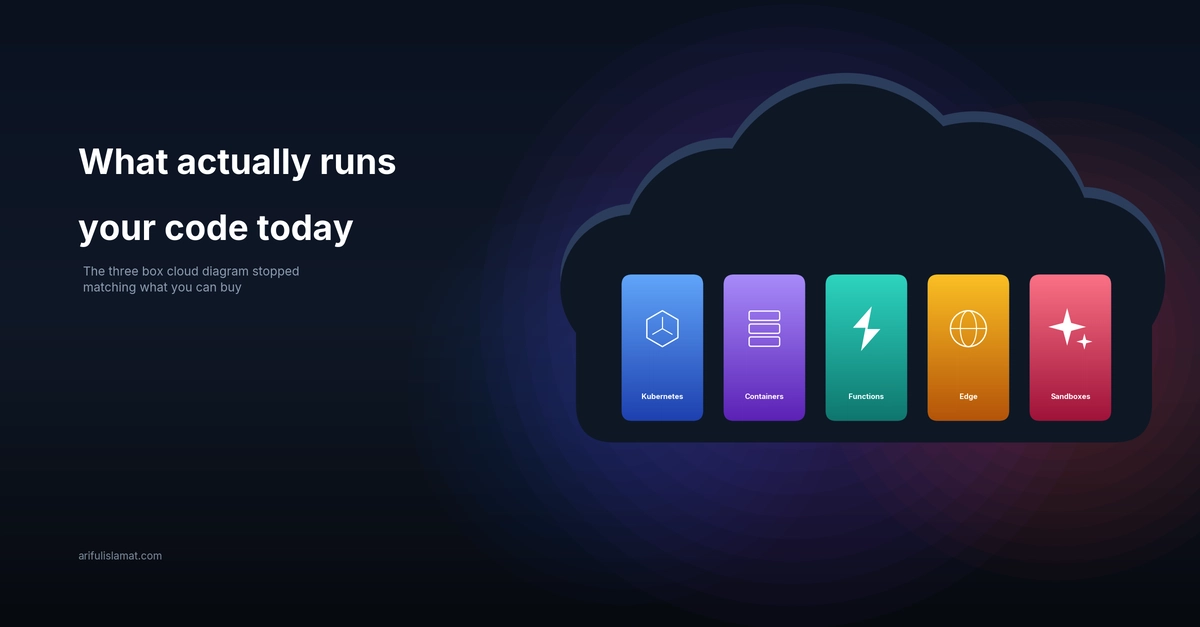
The first stack can be conceptualized as the Application Execution Stack. This is where the code you write, or that is written by AI, actually runs. It begins with the fundamental compute resources, analogous to IaaS, but quickly moves into managed environments. Think of it less like a traditional PaaS and more like a series of specialized execution runtimes. This includes serverless functions, container orchestration platforms (like Kubernetes), managed virtual machines, and increasingly, dedicated environments for AI model inference and training.
Within this Application Execution Stack, the database layer has become a critical, often independently managed component. It’s no longer just a service provided implicitly by a PaaS. Developers select and manage database services – whether managed SQL, NoSQL, time-series, or vector databases – as distinct entities. These services require their own provisioning, scaling, and maintenance, effectively forming a parallel stack or a deeply integrated, yet distinct, layer.
The second stack is the AI Development & Operations Stack. This is a newer construct, driven by the proliferation of AI agents and MLOps. It encompasses tools and platforms for AI model training, data management (including specialized data pipelines and feature stores), model deployment, monitoring, and governance. While parts of this stack might leverage the Application Execution Stack for running models, the development and operational concerns are distinct. This includes environments for prompt engineering, fine-tuning models, and managing AI-specific infrastructure like GPUs.
SaaS, in this new paradigm, is best understood as a fully managed end-user application that consumes services from both of these stacks. When you use a SaaS product, you are interacting with an application that has its own underlying infrastructure and platform needs, but these are entirely abstracted away from you. The SaaS provider manages their own Application Execution Stack and potentially elements of an AI Development & Operations Stack if their product incorporates AI features.
Referenced Sources
- verified