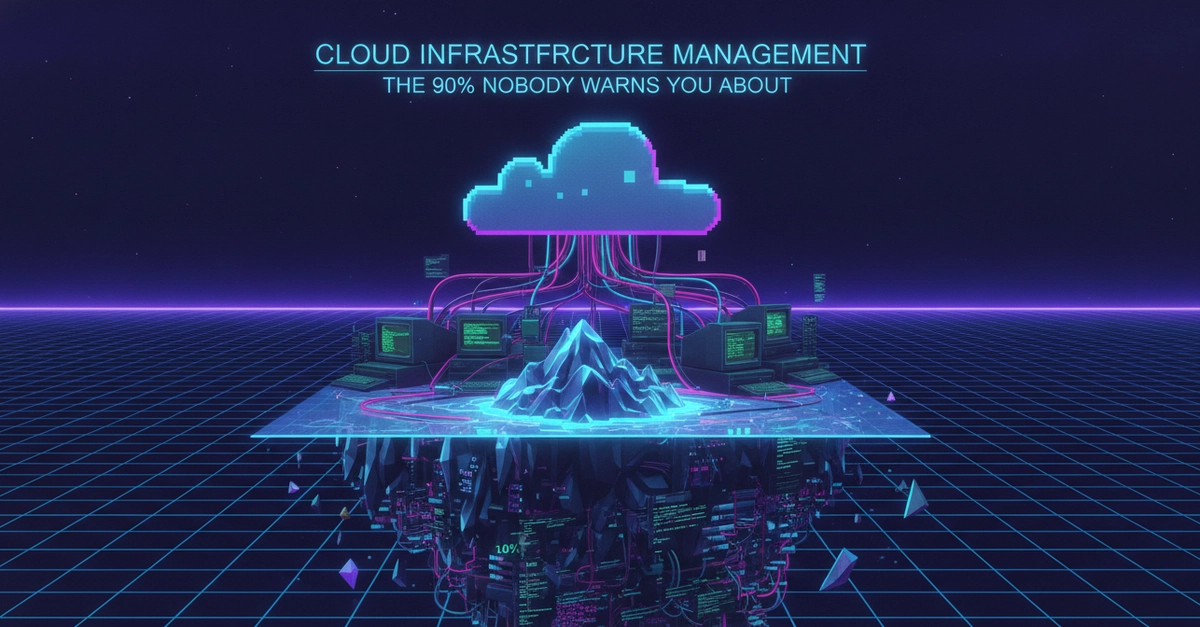
The Hidden 90% of Cloud Infrastructure Management
Most discussions around cloud infrastructure focus on the initial setup. Spinning up servers, configuring networks, and deploying applications often feel like the core challenge. This initial phase, typically involving clicking through a console or writing a few lines of Terraform, represents only about 10% of the effort. The real, sustained challenge—the other 90%—begins after deployment. This is the operational burden, the ongoing maintenance, and the slow-motion incidents that can cripple a system and its team. This overlooked 90% is where most cloud strategies falter.
The critical distinction between teams that manage cloud environments effectively and those that struggle lies in their approach to this operational 90%. It’s not about the initial build; it’s about the ongoing life of the infrastructure. This phase encompasses everything from ensuring reliability and security to managing costs and adapting to evolving needs. Ignoring this substantial portion of the cloud lifecycle is a direct path to operational debt and late-night emergencies.
Infrastructure as Code: The Bedrock of Sanity
The most significant differentiator for teams that maintain operational sanity is the adoption of Infrastructure as Code (IaC). If infrastructure configurations are not defined in code, they effectively do not exist in a manageable, repeatable, or version-controlled state. Manual changes made directly in cloud provider consoles, often referred to as “configuration drift,” create undocumented, unmonitored, and unrecoverable deviations from the desired state. This drift is a primary source of bugs, security vulnerabilities, and unexpected outages. IaC, using tools like Terraform, Pulumi, or AWS CloudFormation, ensures that infrastructure is treated like software: versioned, tested, and deployed predictably.
The principle is simple: every change, every modification, every addition to the infrastructure must be initiated through code. This code then becomes the single source of truth. Auditing becomes trivial. Rollbacks are straightforward. New team members can understand the environment by reading the code. This disciplined approach prevents the chaos that arises from ad-hoc manual interventions, which are the hallmark of teams struggling with the 90%.
Beyond Deployment: The Operational Realities
Once infrastructure is deployed, the real work begins. This encompasses several critical, often underestimated, areas:
Monitoring and Alerting: Catching Problems Before They Cascade
Effective monitoring is not just about collecting metrics; it’s about understanding the health and performance of your entire system. This involves setting up comprehensive logging, tracing, and metrics collection across all services and infrastructure components. More importantly, it requires configuring intelligent alerting that distinguishes between noise and genuine issues. Alerts should be actionable, providing sufficient context to diagnose and resolve problems quickly. Without robust monitoring, teams are flying blind, often only realizing there’s a problem when users start complaining or systems fail catastrophically.
Security and Compliance: A Continuous Effort
Security is not a one-time setup; it's an ongoing process. This includes regular security audits, vulnerability scanning, patch management, identity and access management (IAM) reviews, and adherence to compliance standards. The cloud environment is dynamic, and new threats emerge constantly. Teams must be proactive in identifying and mitigating risks. This involves not just technical controls but also establishing clear policies and training for personnel. Compliance requirements, whether GDPR, HIPAA, or industry-specific, demand continuous validation and documentation, adding significant overhead.
Cost Management and Optimization: Taming the Cloud Bill
Cloud costs can escalate rapidly if not managed diligently. This involves understanding spending patterns, identifying underutilized resources, rightsizing instances, and leveraging cost-saving options like reserved instances or spot instances where appropriate. Cost optimization is an ongoing discipline, requiring regular analysis and adjustments. Without a dedicated focus, cloud bills can become a significant and unexpected drain on resources. Teams often underestimate the effort required to track, attribute, and optimize cloud spend across various services and projects.
Disaster Recovery and Business Continuity: Planning for the Worst
While initial setup might include basic redundancy, true disaster recovery (DR) and business continuity (BC) planning is a complex and often expensive undertaking. It involves designing for resilience, defining recovery time objectives (RTOs) and recovery point objectives (RPOs), and regularly testing DR plans. This goes beyond simply having backups; it requires a strategy for recovering entire systems and data in the event of a major outage, region failure, or catastrophic event. The cost and complexity of building and maintaining effective DR/BC capabilities are substantial and frequently deferred.
Performance Tuning and Scalability: Evolving with Demand
As applications grow and user demand fluctuates, infrastructure must adapt. Performance tuning involves identifying bottlenecks, optimizing configurations, and ensuring efficient resource utilization. Scalability requires designing systems that can automatically or manually adjust capacity to meet demand. This is not a set-it-and-forget-it task; it requires continuous observation, analysis, and refinement of the infrastructure to ensure it can handle peak loads without compromising performance or user experience. The architecture designed for 1,000 users may not suffice for 100,000.
The Human Element: Skills and Culture
The 90% of cloud infrastructure management is as much about people and culture as it is about technology. Teams need individuals with deep operational expertise, not just deployment skills. This includes site reliability engineers (SREs), DevOps engineers, and cloud security specialists. Furthermore, a culture that prioritizes operational excellence, continuous improvement, and proactive problem-solving is essential. Without the right skills and a supportive culture, even the best IaC practices can falter under the weight of day-to-day operational demands.
The teams that succeed in the cloud are those that recognize the 90% problem and invest accordingly. They treat infrastructure management as a continuous, critical discipline, not an afterthought. This requires a shift in mindset, from focusing solely on rapid deployment to embracing the long-term responsibilities of running reliable, secure, and cost-effective systems in the cloud.