The Illusion of 'Finance's Problem'
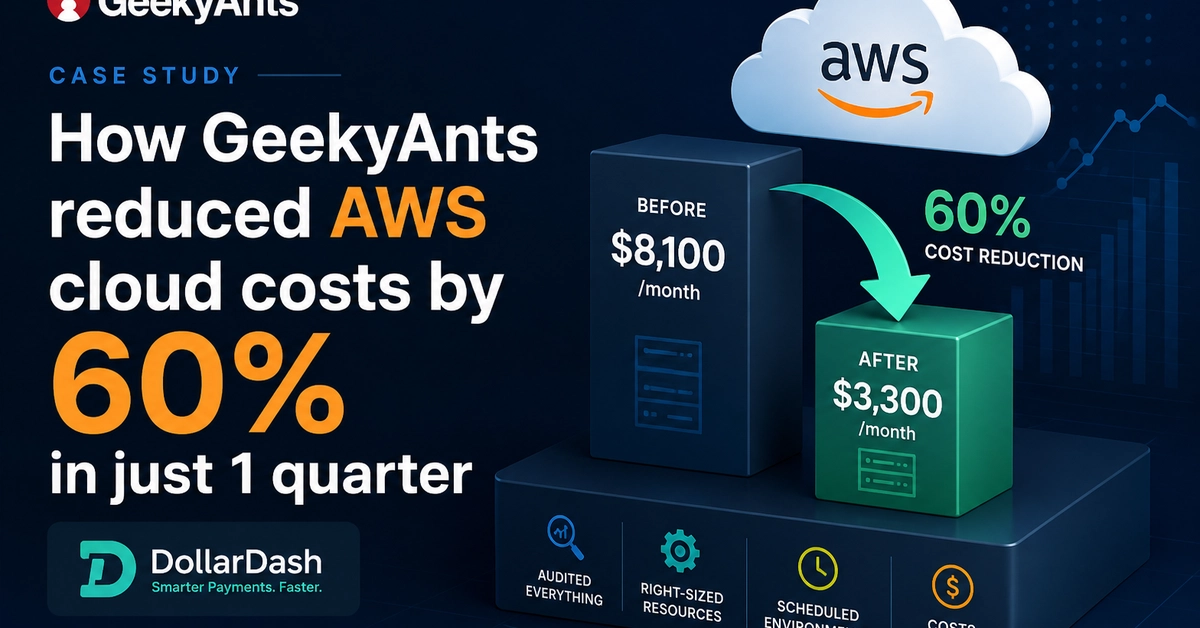
The AWS bill arrives, larger than anticipated. Finance flags the increase. Engineering teams scramble, sifting through dashboards. They might find a few oversized instances, decommission forgotten environments, and then, everyone moves on. This cyclical response, however, is fundamentally flawed. Cloud cost optimization is not a quarterly finance exercise; it is an intrinsic engineering discipline.
Infrastructure decisions made during development directly dictate operational costs. If engineers do not actively consider resource utilization, environment scheduling, database sizing, and workload patterns while building systems, no amount of end-of-quarter financial reporting can rectify the underlying inefficiencies. The responsibility for cloud expenditure must shift from a reactive finance post-mortem to a proactive engineering mindset.
Engineering Ownership: A Paradigm Shift
When engineers treat cloud costs as a core concern, the entire development lifecycle transforms. This involves understanding the cost implications of architectural choices. For example, selecting a managed database service versus self-hosting, choosing between different instance types for compute, or implementing efficient data storage strategies all have direct and significant financial consequences. These are not abstract financial concepts; they are concrete engineering trade-offs.
Consider the lifecycle of a feature. From initial design and prototyping through to deployment and ongoing maintenance, every stage presents opportunities for cost optimization. Engineers should be equipped with tools and knowledge to estimate the cost impact of their decisions before they are implemented. This proactive approach prevents the common scenario of discovering massive, unexpected bills after deployment.
This ownership extends to the entire engineering team, not just senior architects or DevOps specialists. Junior developers, for instance, can be trained to understand the cost of spinning up temporary development environments or the impact of inefficient code on resource consumption. Making cost awareness a part of the engineering culture, akin to security or performance best practices, is paramount. It requires integrating cost considerations into code reviews, architectural discussions, and even sprint planning.
The 'A+B Problem' Analogy for Engineering Overreach
The challenge of cloud cost optimization can be starkly illustrated by an extreme, albeit humorous, example from competitive programming: the 'A+B Problem'. This is a simple task requiring a program to read two numbers and output their sum. Yet, participants have historically demonstrated an astonishing capacity for 'over-engineering' this trivial problem. They have deployed complex data structures, advanced algorithms, and elaborate coding styles—all for a task that demands none of it.
This 'over-engineering' phenomenon, while often a display of technical prowess, mirrors the way engineering teams can inadvertently inflate cloud costs. They might choose overly powerful instances for development servers, implement complex caching layers where simple queries suffice, or deploy distributed systems for workloads that could be handled by a single, well-optimized instance. The underlying principle is the same: applying more resources or complexity than is strictly necessary for the task at hand. In competitive programming, this leads to wasted time and potential timeouts; in cloud environments, it leads to escalating bills.
The source material highlights how 'warriors picked up their algorithmic weapons and launched an assault on a seemingly impenetrable 'simple' fortress.' This dedication to complex solutions for simple problems, while perhaps showcasing ingenuity, ultimately misses the point of efficiency. Similarly, applying sophisticated infrastructure patterns or over-provisioning resources 'just in case' without a clear, cost-justified need mirrors this over-engineered approach. It’s a failure to right-size the solution to the problem, a failure that directly impacts the operational budget.
Practical Steps for Engineering-Led Cost Optimization
To embed cost optimization into engineering practice, several steps are crucial:
- Educate and Empower Engineers: Provide training on cloud cost models, pricing structures of various services (e.g., EC2 instance types, S3 storage classes, Lambda pricing), and the financial impact of architectural decisions. Empower them with dashboards and tools that break down costs by service, team, or project.
- Integrate Cost into Development Workflow: Make cost estimation a part of the design and architecture review process. Encourage engineers to use cost calculators provided by cloud vendors during development. Implement checks for idle resources or over-provisioned services in CI/CD pipelines.
- Right-Sizing Resources: Continuously monitor resource utilization (CPU, memory, network I/O, disk I/O) and adjust instance types, database sizes, and storage capacities accordingly. Automate this process where possible.
- Environment Management: Implement policies for automatically shutting down non-production environments outside of business hours or when not in use. Use ephemeral environments for testing and development that are provisioned on-demand and de-provisioned when finished.
- Leverage Spot Instances and Savings Plans: For fault-tolerant or non-critical workloads, utilize cheaper spot instances. For predictable workloads, commit to savings plans or reserved instances to secure discounts. Engineers should understand the trade-offs involved.
- Optimize Data Storage and Transfer: Implement data lifecycle policies to move older data to cheaper storage tiers (e.g., S3 Glacier). Monitor and optimize data transfer costs, which can often be a significant hidden expense.
- Code-Level Efficiency: Encourage writing efficient code that minimizes CPU cycles, memory usage, and I/O operations. This directly translates to lower resource consumption and, consequently, lower cloud bills.
The Unanswered Question: What Happens to the Culture?
While the technical and process-oriented solutions for engineering-led cost optimization are clear, a more profound question remains: how do we fundamentally shift the culture within engineering teams to prioritize financial responsibility alongside technical excellence? For too long, the cost of cloud infrastructure has been an abstract, deferred expense. Now, as cloud spend escalates, the challenge isn't just about implementing new tools or processes, but about fostering a deep-seated understanding and ownership of financial implications at every level of the engineering organization. What are the long-term cultural impacts when engineers are held accountable for the operational budget of their creations?