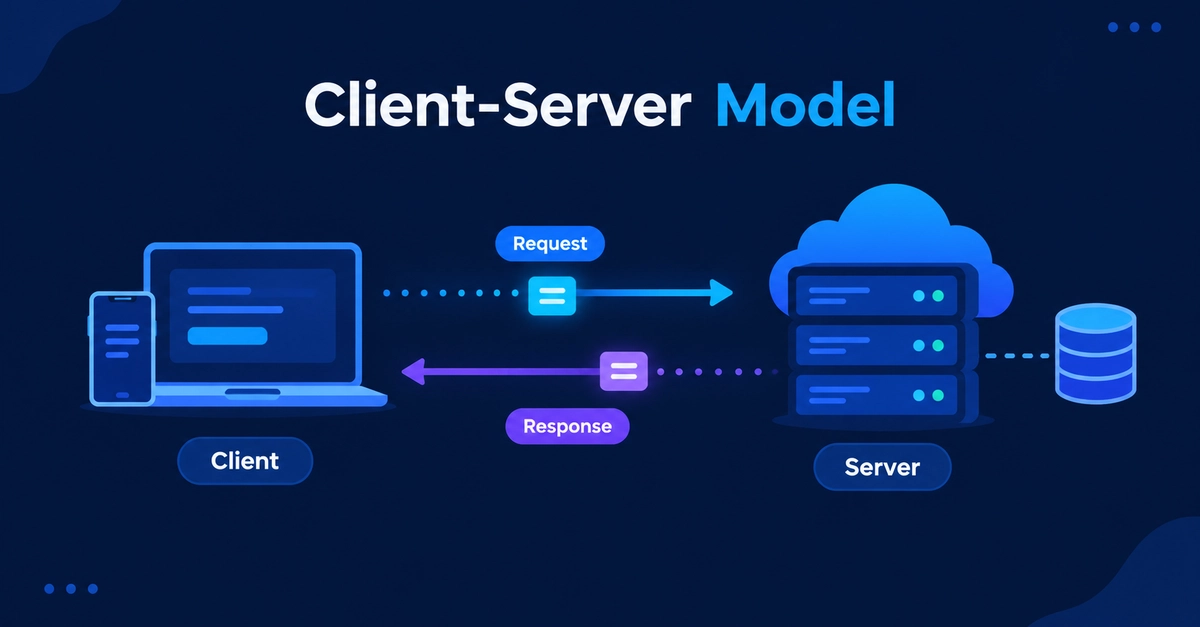
The Client-Server Model: A Digital Grocery Store Analogy
Imagine walking into a grocery store. You have a list of items you need. You approach the counter and hand your list to the shopkeeper. The shopkeeper doesn't personally fetch the items; instead, they relay your request to their staff. A store worker then gathers everything on your list, brings it back to the counter, and the shopkeeper hands it over to you. This entire interaction is a perfect, albeit simplified, analogy for the client-server model that underpins much of the internet.
In this scenario, you are the Client. You initiate the interaction by making a request – your shopping list. You don't go into the aisles and pick items yourself; you rely on someone else to fulfill your needs. The shopkeeper and their staff represent the Server. They receive your request, process it (by finding the items), and send back a response (your gathered groceries).
This fundamental pattern of a client requesting resources or services and a server providing them is the bedrock of how we interact with digital information. Whether you're browsing a website, sending an email, or streaming a video, a client-server architecture is almost certainly at play.
How It Works Technically
At its core, the client-server model is a distributed application structure that partitions tasks or workloads between providers of a resource or service (servers) and service requesters (clients). This model is designed to allow multiple clients to access shared resources and services provided by a central server.
When you type a website address into your browser (like www.example.com), your browser acts as the client. It sends a request over the internet to the server that hosts the website's files. This request typically uses the Hypertext Transfer Protocol (HTTP) or its secure version, HTTPS. The server, upon receiving the request, processes it. This might involve retrieving a webpage, fetching data from a database, or executing some logic.
Once the server has prepared the requested information, it sends it back to your browser as a response. Your browser then interprets this response – rendering the HTML, CSS, and JavaScript to display the webpage on your screen. If the server cannot fulfill the request, it sends back an error message, such as the familiar '404 Not Found'.
This constant cycle of request and response is how virtually all web interactions occur. The server is typically a powerful computer or a cluster of computers designed to handle many client requests simultaneously. Clients, on the other hand, can be any device capable of making requests – a desktop computer, a laptop, a smartphone, or even an Internet of Things (IoT) device.
Key Components and Characteristics
The client-server model has several defining characteristics:
- Centralization: Servers act as central hubs for resources and data. This makes management, updates, and security easier to implement and enforce.
- Scalability: Servers can be upgraded or scaled horizontally (by adding more servers) to handle increasing client loads. This allows applications to grow without requiring individual clients to be upgraded.
- Resource Sharing: Multiple clients can access the same resources from a single server, promoting efficiency and reducing redundancy.
- Separation of Concerns: The client is responsible for the user interface and initiating requests, while the server is responsible for data storage, processing, and managing access to resources.
- Communication Protocols: Clients and servers communicate using standardized protocols like HTTP, TCP/IP, FTP, and SMTP. These protocols define the rules for how data is formatted, transmitted, and received.
Think of a shared printer in an office. Everyone in the office (clients) can send documents to the printer (server) to be printed. The printer manages the queue and handles the printing job, ensuring that each document is printed correctly without conflicting with others. This is a physical manifestation of the client-server model, where the printer is the server providing a service to multiple clients.
Examples in Action
The client-server model is ubiquitous. Here are a few common examples:
- Web Browsing: As described, your browser (client) requests web pages from web servers.
- Email: When you send or receive an email, your email client (e.g., Outlook, Gmail app) communicates with an email server (e.g., an SMTP server for sending, an IMAP or POP3 server for receiving).
- Online Gaming: Multiplayer games often use dedicated game servers that manage the game state, player interactions, and synchronize actions for all connected clients.
- File Sharing: Services like Dropbox or Google Drive use client applications to sync files with cloud servers.
- Databases: Applications often act as clients to database servers, requesting data, inserting new records, or updating existing ones.
The power of this model lies in its ability to decouple the user interface from the underlying data and processing logic. This allows for flexibility in how applications are developed and deployed, and how users interact with them. It’s the invisible engine that powers much of our digital lives.
Advantages and Disadvantages
Like any architectural pattern, the client-server model has its strengths and weaknesses.
Advantages:
- Centralized Control: Easier to manage and update data and applications from a single point.
- Security: Security measures can be implemented and enforced at the server level, protecting data more effectively.
- Scalability: Servers can be scaled independently of clients to meet demand.
- Accessibility: Clients can access services from anywhere with an internet connection.
Disadvantages:
- Single Point of Failure: If the server goes down, all connected clients lose access to the service. This is a significant vulnerability.
- Server Overload: A massive influx of requests can overwhelm the server, leading to slow performance or complete failure.
- Network Dependency: Both clients and servers rely heavily on a stable network connection.
- Cost: Maintaining powerful, reliable servers can be expensive.
Despite its disadvantages, the client-server model remains the dominant paradigm for most network applications due to its inherent advantages in manageability, scalability, and resource centralization. Understanding this model is crucial for anyone looking to grasp the fundamentals of how networks, and the internet, operate.