Unexpected Resource Consumption
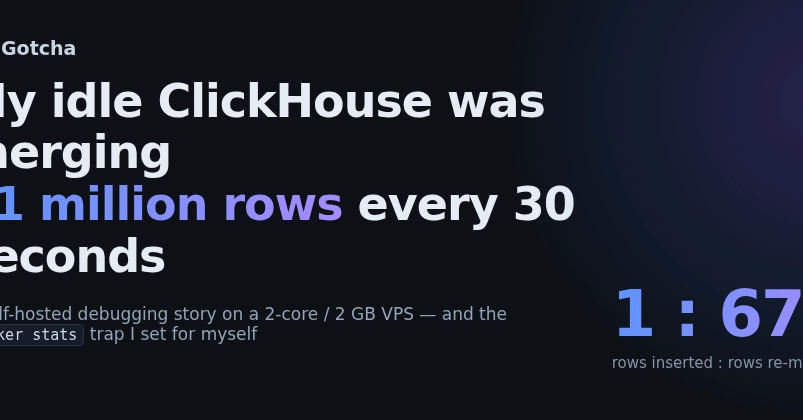
Running a self-hosted observability tool on a minimal VPS (2 cores, 2GB RAM, 20GB SATA SSD) for two low-traffic sites, the author encountered an unexpected issue: ClickHouse was consuming an inordinate amount of resources. Despite minimal event ingestion, docker stats revealed ClickHouse using 880MB of its 1GB memory limit, causing the entire system to swap. This prompted an investigation into the database's internal operations, revealing a significant amount of I/O activity directed towards self-maintenance rather than processing incoming data.
Data vs. Metadata: A Stark Contrast
The initial diagnostic step involved differentiating the actual application data from ClickHouse's internal metadata and operational data. The results were striking. The application's data, consisting of errors, traces, and metrics, occupied a mere 543 KB and contained only 16,000 rows. In stark contrast, ClickHouse's own system database, which stores metadata about tables, parts, and merges, consumed a massive 579 MB and held 46.3 million rows. This immediately pointed to the problem not being an influx of new data, but rather ClickHouse's internal processes for managing existing data.
The Mechanics of Excessive Merging
ClickHouse, a columnar database optimized for analytical queries, employs a merge tree engine. This engine stores data in parts, and periodically merges smaller parts into larger ones to improve query performance and data compression. The issue arose because ClickHouse was aggressively merging data parts, even when idle and with minimal new data arriving. The author observed that the database was merging approximately 11 million rows every 30 seconds. This high rate of background merging activity was the direct cause of the excessive memory consumption and subsequent swapping, as the merging process itself requires significant memory and I/O resources.
The surprising detail here is not the sheer volume of rows being merged, but the *rate* at which it was happening on an ostensibly idle system. Typically, background merges are a sign of active data ingestion or a system catching up. Here, it was an internal churn that was consuming resources disproportionately to the actual data volume or incoming traffic. This suggests that the configuration or the nature of the data being managed by the system database itself, rather than the application data, was the root cause of the performance bottleneck.
Root Cause: System Database Bloat
Further investigation revealed that the bloat was primarily within ClickHouse's system database. This database contains critical metadata, including information about data parts, merge operations, and system-level statistics. In this specific case, the system database had accumulated an unusually large number of rows, each representing an internal operation or state. The sheer volume of metadata entries was triggering frequent and resource-intensive merge operations on these metadata parts. This is akin to a librarian spending all their time cataloging the catalog itself, rather than managing the books on the shelves.
The author theorized that certain system tables, possibly related to historical merge operations or internal statistics, had grown excessively large. ClickHouse's background merge process, designed to optimize user data, was instead spending its cycles merging these internal metadata tables. The low-spec VPS exacerbated the problem; with limited RAM and slow SSD, the swapping caused by these merges brought the entire database to a crawl, impacting the observability tool's functionality.
Mitigation and Lessons Learned
To resolve the issue, the author decided to manually clean up the system database. This involved identifying and removing old or redundant entries, specifically targeting tables that had grown disproportionately large. After a cleanup, the background merge activity significantly reduced, and ClickHouse returned to normal resource utilization. The experience served as a critical lesson in monitoring not just application data but also the internal state and metadata of databases, especially in resource-constrained environments.
The incident underscores the importance of understanding ClickHouse's internal workings, particularly its merge tree engine and the management of its system database. For users running ClickHouse on minimal hardware, or those experiencing unexplained performance degradation, a thorough audit of the system database and its historical merge activity is essential. It’s a reminder that even a database with minimal ingested data can become a resource hog if its internal housekeeping mechanisms are misconfigured or overwhelmed by metadata churn.
The Unanswered Question: Configuration Drift or Design Flaw?
What remains unaddressed is whether this excessive growth of the system database is a common configuration drift issue, or if there's a potential design aspect in ClickHouse that, under specific low-ingestion, long-running conditions, can lead to such metadata bloat. Understanding this could inform proactive maintenance strategies or even future ClickHouse optimizations for edge cases like this. If it's a common pattern, it suggests a need for better automated cleanup or monitoring tools specifically for ClickHouse's internal metadata tables.