The Benchmark Setup: Beyond Simple Retrieval
Giving a large language model like Claude a "brain" – essentially, the ability to search and retrieve information from a large corpus – sounds like a straightforward way to boost its capabilities. However, accurately measuring the performance and cost of such systems is complex. A recent experiment, detailed on Dev.to, aimed to do just that, moving beyond simple retrieval metrics to a more rigorous, adversarial testing environment. The goal was to compare different memory systems for Claude, ensuring each had sufficient capacity and a consistent admission gate. Crucially, every outcome was judged not by another LLM, but by executing checker code against the actual code the agent produced. This approach removes subjective LLM judging and focuses on functional correctness.
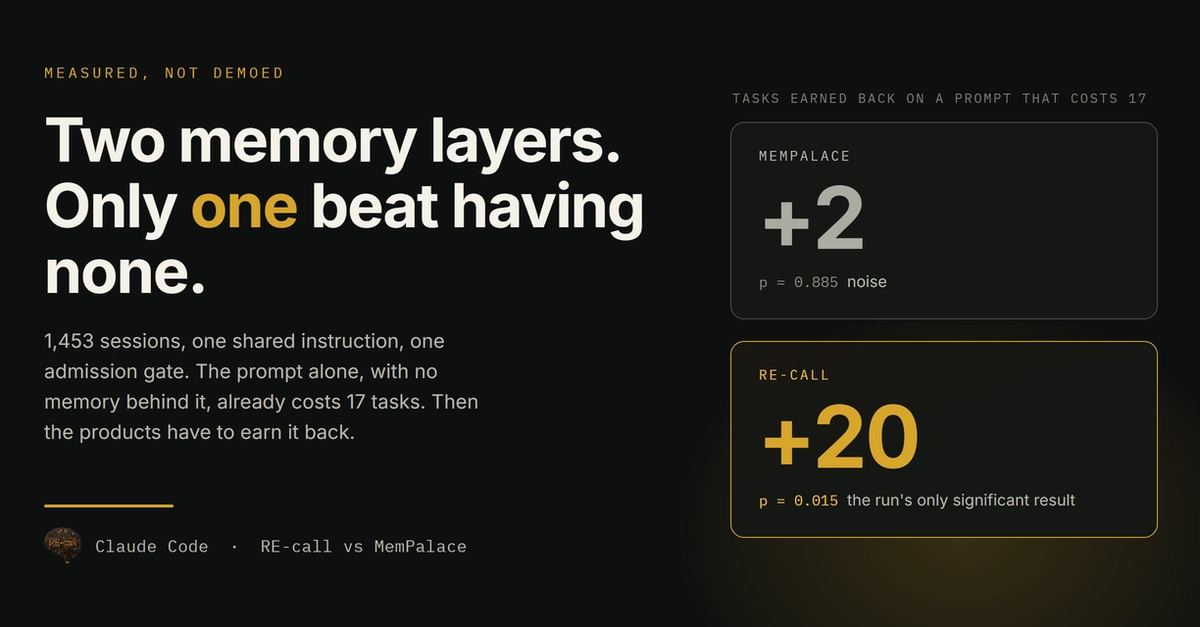
The experiment involved 1,453 agent sessions, testing four distinct memory system configurations. The key variable was the "corpus condition," which determined the nature and size of the data the agent could access. This setup was designed to be challenging, pushing the boundaries of retrieval and reasoning for the LLM.
The Corpus: A Haystack of Distractors
At the heart of the benchmark was the corpus, a carefully constructed dataset designed to test the limits of retrieval. Each condition featured a corpus of 4,911 documents, totaling approximately 27,000 embedded chunks. The adversarial nature of this corpus is its defining feature: 4,902 of these documents were "adversarial distractors." These were generated using the corpus's own vocabulary, making them semantically similar and highly confusable with the actual target material. The remaining documents contained the 36 specific tasks the agent was meant to solve.
This extreme ratio of distractors to target material is critical. In previous, smaller-scale tests, retrieval hit@10 (meaning the correct document was found within the top 10 search results) was 1.000. This perfect score was a limitation; it couldn't distinguish between a retrieval system that worked perfectly and an agent that simply never needed to search. The large, distractor-rich corpus in this experiment provides a much tougher environment, forcing the retrieval system to perform under pressure and the agent to correctly select relevant information from a sea of noise.

Measuring Cost: Token Consumption and Performance
The experiment meticulously tracked the token consumption for each agent session. This is a direct proxy for the cost of running these LLM agents, as API calls are priced per token. The results showed significant cost variations depending on the memory system and the complexity of the task. Some sessions, particularly those requiring extensive search and synthesis of information from multiple documents, consumed thousands of tokens, translating to tangible monetary costs.
The surprising detail here is not just the raw token counts, but how they correlated with performance. In several instances, more aggressive search strategies (which consumed more tokens) did not necessarily lead to better outcomes. Conversely, some configurations that were more conservative with search queries still managed to achieve high accuracy, suggesting a more efficient retrieval or reasoning process. This highlights the trade-off between exploration (searching broadly) and exploitation (using retrieved information effectively) and its direct impact on operational costs.
The Outcomes: Functional Correctness Over LLM Judgement
The true innovation of this benchmark lies in its evaluation method. Instead of relying on an LLM to grade the output – a common but potentially biased approach – this experiment executed checker code against the agent's generated code. For tasks involving code generation, this means compiling and running the code, checking its output against predefined test cases. This provides an objective, binary measure of success: did the code work as intended, or did it fail?
The results were illuminating. Across the four memory system conditions, performance varied. Some systems struggled significantly with the high density of distractors, leading to incorrect code generation and task failure. Others demonstrated a more robust ability to filter noise and locate the necessary information. The experiment revealed that even with substantial token budgets, agents could fail if their retrieval mechanisms were not finely tuned or if their reasoning process couldn't synthesize disparate pieces of information correctly. The data suggests that the efficiency of the retrieval system, specifically its ability to rank relevant documents highly and filter out irrelevant ones, is paramount, even more so than the sheer volume of data available.
Implications for Agents and Developers
This benchmark provides critical insights for anyone building or deploying LLM-powered agents, particularly those designed to interact with large codebases or complex documentation. The cost of providing these agents with extensive search capabilities is not trivial. Developers must consider not only the API costs associated with token consumption but also the engineering effort required to build and optimize effective memory and retrieval systems.
The experiment underscores that simply feeding an LLM more data or giving it access to a larger search index is not a panacea. The quality of retrieval, the ability to handle ambiguity and adversarial data, and the efficiency of the agent's reasoning process are key determinants of success. For developers looking to integrate LLMs into workflows that require precise information retrieval from large, potentially noisy datasets, this research offers a stark reminder: the "brain" you give your AI has a very real and measurable operational cost, and its effectiveness hinges on more than just its size.