The Challenge of Financial Document OCR
Extracting information from financial documents like bank statements, invoices, and receipts presents a unique set of challenges that traditional Optical Character Recognition (OCR) tools often fail to address effectively. After processing thousands of these documents, it's clear that financial OCR is significantly harder than generic document digitization. The core issues stem from how financial data is presented, which deviates sharply from standard document formats.
Traditional OCR engines, such as Tesseract or AWS Textract, struggle with financial documents for several critical reasons:
- Implicit Table Structure: Financial institutions rarely use HTML tables. Instead, columns are typically delineated by whitespace. This makes it exceedingly difficult for standard OCR to discern where one data column ends and another begins, leading to misaligned data and incorrect associations between labels and values.
- Number Accuracy Imperative: In accounting and finance, precision is paramount. A simple confusion between the numeral '1' and the lowercase letter 'l', or between '0' and 'O', can lead to significant errors. A single misread digit can invalidate double-entry bookkeeping, causing cascading problems in financial reconciliation.
- Format Heterogeneity: Each financial institution employs distinct layouts and design conventions. A bank statement from Chase will look vastly different from one issued by Wells Fargo, and invoice formats can vary wildly between vendors. This lack of standardization requires OCR solutions to be highly adaptable, a trait often lacking in rigid traditional systems.
The output from traditional OCR often consists of raw, unstructured text. While useful for simple text extraction, it lacks the semantic understanding required to parse complex financial tables, identify specific transaction types, or accurately capture monetary values with their associated currencies and dates. This necessitates significant post-processing and manual correction, negating the efficiency gains expected from an OCR solution.
Claude Vision API's Advantage in Financial Contexts
Anthropic's Claude Vision API offers a more sophisticated approach by leveraging large language model (LLM) capabilities. Unlike traditional OCR that focuses solely on character recognition, Claude Vision understands context and structure. This makes it particularly well-suited for the nuances of financial documents. The API can interpret visual layouts, understand the spatial relationships between text elements, and infer meaning from the arrangement of data, even when explicit structural markers like HTML tags are absent.
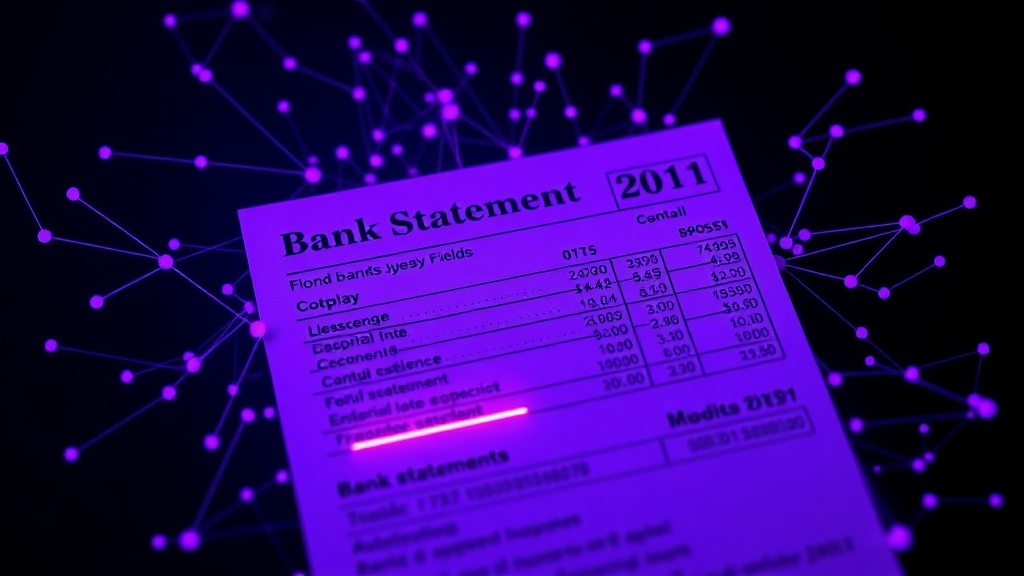
The ability of Claude Vision to process image inputs alongside text prompts allows for a more holistic understanding of the document. Developers can provide the image of a bank statement and prompt the model to extract specific information, such as transaction dates, descriptions, amounts, and running balances. The model can then use its understanding of common financial document layouts to identify these elements accurately, even if the formatting differs from one document to another.
One of the key differentiators is Claude Vision's performance on numerical data. Its underlying LLM architecture is trained on vast datasets that include financial information, enabling it to better distinguish between similar-looking characters (like '1' and 'l', or '0' and 'O') when they appear in a numerical context. This significantly reduces the error rate for critical financial figures, a common pitfall for traditional OCR.
Furthermore, Claude Vision's prompt engineering capabilities allow developers to guide the extraction process. By crafting specific prompts, users can instruct the model to focus on particular sections of a document, extract data into a structured format (like JSON), or perform calculations based on extracted figures. This flexibility moves beyond simple text extraction to intelligent data interpretation.
Productionizing Claude Vision for Financial OCR
Integrating Claude Vision into a production system for financial document OCR requires careful consideration of several factors. The initial setup involves API key management, handling image uploads, and defining clear, effective prompts. The iterative nature of prompt engineering is crucial; what works for one document type might need refinement for another.
A common workflow involves pre-processing the document image to improve clarity and reduce noise before sending it to the Claude Vision API. This can include deskewing, cropping, and adjusting contrast. Once the API returns the extracted data, a robust validation layer is essential. This layer should verify the accuracy of critical data points, such as numerical values and dates, by cross-referencing with expected formats or applying business rules.
For instance, when processing invoices, a validation step might check if the sum of line item amounts matches the total amount due, or if the invoice date is within a reasonable range. For bank statements, it might involve verifying that transaction dates are sequential and that running balances are consistent. This validation step acts as a safety net, catching potential misinterpretations by the AI and ensuring data integrity.
The surprising detail here is not just that Claude Vision *can* do this, but how well it performs with relatively straightforward prompting on complex, unstructured financial documents. While traditional OCR might require extensive training data and custom models for each document type, Claude Vision demonstrates a remarkable ability to generalize from its pre-training, making it a more accessible and faster solution for many financial OCR use cases.
Key Lessons Learned
Building a production-ready financial OCR system with Claude Vision involves several key takeaways:
- Prompt Engineering is Key: The quality of the extracted data is directly proportional to the clarity and specificity of the prompts. Experimentation is necessary to find optimal prompts for different document types and extraction goals. Consider instructing the model to output data in a structured format like JSON for easier parsing.
- Iterative Refinement: Expect to iterate on prompts and validation logic. What works for a batch of invoices might require adjustments for receipts or different invoice templates. Continuous monitoring of extracted data quality is vital.
- Validation is Non-Negotiable: Never rely solely on the AI's output for critical financial data. Implement robust validation rules to check for numerical accuracy, logical consistency, and adherence to expected formats. This is the final line of defense against errors.
- Understand API Limitations: While powerful, Claude Vision is not infallible. Complex layouts, poor image quality, or ambiguous data can still lead to errors. Design your system with error handling and mechanisms for human review where necessary.
- Cost Management: Processing thousands of documents involves API costs. Optimize image sizes and prompt lengths where possible, and consider batching requests or implementing caching strategies if appropriate to manage expenses.
By understanding these challenges and leveraging the contextual understanding of Claude Vision, developers can build more accurate and efficient financial document processing systems. The shift from character-based recognition to AI-driven contextual interpretation marks a significant advancement in handling the complexities of financial data extraction.