Claude Opus 5: A Step Forward, But Not a Leap for SDK Fluency
Anthropic's Claude Opus 5, released recently, shows a marked improvement in understanding and generating code that utilizes established Software Development Kits (SDKs). However, a close examination reveals that while the model has successfully closed the gap on API changes from the previous year, it still falters when faced with the most recent, cutting-edge SDK updates. This nuanced performance suggests that while AI coding assistants are becoming more adept at understanding evolving developer tools, they have not yet achieved mastery over the bleeding edge of API evolution.
The challenge lies in the rapid pace of development within the tech ecosystem. Libraries and frameworks are constantly updated, introducing new features, deprecating old ones, and fundamentally altering how developers interact with them. For AI models, which are trained on vast datasets of code, keeping up with these changes is a monumental task. The data used for training often lags behind the latest releases, meaning models might still be referencing outdated documentation or code examples. This is precisely the problem that SDKProof, a tool developed to test AI's grasp of current APIs, aims to expose.
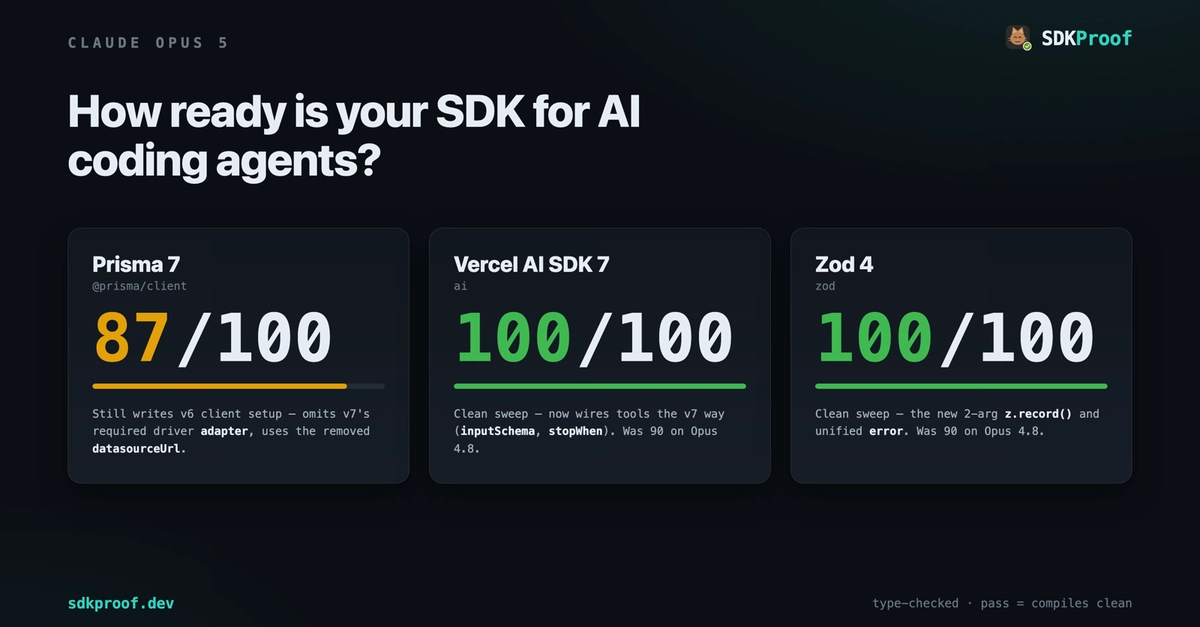
When tested against a range of SDKs, Claude Opus 5 demonstrated impressive proficiency with libraries that had their major updates in 2023 or earlier. For instance, it achieved a perfect score (100%) on the TanStack Query 5 SDK, which saw its major release in 2023. Similarly, it scored 100% on Zod 4 (released in 2025, but likely with significant training data available from its development phase) and 92% on Next.js 16 (also slated for late 2025). These results indicate that Opus 5 can effectively navigate and generate code for APIs that have been stable for a considerable period, suggesting its training data is robust for these established versions.
The Frontier: 2025 SDKs and Beyond
The picture shifts dramatically when Opus 5 encounters SDKs with the most recent or upcoming major releases. While Prisma 7 (late 2025) and Next.js 16 (late 2025) saw scores of 87% and 92% respectively, the Vercel AI SDK 7 (mid-2025) dropped to a perfect 100% score, but this reflects a successful application of the SDK rather than a struggle. The real test comes with the freshest APIs. The tool's author notes that the model struggled with the 2025 updates for Prisma and Next.js, implying that while it can handle some newer versions, the truly bleeding-edge APIs remain a challenge. This suggests a lag in the model's knowledge base, or perhaps an inability to infer the nuances of API changes that haven't yet been widely documented or used in training data.
This performance gap is not unique to Claude Opus 5. It's a systemic issue for all large language models trained on code. Developers often rely on the latest versions of libraries for performance improvements, new features, and security patches. When AI coding assistants fail to accurately reflect these changes, they can generate code that is either non-functional, inefficient, or insecure. For developers building on rapidly evolving platforms like Vercel or Next.js, this means they cannot yet fully delegate the task of integrating the latest SDK features to AI without rigorous human oversight.
The implications for developers are clear: while Opus 5 can be a powerful tool for generating boilerplate code or working with established libraries, it should not be treated as an infallible source for the absolute latest API implementations. Developers must still exercise their judgment, consult the most up-to-date documentation, and test generated code thoroughly, especially when working with features introduced in the last year or expected in the near future.
The Unanswered Question: When Will AI Catch Up?
What remains to be seen is how quickly models like Claude Opus 5 will be able to bridge this gap. The development cycle for AI models is lengthy, involving extensive training periods. Meanwhile, the pace of SDK development shows no signs of slowing. This creates a perpetual challenge for AI developers and researchers: how to ensure their models are trained on data that is not just vast, but also current and representative of the most recent developer practices. Without a more dynamic or specialized training approach for rapidly changing APIs, AI coding assistants will likely continue to lag behind the bleeding edge, requiring human developers to remain the ultimate arbiters of code quality and correctness.
The current state of AI coding assistants is akin to a highly knowledgeable student who has aced all their past exams but is still struggling with the pop quiz on this morning's lecture. They possess a deep understanding of foundational concepts and historical knowledge, but the immediate, evolving details escape them. This is not a failure, but a characteristic of their learning process. For developers, this means leveraging AI for what it does best – accelerating common tasks and providing a strong foundation – while remaining vigilant about the specifics of the latest API changes.
The path forward likely involves more frequent model updates, specialized fine-tuning on recent code repositories, and potentially new training methodologies that can ingest and process rapidly changing API documentation in near real-time. Until then, the human developer's expertise in navigating the newest SDKs remains indispensable.