Claude Fable 5.1: A Leap in Business Process Automation
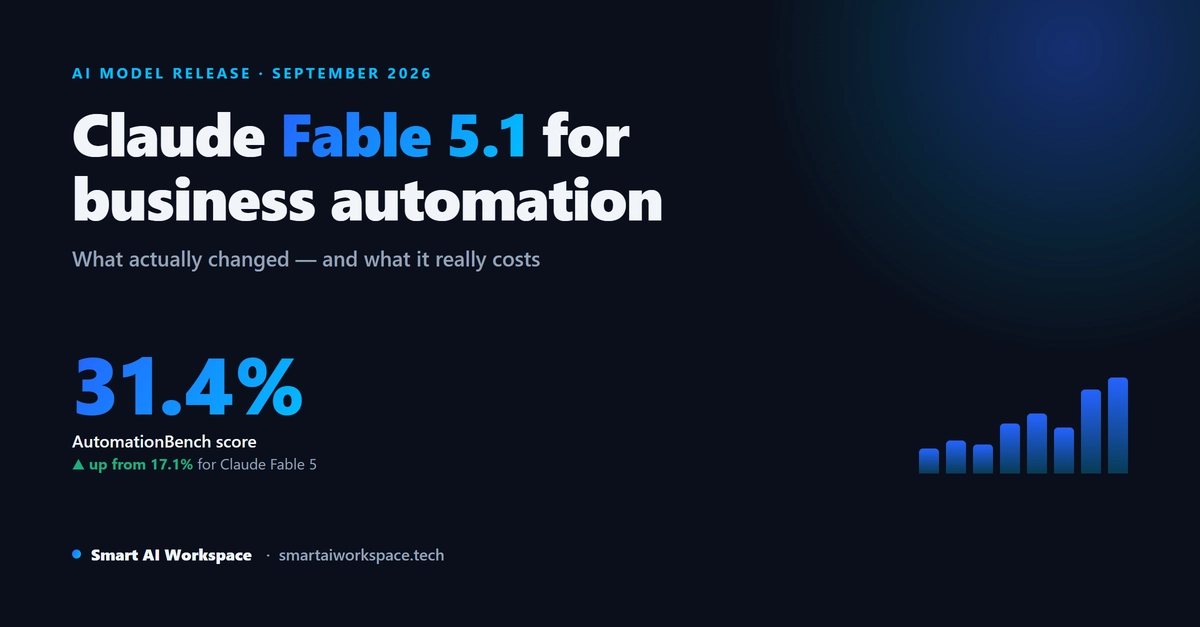
Anthropic announced the release of Claude Fable 5.1 and Mythos 5.1 on September 1, 2026. Fable 5.1 is now generally available, while Mythos 5.1 is restricted to vetted organizations in cybersecurity and life sciences. The headline figure for Fable 5.1 is its performance on AutomationBench, a benchmark designed to measure a model's ability to automate actual business processes. Fable 5.1 achieved a score of 31.4%, a dramatic increase from Claude Fable 5's score of 17.1% just three months prior. This near-doubling in performance within a single release cycle is significant because the core capability of completing multi-step jobs without human intervention is critical for many business automation tasks.
This advancement suggests Fable 5.1 is substantially better equipped to handle complex, sequential workflows that are common in business operations. For businesses that have been evaluating LLMs for automation, this jump in AutomationBench score indicates a potential step-change in what can be achieved. However, the decision of whether to adopt Fable 5.1, or stick with Fable 5 or the more powerful Opus 5, requires a nuanced understanding of performance, cost, and specific use cases.

Understanding AutomationBench and Fable 5.1's Performance
AutomationBench is not a synthetic benchmark; it aims to simulate real-world business scenarios. It tests a model's capacity to execute multi-step tasks, manage context across those steps, and arrive at a correct outcome without requiring human oversight. This is precisely the kind of capability that distinguishes a helpful AI assistant from a tool that can genuinely streamline operations. Fable 5.1's score of 31.4% means it can successfully complete over 30% of the simulated business processes in the benchmark. While this figure might seem modest in absolute terms, its rapid improvement from 17.1% is the key indicator of progress. Most AI models see incremental gains between releases; a near doubling suggests architectural or training improvements specifically targeting complex task completion.
The implications for business automation are substantial. Tasks that previously required extensive human scaffolding, error checking, and manual handoffs may now be feasible for Fable 5.1 to manage end-to-end. This could include anything from complex data entry and reconciliation to sophisticated customer support workflows, report generation, and even certain aspects of software development or testing. The ability to reliably complete these tasks autonomously is the holy grail for many automation initiatives, and Fable 5.1 appears to be moving closer to that goal.
Cost Considerations: Beyond the Sticker Price
While Anthropic reports impressive benchmark numbers, understanding the true cost of using Fable 5.1 involves looking beyond the per-token pricing. The model's behavior, its tendency to produce accurate results, and the complexity of the tasks it can handle all factor into the total cost of ownership. A model that is cheaper per token but requires more human intervention or produces more errors can ultimately be more expensive than a slightly higher-priced model that performs reliably.
Fable 5.1's increased capability on AutomationBench suggests it might be more efficient for complex tasks. If it requires fewer calls, less prompt engineering, or generates fewer incorrect outputs that need human correction, its effective cost for achieving a specific automation goal could be lower than that of its predecessor. However, Anthropic has not detailed specific pricing changes for Fable 5.1 compared to Fable 5. Businesses will need to conduct their own cost-benefit analyses. This involves not just looking at API costs but also at the reduction in human labor, the speed of task completion, and the accuracy of the AI's output.
For instance, a workflow that previously took a human 10 minutes and required 5 API calls to Fable 5 might now be completed by Fable 5.1 in 2 minutes with 3 API calls. Even if Fable 5.1's per-token cost is slightly higher, the total operational cost could decrease due to the significant reduction in human time and fewer model interactions.
When to Choose Fable 5.1, Fable 5, or Opus 5
The decision matrix for selecting the right Claude model for business automation is becoming more complex, but also more granular. Fable 5.1 is clearly the frontrunner for tasks requiring sophisticated, multi-step automation where reliability and end-to-end completion are paramount. Its near-doubling on AutomationBench makes it the go-to for applications where minimizing human oversight is a primary objective.
However, Fable 5 might still be a viable option for simpler, less complex automation tasks where its lower performance on AutomationBench is not a bottleneck. If a workflow is straightforward and requires minimal sequential reasoning, Fable 5's potentially lower operational cost or faster response times for simpler queries could make it more suitable. Developers should benchmark their specific use cases on both Fable 5 and Fable 5.1 to determine the optimal balance of performance and cost.
Opus 5 remains the most powerful and capable model in Anthropic's lineup. It is likely to outperform Fable 5.1 on a broader range of complex reasoning, creative generation, and highly nuanced tasks. Opus 5 should be considered for critical applications where the absolute highest level of performance and intelligence is required, and where the cost is secondary to accuracy and capability. For instance, in highly sensitive legal document analysis, complex scientific research assistance, or advanced strategic planning, Opus 5 might still be the preferred choice, even if Fable 5.1 excels at structured business process automation.
Mythos 5.1: A Specialized Tool for High-Stakes Domains
The concurrent release of Mythos 5.1 signals Anthropic's strategy to offer specialized models for sensitive industries. Mythos 5.1 is not available to the general public, reserved instead for organizations in cybersecurity and life sciences. This suggests that Mythos 5.1 has undergone specific fine-tuning, safety protocols, or regulatory compliance measures tailored to these demanding fields. For companies in these sectors, Mythos 5.1 could offer a more secure, reliable, and compliant AI solution than a general-purpose model, even Fable 5.1.
While details on Mythos 5.1's specific capabilities and benchmarks are not public, its restricted access implies enhanced security, data privacy, or specialized knowledge relevant to its target domains. Organizations that qualify for access should investigate its suitability for their unique challenges, as it may represent a significant advancement over generalist models for their specific needs.
The Road Ahead for Business AI
Claude Fable 5.1's performance on AutomationBench is a strong indicator of the rapid progress in AI’s ability to handle real-world business tasks. The near-doubling in score within three months is a testament to Anthropic's focused development. As AI models become more adept at autonomous task completion, the barrier to entry for sophisticated automation decreases. Businesses that have been hesitant due to AI's limitations in executing multi-step processes may find Fable 5.1 a compelling option. However, the true value will be realized not just in benchmark scores, but in how effectively these models can be integrated into existing workflows, managed cost-effectively, and deployed reliably. The availability of specialized models like Mythos 5.1 further highlights a growing trend towards tailored AI solutions for specific industries, promising deeper integration and more impactful applications in the future.