Automating Code Review with Claude Skills
The familiar developer frustration of submitting code to an AI, only to find minor errors upon review, is a cycle Anthropic aims to break. The company recently detailed a method for building automated verification loops directly into Claude Code, transforming the AI from a code generator into a self-correcting development assistant. This approach leverages 'skills' to encode repeatable checking and fixing routines, ensuring a higher quality of output without constant human intervention.
Traditionally, AI-assisted coding involved a human-in-the-loop for every iteration. Developers would prompt Claude for code, receive the output, manually test or lint it, identify issues, correct them, and then resubmit. This manual verification process, while necessary, negates much of the efficiency gains promised by AI coding tools. Anthropic's new methodology encodes these verification steps as 'skills' that Claude can execute autonomously. Think of it less like a single-use tool and more like a diligent junior developer who automatically runs a predefined checklist before presenting their work.
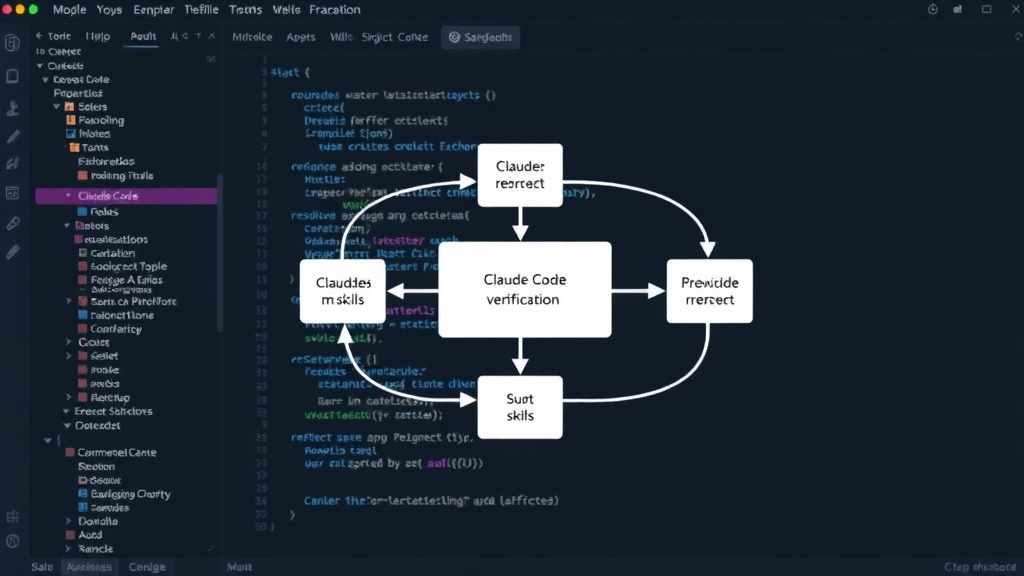
A verification loop fundamentally involves an AI agent reviewing its own work. This review can encompass a range of automated checks: running unit tests, executing linters for style and syntax errors, performing static analysis for potential bugs, or even custom validation logic tailored to specific project requirements. The critical innovation here is Anthropic's ability to package these checks into reusable 'skills.' This means that instead of re-prompting Claude with explicit instructions for each verification step, the AI can be configured to automatically apply a consistent set of checks across all code generation tasks within a session or project. This ensures that adherence to standards and error detection are not forgotten or inconsistently applied.
What Are Claude Skills?
In the context of Claude, 'skills' are essentially pre-defined capabilities or functions that the AI can access and execute. These are analogous to tools or libraries that a human developer might import to perform specific tasks. For verification loops, these skills are designed to perform the actual checks. For instance, a 'run_unit_tests' skill might execute a provided test suite against generated code, while a 'lint_code' skill could invoke a linter like ESLint or Flake8.
The power of skills lies in their reusability and composability. A developer can define a set of verification skills relevant to their project's needs – perhaps including specific security checks, performance benchmarks, or adherence to internal coding guidelines. Once defined, these skills can be associated with a Claude Code session. When Claude generates code, it can then be instructed to first 'run its skills' on the output. If any skill reports a failure, Claude can be prompted to automatically attempt a fix based on the error feedback. This creates a closed loop where the AI not only generates code but also validates and refines it until it meets the defined criteria.
Building the Verification Loop
The implementation of these verification loops requires a structured approach. Developers need to:
- Define Verification Criteria: Clearly outline what constitutes acceptable code. This includes specifying which tests must pass, which linting rules must be satisfied, and any other relevant quality gates.
- Develop or Select Skills: Create or choose existing tools that can perform these checks. These could be simple shell scripts, command-line tools, or even other AI agents designed for specific analysis tasks.
- Integrate Skills with Claude: Configure Claude Code to recognize and utilize these defined skills. This typically involves providing Claude with the necessary prompts and context to understand when and how to invoke each skill.
- Establish Feedback Mechanisms: Ensure that the output of each skill (e.g., test results, linting errors) is fed back to Claude in a format it can understand and act upon to correct the code.
The surprising detail here is not the concept of automated code checking, which has existed for decades in the form of CI/CD pipelines and static analysis tools. The novelty lies in Anthropic's approach to embedding this capability directly within the AI's interaction model as a first-class feature, making it accessible and configurable for individual developer sessions rather than solely relying on external infrastructure.
The Benefits of Automated Verification
The primary benefit is a dramatic reduction in the time developers spend on manual code review and debugging. By automating checks that are often repetitive and tedious, developers can focus on higher-level design and problem-solving. This leads to faster iteration cycles and quicker deployment of features.
Furthermore, embedding verification as a skill ensures consistency. Every piece of code generated by Claude, when configured with these skills, will undergo the same rigorous checking process. This can lead to a more uniform codebase and fewer