The Hidden Token Tax in Claude Code
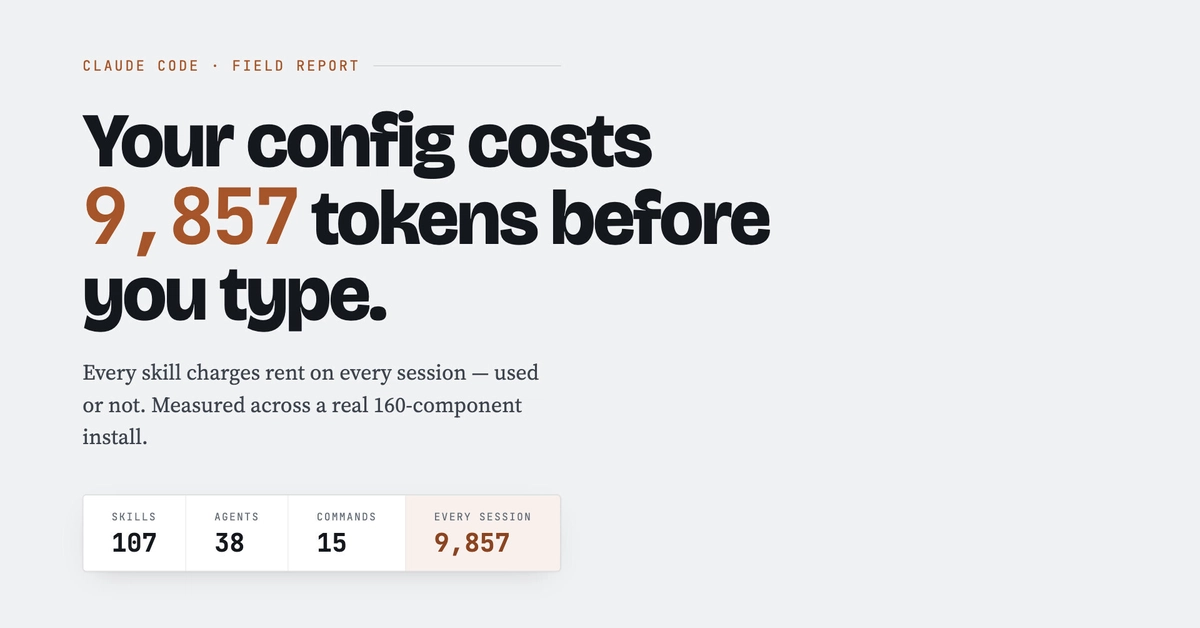
Many users of Claude Code, an AI assistant for developers, are unaware of a significant, hidden cost associated with its extensive customization. The author discovered that their Claude Code configuration, built over months by installing various skills, agents, and commands, consumes approximately 9,857 tokens before any code is written or any prompt is entered. This substantial overhead impacts every single session, effectively acting as a constant tax on usage.
The issue stems from how Claude Code manages its installed functionalities. Users typically add skills and agents as they discover them, often without a clear process for removing those that are no longer needed. While the direct execution cost of a skill (its body) is incurred only when it’s triggered, the token cost associated with its description is perpetual. Every installed skill, agent, and command has a description that must be loaded into the model's context window for the AI to understand what functionalities are available. This means that the cumulative size of all these descriptions sits in the active session, consuming tokens constantly, irrespective of whether the functionality is ever used.
The author found that their collection of 107 skills, 38 agents, and 15 commands accumulated to this 9,857 token cost. This is not a one-time load cost; it's a persistent 'rent' paid for the availability of these tools within the Claude Code environment. This discovery highlights a critical aspect of managing AI assistants: the often-overlooked overhead of their configuration and the need for diligent management of installed components.
Understanding Skill Costs: Body vs. Description
The distinction between a skill's 'body' and its 'description' is crucial for understanding this hidden cost. When a user interacts with Claude Code and a specific skill is activated, the AI loads and processes the skill's body. This is the operational code, the logic that performs the requested task. The token cost for the body is directly tied to its usage – you pay when you use it. This is generally considered a fair exchange; the user initiates an action, and the AI expends resources to fulfill it.
However, the description of each skill, agent, and command serves a different purpose. These descriptions are what the underlying AI model reads to understand the capabilities of the assistant. When Claude Code starts a session, it needs to know what tools are at its disposal. To do this, it loads the descriptions of *all* installed components into its context window. This is not a temporary load; it's a persistent presence. Think of it less like a pay-per-use service and more like renting storage space for each tool's manual. Even if you never open a specific manual, you're still paying for the space it occupies in your limited workspace (the context window).
This 'rent' accumulates. With 107 skills, 38 agents, and 15 commands installed, the total token count for their descriptions reached nearly 10,000. This is a substantial portion of Claude Code's context window, especially considering that the user's own prompts and the AI's responses also consume tokens. The author aptly describes this persistent consumption as 'rent,' emphasizing that it's paid for the entire duration of the session, whether the specific functionality is ever invoked or not. This model incentivizes users to be highly selective about what they install, a practice often overlooked in the enthusiasm for adding new AI capabilities.
The Impact on Session Performance and Cost
A 9,857 token overhead before typing a single character has significant implications. Firstly, it directly impacts the available context window for actual work. If Claude Code has a maximum context window of, say, 100,000 tokens, nearly 10% is already consumed by descriptive metadata. This leaves less room for complex code analysis, multi-turn conversations, or lengthy explanations, potentially degrading the quality of AI assistance for intricate tasks.
Secondly, it affects the cost of using Claude Code. Many AI services charge based on token consumption. A higher baseline token usage means that every interaction, no matter how small, starts from a more expensive point. For developers who rely on AI assistants for extended coding sessions, this 'hidden tax' can lead to unexpectedly higher bills. The author’s finding is a stark reminder that the perceived cost of an AI tool is not just in its active processing but also in the persistent overhead of its configuration.
The ease with which users can install new skills and agents in platforms like Claude Code, often without clear guidance on managing or removing them, exacerbates this problem. It creates an environment where 'installation bloat' is a natural consequence of exploration and utility-seeking. The author’s proactive step of measuring this cost is a valuable service to the community, prompting a necessary conversation about the economics and practical management of AI tool ecosystems.
Checking Your Own Claude Code Token Costs
The author provides a method to check these costs, empowering users to assess their own 'token rent.' While the exact mechanism for checking is not detailed in the provided excerpt, the implication is that it involves inspecting the configuration and summing the token counts of all installed component descriptions. This process is crucial for anyone using heavily customized AI assistants. Developers and power users should regularly audit their installed skills, agents, and commands, removing anything that is no longer actively used or provides marginal benefit. This not only reduces the baseline token consumption but also potentially improves the AI's performance by presenting it with a less cluttered set of available tools, allowing it to focus on the most relevant functionalities.
The discovery serves as a critical lesson for the burgeoning field of AI-powered developer tools. As these assistants become more sophisticated and customizable, understanding their underlying resource consumption—both active and passive—is paramount. Ignoring the 'rent' of configuration can lead to diminished performance and increased costs, ultimately hindering the very productivity gains these tools are meant to provide. The author’s 9,857 token realization is a powerful case study in the unseen economics of AI customization.
What remains unaddressed is how platforms like Claude Code might evolve to mitigate this 'rent' cost for users. Will future versions offer more efficient ways to load descriptions, perhaps only loading them as needed or providing better tools for automatic cleanup of unused components? The current model, while functional, places a significant burden of management on the user, a burden that grows with the utility and customization of the tool.