The Unseen Barrier: HP Laser 1008a and macOS
For years, users of the HP Laser 1008a printer on macOS have faced a peculiar digital wall. Despite its widespread availability and decent performance, this monochrome laser printer lacked official driver support for Apple's operating systems. This meant users had to resort to convoluted workarounds, such as running Windows in a virtual machine or using generic, often unreliable, PostScript drivers. The result was a frustrating experience, diminishing the utility of an otherwise capable device for a significant segment of the user base. The core of the problem lay in the proprietary nature of printer communication protocols and the lack of readily available, open-source driver development resources for this specific model.
AI as the Unexpected Driver Developer
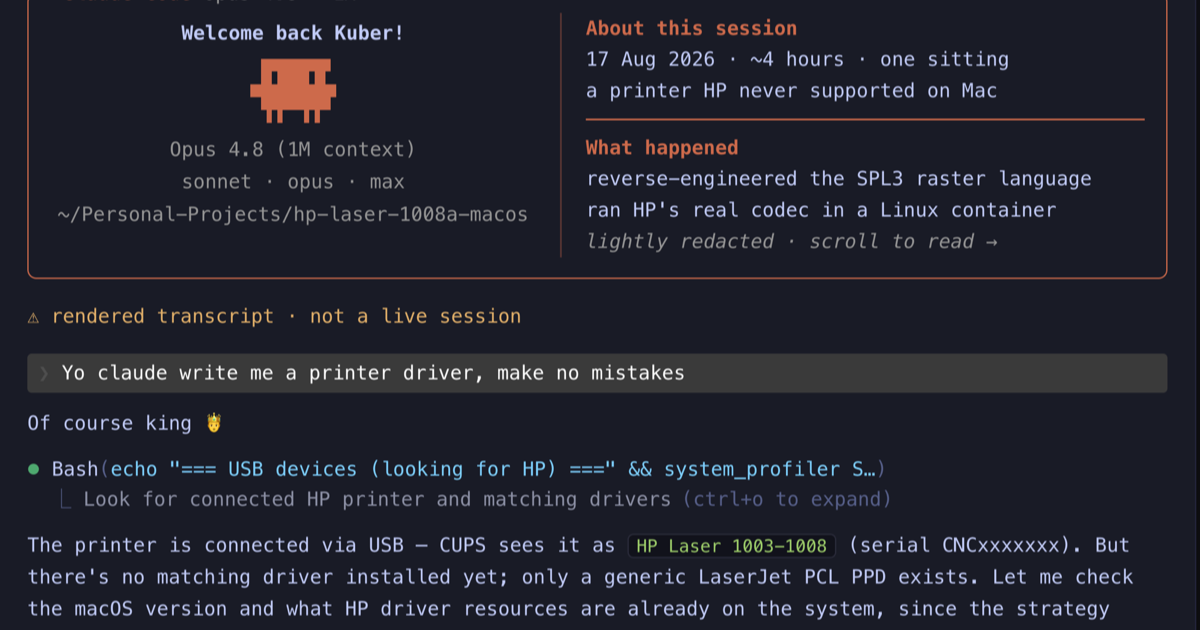
Enter Claude, the AI model developed by Anthropic. In a remarkable demonstration of AI's capability beyond typical chatbot functions, a developer utilized Claude to dissect and understand the communication protocols required to make the HP Laser 1008a work natively with macOS. This wasn't a case of the AI directly writing a driver; rather, it acted as an intelligent assistant, helping the developer reverse-engineer the necessary logic.
The process involved feeding Claude information about the printer's expected behavior and the macOS printing system's requirements. Claude, with its advanced natural language understanding and code generation capabilities, was able to interpret these inputs and suggest code snippets and logical pathways that mimicked the behavior of a native driver. Think of it less like an AI writing a complete application from scratch, and more like a highly knowledgeable co-pilot that can interpret complex technical documentation and suggest the correct flight path, even when the original flight manual is incomplete or missing.
Deconstructing the Printer Protocol
The challenge with many consumer-grade printers, especially older or more budget-oriented models, is that manufacturers often do not release detailed specifications or open-source drivers. This forces users and third-party developers to engage in a process known as reverse engineering. This typically involves capturing the data sent from a working system (often Windows, where drivers are more commonly provided) to the printer and analyzing it to understand the commands, control sequences, and data formats that the printer understands.
In this instance, the developer likely presented Claude with observed data streams or descriptions of the printer's responses. Claude's task was to infer the underlying structure and meaning of these communications. It could then help translate this understanding into code that macOS's CUPS (Common Unix Printing System) could interpret. CUPS is the standard printing system used by macOS, and creating a driver for it involves defining how to format print jobs into a language the printer understands and how to manage printer status and capabilities.
The Code and the Community
The outcome of this AI-assisted endeavor is a set of code that allows macOS to communicate directly with the HP Laser 1008a. This means users can now add the printer through standard macOS system preferences, select it as a printing option from any application, and print without relying on clunky intermediaries. The solution bypasses the need for proprietary drivers by implementing the necessary communication logic within the macOS printing framework.
This development is significant not only for the immediate beneficiaries – HP Laser 1008a owners on macOS – but also as a proof of concept. It demonstrates how advanced AI tools can democratize complex technical tasks. What once required deep expertise in low-level hardware communication, driver development, and operating system internals, can now be significantly accelerated and made more accessible with the aid of sophisticated AI models like Claude. The developer's work, likely shared within technical communities, could inspire similar solutions for other unsupported hardware.
Implications Beyond a Single Printer
The success of using Claude to bridge the gap between a specific printer and an operating system highlights a broader trend: AI as a tool for overcoming proprietary hardware and software limitations. For developers, this means AI can become an indispensable partner in debugging, reverse engineering, and even creating custom integrations for hardware that lacks official support. It lowers the barrier to entry for complex tasks that were previously the domain of highly specialized engineers.
What remains to be seen is how manufacturers will respond to such AI-driven community solutions. Will it encourage more open driver development, or will it lead to more complex obfuscation techniques to prevent reverse engineering? Furthermore, the ethical considerations of using AI for reverse engineering proprietary systems will likely evolve as these capabilities become more widespread. For now, however, the HP Laser 1008a users on macOS can rejoice in a problem solved, thanks to a blend of human ingenuity and artificial intelligence.