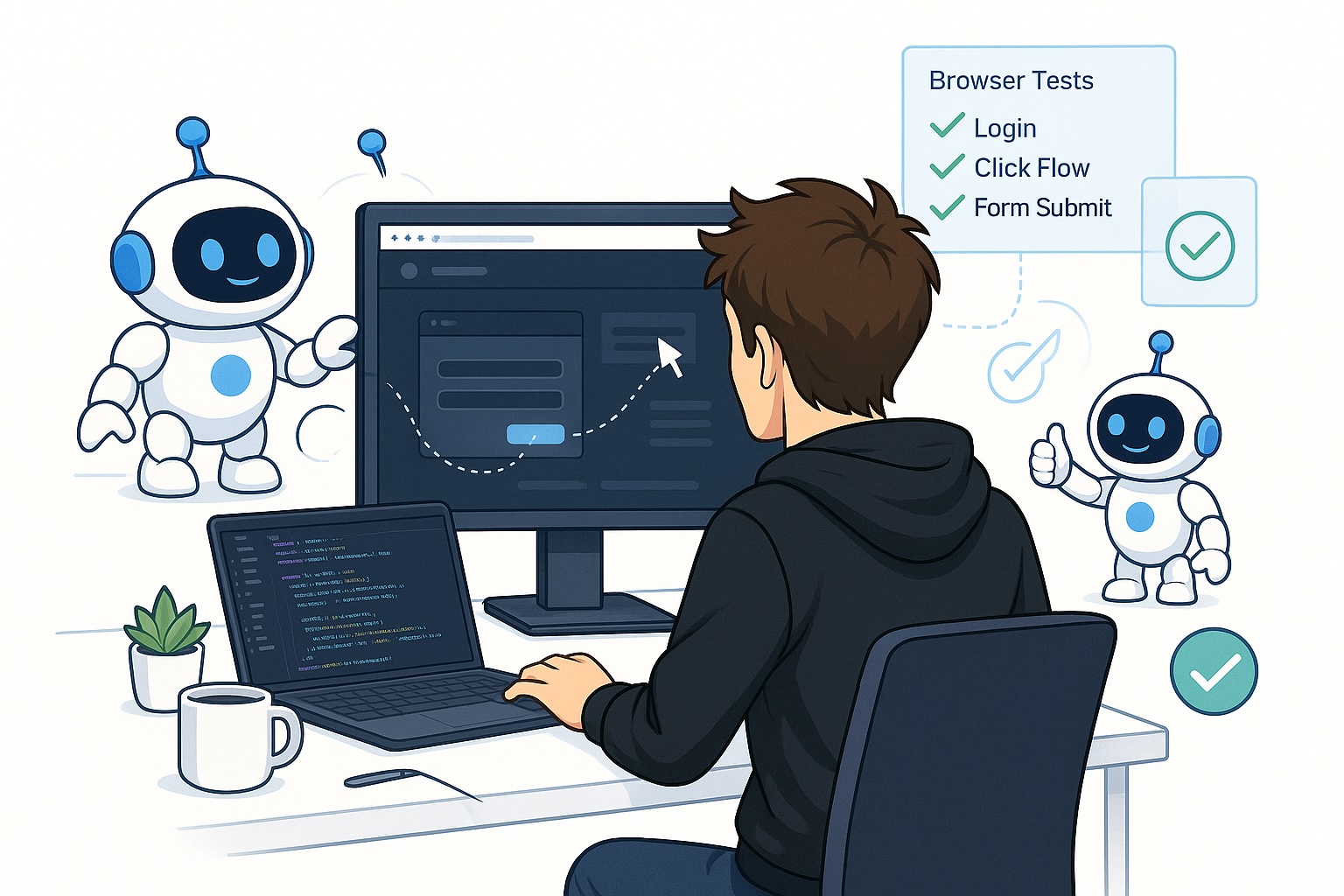
The Need for Robust Testing in AI Coding Agents
The rapid advancement of AI coding assistants, like Anthropic's Claude Code, promises to transform software development. These tools can generate code, refactor existing logic, and even draft entire functions. However, as these agents become more integrated into development workflows, ensuring their output is reliable, secure, and correct becomes paramount. Traditional software testing methodologies, while essential, often fall short when applied directly to the probabilistic and generative nature of AI models. This is where the introduction of specific end-to-end testing frameworks for AI code generation becomes critical. Claude Code's new capabilities aim to bridge this gap, providing developers with a more structured way to validate the AI's contributions.
End-to-end testing, in the context of AI coding agents, involves simulating real-world usage scenarios to verify that the generated code functions as intended within a larger system. It goes beyond simple unit tests that might check individual functions. Instead, it focuses on the entire flow, from the AI's interpretation of a prompt to the final execution of the code it produces. For developers relying on Claude Code, this means being able to trust that the code snippets or complete modules generated will integrate seamlessly and perform as expected, reducing debugging time and increasing confidence in the AI's assistance.
How Claude Code Facilitates End-to-End Testing
Anthropic has integrated features within Claude Code that allow developers to define and execute comprehensive test suites against AI-generated code. This isn't just about asking Claude to write tests; it's about providing a framework where Claude's output can be automatically subjected to rigorous testing protocols. The system allows for the definition of input parameters, expected outputs, and environmental conditions that the generated code must satisfy. This structured approach ensures that the AI's performance is evaluated not in isolation, but within the context of its intended application.
The core of this new capability lies in its ability to interpret complex prompts that include not only the request for code generation but also the specification of testing criteria. Developers can now prompt Claude Code with a problem description, a desired solution, and a set of test cases that the solution must pass. Claude Code then attempts to generate code that meets both the functional requirements and the testing benchmarks. The integrated testing environment can then execute these tests against the generated code, providing feedback on its correctness and adherence to specifications. This iterative process, guided by concrete test results, significantly enhances the quality and reliability of the AI's output.
Defining Test Scenarios and Assertions
To effectively leverage Claude Code's testing features, developers need to craft precise prompts that encapsulate the entire testing scenario. This typically involves several key components:
- Problem Statement: A clear description of the task the code should accomplish.
- Code Generation Request: Instructions for Claude Code on what kind of code to generate (e.g., a Python function, a JavaScript module).
- Test Cases: A set of inputs and their corresponding expected outputs. This is where the end-to-end aspect is most prominent, as these test cases should ideally cover various edge cases, typical usage scenarios, and error conditions.
- Assertion Logic: Rules or conditions that the generated code must satisfy. This can include performance metrics, adherence to specific coding standards, or successful integration with mock dependencies.
For instance, a developer might prompt Claude Code to generate a function for parsing CSV files. The prompt would include the desired function signature, the expected behavior for valid CSV inputs, how to handle malformed rows, and perhaps a performance benchmark for large files. Claude Code would then generate the Python code, and the integrated testing framework would execute the provided test cases, checking for correct parsing, error handling, and performance against the specified benchmarks. The surprising detail here is not just that Claude can generate code, but that it can now be directed to self-validate its output against predefined, complex test suites, making it a more robust development partner.
The Benefits for Developers and Teams
The introduction of end-to-end testing capabilities within Claude Code offers substantial benefits. Firstly, it dramatically reduces the time developers spend on manual testing and debugging of AI-generated code. By automating the verification process, teams can integrate AI assistance more confidently and at a faster pace. Secondly, it enhances the overall quality and reliability of software projects. When AI-generated components are rigorously tested, the likelihood of introducing bugs or security vulnerabilities is significantly lowered. This is akin to having an automated quality assurance engineer working alongside your development team, constantly verifying the integrity of the AI's contributions.
Furthermore, this feature democratizes advanced testing practices. Developers who might not have extensive experience in setting up complex testing frameworks can now benefit from AI-driven test generation and execution. This empowers individual developers and smaller teams to achieve a higher standard of code quality that was previously only accessible to well-resourced organizations. The ability to define comprehensive test scenarios directly within the prompt allows for a more intuitive and accessible approach to ensuring code correctness.
Challenges and Future Directions
While the new end-to-end testing capabilities in Claude Code represent a significant step forward, challenges remain. Crafting effective and comprehensive test cases requires skill and a deep understanding of potential failure modes. Poorly designed tests will not adequately validate the AI's output, potentially leading to a false sense of security. Developers must invest time in learning how to prompt Claude Code effectively for both code generation and test definition. What nobody has addressed yet is how to automatically generate truly adversarial test cases that push the boundaries of AI code generation without explicit human input, ensuring that the AI's capabilities are tested against the most obscure and challenging scenarios.
Future developments will likely focus on enhancing the AI's ability to generate more sophisticated test cases autonomously, perhaps even learning from past testing failures. Integration with existing CI/CD pipelines will also be crucial, allowing for seamless incorporation of AI-generated code testing into the broader development lifecycle. The ultimate goal is to create a symbiotic relationship where AI assists in writing code and also helps ensure that code is robust, secure, and performant, making the development process more efficient and less error-prone.