The Allure of Structure in Retrieval
The current standard for Retrieval-Augmented Generation (RAG) pipelines involves a critical preprocessing step: chunking. Documents are broken down into fixed-size segments, converted into vector embeddings, and then searched using similarity metrics. While effective for many use cases, this approach has a well-documented drawback. Developers have repeatedly encountered scenarios where a RAG system, despite finding text semantically close to a query, returns fragments that are structurally meaningless when isolated from their original context. Imagine a dense technical specification; a RAG system might pull three sentences from the middle of a critical section, each individually relevant, but together they fail to convey the necessary context or nuance without their surrounding paragraphs, headings, and logical flow.
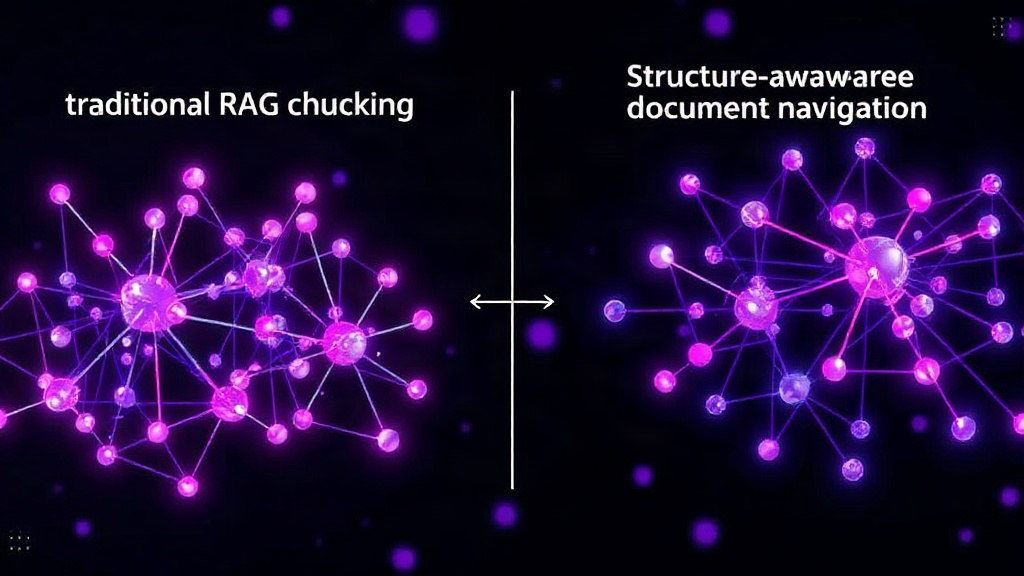
This limitation has spurred innovation, leading to concepts like IBM's 'Chunkless RAG'. The core idea is to move beyond fixed-size text splits and instead leverage the inherent structure within documents. Tools such as Docling are designed to parse documents like PDFs, not just into raw text, but into structured representations that preserve elements like headings, tables, lists, and section hierarchies. In this model, an AI agent navigates this structured document graph, akin to how a human reader would, seeking relevant information by understanding its place within the larger document. The pitch is that by preserving and utilizing this structural information, RAG systems can overcome the limitations of arbitrary text chunking, delivering more contextually rich and accurate retrieval results.
Questioning the Core Premise
While the promise of 'Chunkless RAG' is undoubtedly appealing, a closer examination suggests that the central claim—that document structure is the primary problem RAG chunking destroys—may be significantly oversold. The real bottleneck in many RAG applications isn't the loss of document hierarchy, but rather the inherent limitations of vector similarity search itself when dealing with complex, nuanced, or highly specific queries.
Consider the nature of information retrieval. Traditional RAG relies on finding vector embeddings that are close in semantic space. This works well when queries map directly to distinct concepts or facts that are well-represented in the embeddings. However, many real-world queries are not simple fact-finding missions. They might involve:
- Complex Reasoning: Queries that require synthesizing information from multiple disparate sections, drawing inferences, or understanding cause-and-effect relationships.
- Ambiguity and Nuance: Queries where the meaning depends heavily on subtle contextual cues, domain-specific jargon, or implicit assumptions that are not easily captured by embeddings alone.
- Procedural Instructions: Queries asking for step-by-step guidance, where the order and specific actions are critical, and isolated sentences are insufficient.
- Comparative Analysis: Queries that ask for comparisons between different entities, products, or concepts, which might be scattered across a document or multiple documents.
In these scenarios, even if a RAG system could perfectly navigate the document's structure, it would still struggle if the underlying retrieval mechanism cannot grasp the complex semantic relationships or the logical flow required to answer the query. Preserving headings and table structures is valuable, but it doesn't inherently equip the system with the ability to perform multi-hop reasoning or understand implicit conditional logic. The problem isn't just that the text fragments are isolated; it's that the system may not understand the *relationship* between the fragments or the *implications* of their placement, even if that placement is structurally known.
Where Structure Alone Falls Short
The 'Chunkless RAG' approach, by focusing on document structure, offers a more sophisticated way to retrieve relevant text segments. However, it doesn't fundamentally alter the core retrieval mechanism. If the query is about a subtle legal distinction, a complex financial calculation, or a nuanced ethical consideration, simply knowing that a piece of text is under a specific heading doesn't guarantee the retrieval system can identify or extract the precise information needed. The semantic gap between the query and the available information might persist, regardless of how well the document's architecture is preserved.
This is akin to giving a librarian a perfectly organized library catalog with detailed subject classifications and cross-references, but the librarian still only knows how to fetch books based on their title's similarity to the request, rather than understanding the content or the relationships between different ideas within the books. The structure helps in locating potential candidates, but the interpretation and synthesis of that information remain a challenge for the retrieval system itself.
Furthermore, not all documents lend themselves equally to structural parsing. While PDFs and structured documents like technical manuals might benefit, unstructured text, handwritten notes, or even complex HTML documents can be difficult to parse into a consistent, navigable hierarchy. The reliance on sophisticated parsing tools introduces its own set of complexities and potential failure points.
Rethinking the Problem: Beyond Chunking and Structure
The true challenge in RAG lies in bridging the semantic gap between user intent and information availability. This involves not just retrieving relevant text, but understanding context, performing reasoning, and synthesizing information. While structural awareness is a valuable enhancement, it is a piece of a larger puzzle.
Several avenues offer more direct solutions to the core retrieval problem:
- Advanced Embedding Models: Developing embedding models that capture more nuanced semantic relationships, including logical flow, causality, and implicit context. This might involve training on structured data or using novel architectures.
- Hybrid Retrieval Strategies: Combining semantic search with keyword search, graph-based retrieval (leveraging explicit knowledge graphs), or even rule-based systems for specific domains.
- Contextual Re-ranking and Synthesis: After initial retrieval, employing more sophisticated models to re-rank results based on deeper contextual understanding, and then using generative models to synthesize answers from multiple retrieved passages, explicitly addressing the need for coherence and completeness.
- Agentic Workflows: Empowering RAG agents to perform multi-step reasoning, ask clarifying questions, or even iteratively refine their search strategy based on initial results, mimicking human problem-solving.
The pursuit of 'Chunkless RAG' highlights a critical area of RAG development: improving retrieval accuracy and context. However, by focusing heavily on document structure as the primary solution, it risks overlooking the more fundamental challenges of semantic understanding and reasoning that plague current RAG systems. The problem isn't solely that we chop up documents; it's that our current retrieval and understanding mechanisms are often too blunt to grasp the full meaning, even when the structure is perfectly preserved. The future likely lies in a combination of better structural awareness, more powerful semantic understanding, and sophisticated reasoning capabilities, rather than a singular focus on eliminating text chunks.