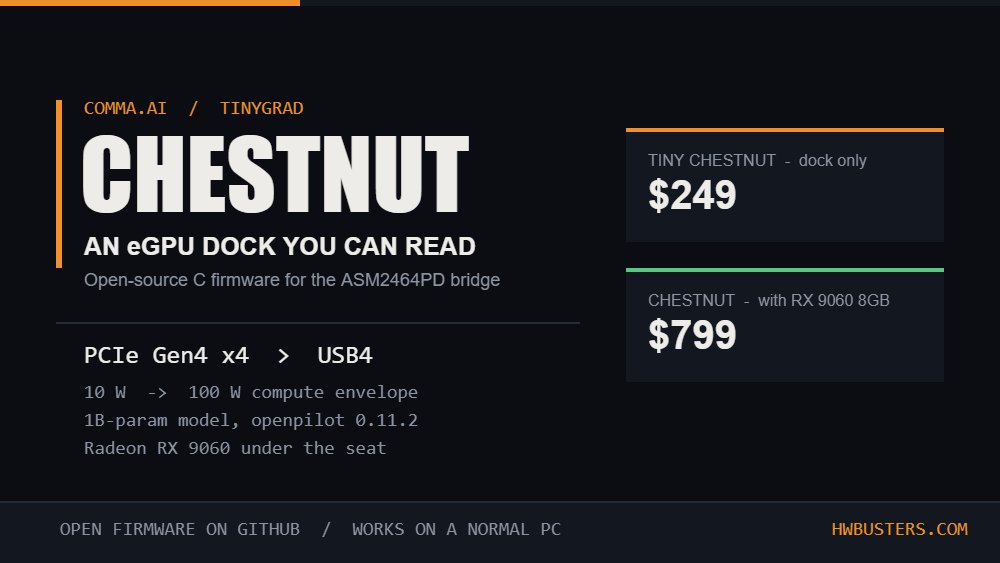
Chestnut: A New Contender in the eGPU Space
The external GPU (eGPU) market has seen its share of players, often focusing on high-performance gaming or professional workstation acceleration. However, a new entrant, codenamed Chestnut, is carving out a different niche by emphasizing transparency and user control through open-source firmware. This approach targets a segment of the market that values customization, repairability, and a deeper understanding of their hardware's inner workings, moving beyond the typical plug-and-play experience.
Chestnut's core innovation lies in its commitment to open-source firmware. This means the software that governs the dock's communication with the host system is publicly available, auditable, and modifiable. This contrasts sharply with most proprietary eGPU solutions, where the firmware is a black box, limiting user intervention and making repairs or modifications difficult. For developers, security professionals, and hardware enthusiasts, this open approach is a significant draw. It allows for deeper integration with custom workflows, the potential for performance tuning beyond manufacturer defaults, and the assurance that there are no hidden functionalities or data-gathering mechanisms within the firmware.
Hardware and Modularity
The Chestnut eGPU dock is designed with a modular philosophy. While specific configurations can vary, the base unit is available for $249, with a higher-end configuration including an RX 9060 GPU priced at $799. This pricing structure suggests a tiered approach, catering to users who may already possess a compatible GPU and wish to leverage the dock's open-source capabilities, or those who want a complete, ready-to-go solution.
The availability of a barebones unit is a critical aspect of its appeal. It allows users to source their own GPUs, potentially from the second-hand market or by upgrading from an existing system. This not only offers cost savings but also provides flexibility in choosing a GPU that precisely matches performance needs and budget. The open-source firmware then ensures that even with a self-sourced GPU, the user has a high degree of control over how the eGPU interacts with their computer. The enclosure itself is designed to accommodate a standard PCIe graphics card, providing a standardized interface for a wide range of GPUs. Power delivery is handled by an integrated power supply unit (PSU), which is typically sized to support high-end graphics cards, further simplifying the setup process.
The Significance of Open-Source Firmware
In the realm of hardware, firmware is the low-level software that controls a device's basic functions. For an eGPU, firmware is crucial for managing the Thunderbolt or USB4 connection, translating host commands to the GPU, and handling power states. Proprietary firmware can be a barrier to innovation and user empowerment. It often leads to vendor lock-in, where a user is tied to a specific manufacturer's ecosystem and software updates. Furthermore, closed-source firmware can hide potential security vulnerabilities or performance limitations that users have no way of identifying or rectifying.
Chestnut's open-source firmware, likely built upon existing open-source projects or developed in-house with a commitment to transparency, offers several advantages. Firstly, it fosters a community of developers who can contribute to its improvement, identify bugs, and add new features. This collaborative model can lead to more robust and feature-rich firmware over time than a single company might be able to produce. Secondly, it provides a level of security assurance. With the source code available, security researchers can audit it for vulnerabilities, and users can be confident that the firmware is not engaging in any untoward activities. Think of it less like a locked-down appliance and more like an open-source operating system for your eGPU, where you can see and understand every line of code.
The implications for developers are particularly interesting. They can potentially write custom drivers or middleware that interact directly with the eGPU's firmware, enabling novel applications or optimizing performance for specific computational tasks. This could range from custom machine learning inference pipelines to specialized rendering engines. The ability to probe and modify the firmware opens doors for advanced hardware-level debugging and performance analysis, tools that are often inaccessible with standard consumer eGPU solutions.
Market Positioning and Future Potential
Chestnut enters a market dominated by established players like Razer, Akitio, and Sonnet. These companies typically offer polished, integrated solutions aimed primarily at gamers and creative professionals. Chestnut's differentiator is its appeal to a more technically inclined audience. The focus on open-source firmware positions it not just as a hardware product, but as a platform for innovation and customization. This strategy mirrors the broader trend in the tech industry where open-source software and hardware are gaining traction due to their flexibility, transparency, and community-driven development.
The success of Chestnut will likely depend on its ability to build a strong community around its open-source firmware. Providing clear documentation, active support channels, and a roadmap for future development will be crucial. If Chestnut can foster a vibrant ecosystem of developers and users contributing to and benefiting from its open approach, it could establish a significant foothold in the eGPU market, attracting users who prioritize control and transparency over a purely consumer-oriented experience. The company behind Chestnut, HWBusters, has a history of engaging with the hardware community, which bodes well for this open-source strategy.
What remains to be seen is how readily mainstream operating systems and applications will support an eGPU solution with a less conventional firmware approach. While Thunderbolt and USB4 standards provide a robust foundation, the specific nuances of custom firmware can sometimes lead to compatibility challenges. However, the growing interest in modular, repairable, and open hardware suggests a receptive audience for Chestnut's vision.