
The True Cost of AI: Beyond the Sticker Price
Developers often face a crucial decision when selecting AI models for their applications: balancing cost against performance. While some models boast lower per-token or per-inference prices, a recent experiment highlights a critical factor often overlooked in these calculations: the cost of retries due to model failures or suboptimal outputs. This suggests that the cheapest model on paper might not be the most economical in practice, especially for tasks requiring high accuracy and reliability.
A developer conducted a direct comparison between two AI models, GPT-5.6 Luna and DeepSeek V4 Flash, for a specific task: generating a playable browser-based camouflage game from a single prompt. Both models were accessed via the AIHubMix API gateway, ensuring a consistent delivery mechanism.
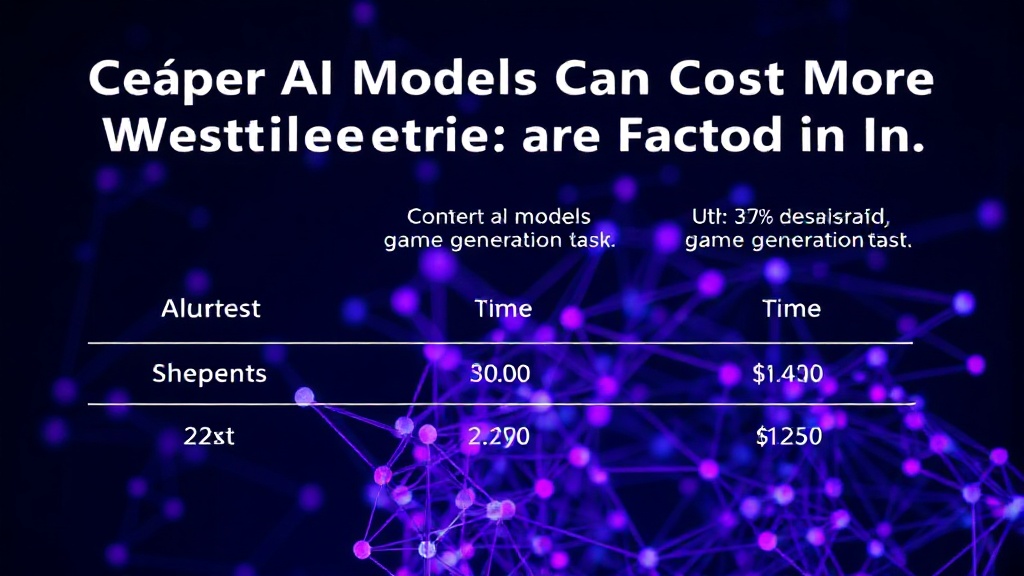
The results were telling. GPT-5.6 Luna, despite its higher upfront cost, completed the task flawlessly on its first attempt, incurring a cost of $0.10 and taking 691 seconds. In contrast, DeepSeek V4 Flash, priced significantly lower at $0.02, required three attempts to achieve a successful output. While the initial cost was dramatically lower, the cumulative time and computational resources spent on the two failed attempts, plus the successful one, are not explicitly detailed in the initial findings but are implied to be substantial.
Understanding the Cost Dynamics
The experiment underscores a fundamental economic principle in AI development: total cost of ownership is not solely determined by per-unit pricing. For generative AI, particularly in tasks like code generation or complex content creation, the probability of a successful, high-quality output on the first try is a significant variable. When a model fails, it doesn't just mean a wasted API call. It often entails:
- Developer Time: Analyzing the failure, debugging, modifying the prompt, and re-submitting the request consumes valuable developer hours. This human cost can quickly dwarf the savings from a cheaper model.
- Computational Resources: Each failed attempt still consumes processing power and API bandwidth, contributing to overall infrastructure costs.
- Delayed Time-to-Market: Frequent retries can significantly slow down development cycles, impacting product launch timelines and competitive positioning.
- User Experience (if applicable): If the AI is directly serving end-users, failed or suboptimal outputs can lead to frustration and a poor user experience, potentially driving users away.
In the case of the camouflage game generation, DeepSeek V4 Flash's lower base price of $0.02 was offset by the need for two additional runs. If each run incurs a similar processing time and the prompt engineering required to eventually succeed is non-trivial, the total operational cost and time investment for DeepSeek V4 Flash could easily surpass that of GPT-5.6 Luna. The 38-second difference in completion time between the flawless GPT-5.6 Luna run and the *successful* DeepSeek V4 Flash run (729s vs 691s) is also noteworthy, suggesting that even when successful, the cheaper model might be less efficient.
Implications for Developers and Businesses
This experiment offers a crucial lesson for anyone building with AI. When evaluating models, developers should look beyond the advertised price per million tokens or per inference. Instead, they should consider:
- Accuracy and Reliability Benchmarks: How often does the model produce a correct or useful output on the first try for tasks similar to yours?
- Error Rates and Failure Modes: What types of errors does the model typically make, and how difficult are they to rectify?
- Prompt Engineering Overhead: Does the model require extensive prompt tuning to achieve desired results, or is it more forgiving?
- Total Cost of Ownership (TCO): This includes API costs, developer time, infrastructure, and potential user impact.
For founders and product managers, this translates directly into budget forecasting and resource allocation. Investing in a slightly more expensive model that offers higher first-pass success rates can lead to significant long-term savings and faster development cycles. It shifts the focus from a simple cost-per-API-call metric to a more holistic view of AI integration efficiency.
The Unanswered Question of Scalability
What remains to be seen is how these cost dynamics evolve as the complexity and scale of the tasks increase. While this experiment involved a single, albeit complex, generation task, many AI applications involve processing vast datasets or handling dynamic, real-time requests. Will models that are cheaper upfront maintain their cost advantage when dealing with millions of inferences, or will their inherent failure rates compound into unmanageable expenses? The answer will likely depend on the specific architecture of the models and the types of tasks they are optimized for. Developers must be prepared to conduct their own rigorous testing to determine the true cost-effectiveness for their unique use cases.