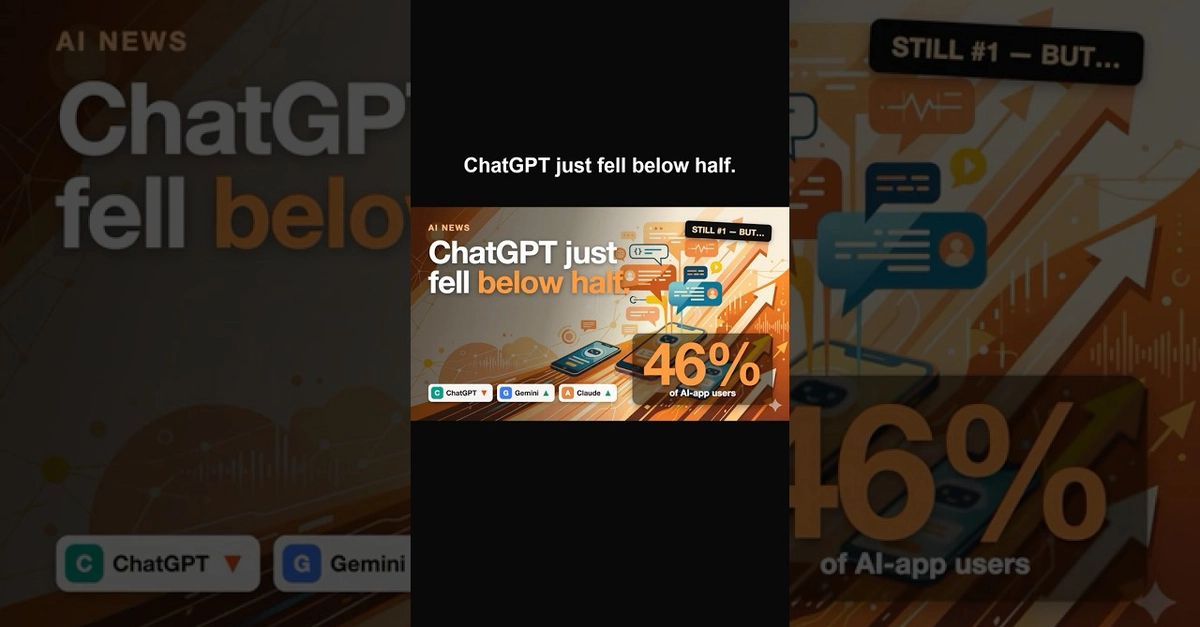
For the first time, ChatGPT's share of AI application users has fallen below the 50% mark, now standing at approximately 46%, according to data from Sensor Tower. This represents a significant shift in user behavior, moving away from a singular reliance on one AI tool. Gemini follows with around 28% of users, and Claude is at approximately 10%.
It is crucial to note that this decline in app user share does not signify an overall drop in ChatGPT's dominance. By web traffic, ChatGPT continues to lead significantly, boasting over 1.1 billion monthly users and capturing about 54.7% of the market. The true change is the erosion of the 'single-app' habit. Users are increasingly adopting multiple AI tools, each chosen for its specific strengths and suitability for particular tasks.
This trend mirrors the evolving workflow of developers and content creators. The question is no longer "which AI is the best?" but rather "which AI is best for this specific task?" This pragmatic approach to AI tool selection has led to a more distributed usage pattern across different platforms.
Task-Specific AI Allocation
For professionals building across full-stack and mobile development, this shift has already been reflected in their daily workflows. The author, a side-project builder, has adopted a strategy of allocating specific tasks to different AI models based on their proven efficacy. This strategy aims to maximize efficiency and leverage the unique capabilities of each AI.
Claude for Code Refinement and Analysis
Claude has become the go-to AI for complex coding tasks. This includes refactoring existing codebases, understanding unfamiliar repositories, and working with long files that can challenge the context windows of other models. Claude also demonstrates a high paid conversion rate, around 13%, suggesting that users who rely on it for daily professional tasks are more inclined to subscribe.
Gemini for Google Ecosystem Integration
Gemini excels in tasks deeply integrated with the Google ecosystem. This includes drafting emails, performing web searches, and any activity that can be seamlessly managed within Google's suite of tools. Its ability to leverage existing browser context and Google services makes it a natural fit for users already immersed in that environment.
ChatGPT for General Purpose Tasks and Creative Generation
While no longer the sole AI tool, ChatGPT remains a powerful generalist. It is still the primary choice for a wide range of common queries, brainstorming sessions, and creative content generation where its vast training data and conversational fluency are most beneficial. Its broad capabilities ensure it remains a core part of a multi-AI toolkit.
The End of the Monolithic AI User
The data indicates a fundamental change: the era of users relying on a single AI for all their needs is drawing to a close. Instead, we are entering a phase where users curate a personal AI stack, much like they manage their software development tools or creative suites. This fragmentation is not a sign of weakness for any single AI but rather a maturation of the AI landscape itself.
As developers and creators, understanding these nuances is key to optimizing workflows. By strategically deploying Claude for deep code work, Gemini for Google-centric tasks, and ChatGPT for broader applications, users can harness the collective power of these AI models more effectively. This multi-AI approach promises greater productivity and more tailored outcomes than a single-tool strategy ever could.
The surprising element here is not the user shift itself, but the speed at which it has occurred. Many anticipated a longer transition period. What remains to be seen is how the AI providers will adapt their strategies to cater to this increasingly specialized user base.