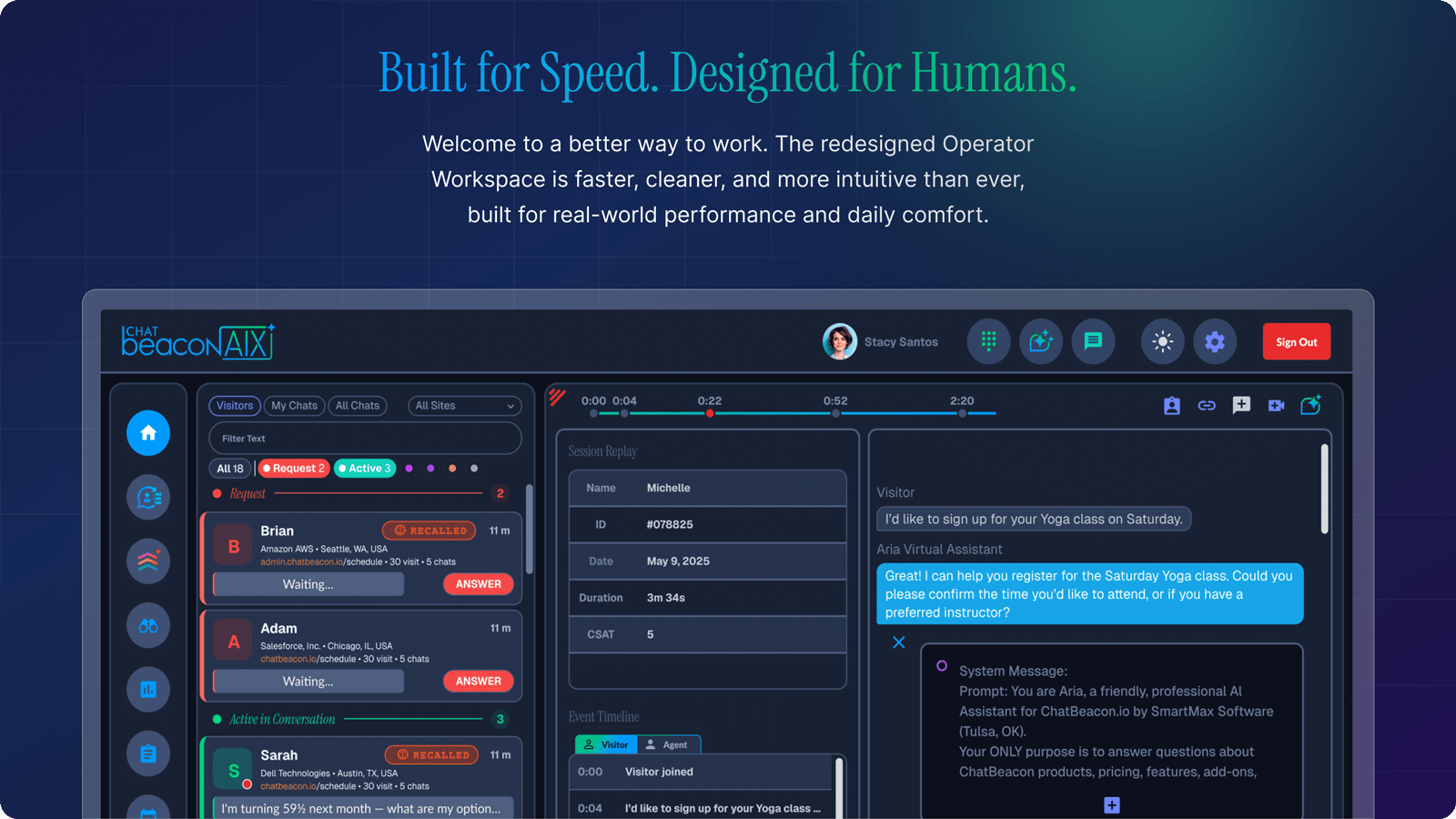
ChatBeacon AIX: Automating Customer Support with Advanced AI
ChatBeacon AIX enters the crowded customer support market with a bold claim: an 87% automated chat resolution rate. This figure, if accurate, positions the platform as a significant disruptor, promising to drastically reduce the burden on human support agents and improve response times for customers. The platform leverages advanced artificial intelligence to understand and respond to customer queries, aiming to handle the majority of common issues without human intervention.
The core of ChatBeacon AIX's offering is its sophisticated AI engine, designed to parse natural language, identify user intent, and retrieve relevant information from a knowledge base or integrated systems. This allows it to provide instant, accurate answers to frequently asked questions, troubleshoot common problems, and even guide users through processes. For businesses, this translates to potential cost savings through reduced staffing needs, 24/7 availability, and the ability for human agents to focus on more complex, high-value interactions that require empathy and nuanced problem-solving.
How ChatBeacon AIX Achieves High Resolution Rates
The reported 87% resolution rate is not merely a statistical anomaly; it stems from a deliberate design philosophy focused on comprehensive AI capabilities. ChatBeacon AIX integrates several key features to achieve this level of automation:
- Natural Language Understanding (NLU): The AI is trained to understand conversational language, including slang, typos, and complex sentence structures. This allows it to accurately interpret customer requests, even when they are not phrased perfectly.
- Contextual Awareness: Unlike simpler chatbots, ChatBeacon AIX maintains context throughout a conversation. It remembers previous interactions within the same chat session, allowing for more fluid and relevant responses without requiring the customer to repeat themselves.
- Dynamic Knowledge Base Integration: The AI can access and query a company's existing knowledge base, FAQs, product documentation, and even internal databases. This ensures that the answers provided are up-to-date and specific to the business's offerings.
- Automated Triage and Escalation: For issues that the AI cannot resolve, it is programmed to intelligently triage and escalate the chat to the appropriate human agent. This process includes summarizing the conversation and providing the agent with all necessary context, minimizing handover friction.
- Proactive Engagement: Beyond reactive support, ChatBeacon AIX can be configured to proactively engage website visitors based on their behavior, offering assistance before a problem even arises. This could include offering help on a complex product page or reminding a user about items left in their cart.

The Impact on Customer Support Operations
The implications of an 87% automated resolution rate are profound for businesses. Firstly, it promises a significant reduction in operational costs associated with customer service. Hiring, training, and maintaining a large team of support agents can be a substantial expense. By deflecting a large portion of inquiries to AI, companies can reallocate resources more efficiently. Secondly, customer satisfaction is likely to improve due to faster response times. Customers often face long wait times when trying to reach human agents, leading to frustration. An AI that can provide instant answers 24/7 addresses this pain point directly. This also frees up human agents to handle more complex, nuanced, or emotionally charged issues, where human empathy and critical thinking are indispensable. Such agents can then focus on building stronger customer relationships and resolving issues that truly require a human touch, potentially leading to higher agent job satisfaction.
However, the success of ChatBeacon AIX hinges on the quality of its AI and the data it is trained on. A poorly implemented AI can lead to frustrating customer experiences, providing incorrect information or failing to understand user queries, which can be more damaging than no support at all. The ability to seamlessly hand over complex issues to human agents is also critical. If the AI fails to recognize when it's out of its depth, customers can become trapped in unhelpful automated loops. The 87% figure is a powerful benchmark, but its real-world effectiveness will depend on the specific industry, the complexity of the products or services offered, and the quality of the knowledge base provided to the AI.
What Lies Ahead for AI in Customer Support
ChatBeacon AIX's aggressive claim signals a broader trend in customer service: the increasing reliance on AI to handle a larger share of customer interactions. As AI technology continues to advance, we can expect even more sophisticated capabilities, such as personalized recommendations, predictive issue resolution, and AI-powered agent assistance tools that suggest responses and actions to human agents in real-time. The question for businesses is no longer whether to adopt AI in customer support, but how to implement it effectively to augment human capabilities rather than replace them entirely. Finding the right balance between automation and human interaction will be key to unlocking the full potential of AI in delivering exceptional customer experiences.
The success of platforms like ChatBeacon AIX will also drive innovation in areas such as sentiment analysis and emotional intelligence in AI, allowing for more empathetic automated responses. Furthermore, the data generated by these AI-powered interactions can provide invaluable insights into customer behavior, product issues, and service gaps, enabling businesses to make data-driven improvements across their operations. For developers and product managers, understanding how to integrate and fine-tune these AI systems will become an increasingly important skill set.