The Challenge of Voice Agent Stagnation
Voice agents, from smart assistants to specialized customer service bots, have become ubiquitous. Yet, their ability to truly learn and adapt after deployment has remained a significant hurdle. Most voice agents operate on static models, meaning their capabilities are fixed at the time of their last training. This leads to a frustrating user experience where agents fail to understand new nuances, slang, or evolving user needs. The technology, while advanced in initial recognition and response generation, often lacks a mechanism for ongoing, autonomous improvement. This stagnation means that even sophisticated voice agents can quickly become outdated, requiring costly and time-consuming retraining cycles to keep pace with user expectations and linguistic evolution.
Consider a customer service voice agent designed to handle common queries. If a new product is launched, or a policy changes, the agent is ill-equipped to address these updates until a human intervenes to retrain its underlying model. This reactive approach is inefficient and fails to leverage the constant stream of user interactions as a valuable data source for improvement. The current paradigm often treats voice agents as finished products rather than dynamic systems capable of continuous refinement. This is where Cekura seeks to disrupt the status quo.
Introducing Cekura: A Continuous Learning Framework
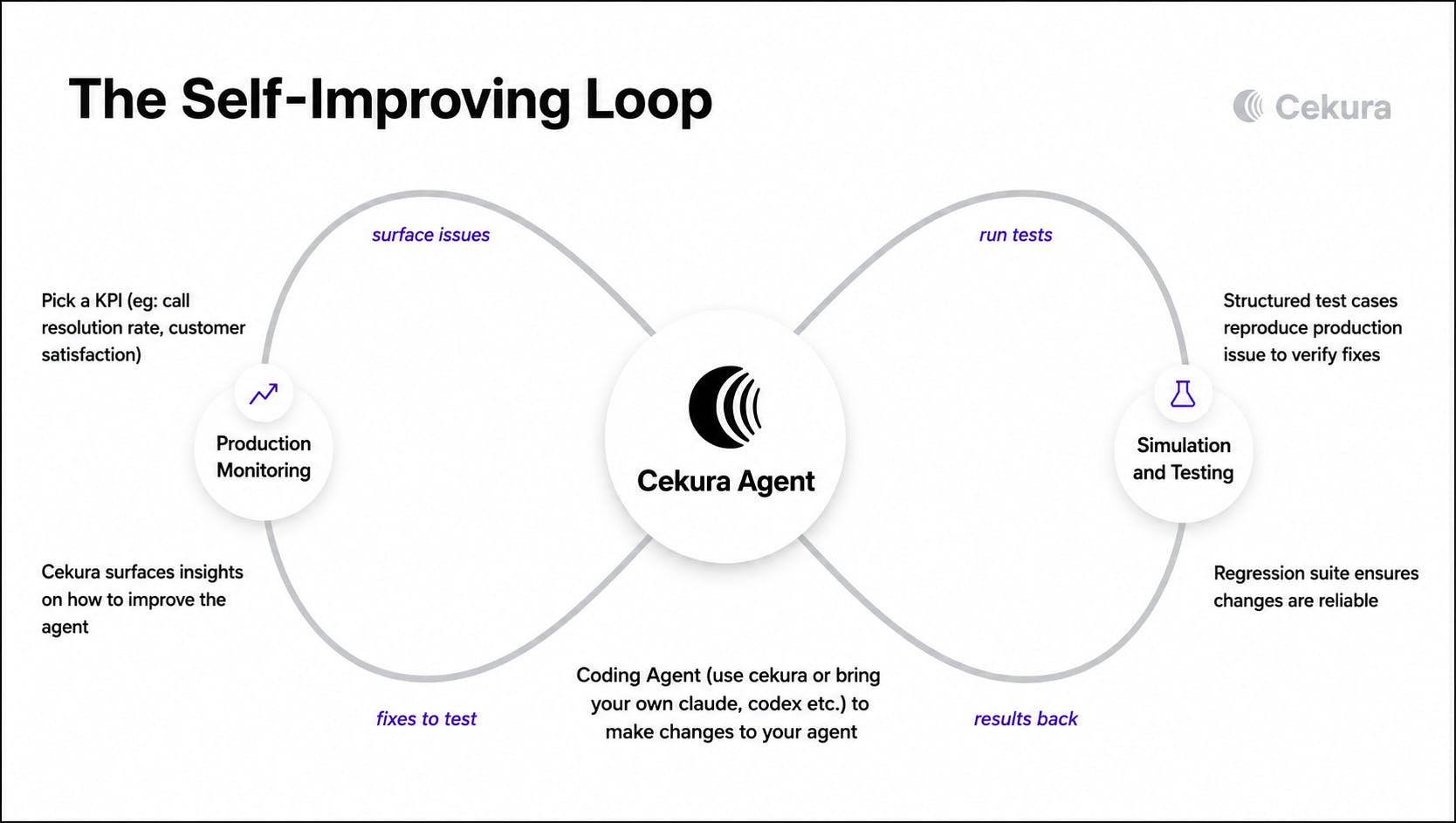
Cekura positions itself as a solution to this persistent problem, offering a framework for what it calls the "self-improvement loop for voice agents." The core idea is to enable voice agents to learn from every interaction, not just to fulfill the immediate request, but to refine their understanding and response capabilities for future engagements. This creates a dynamic system that evolves alongside user behavior and language, rather than falling behind.
The concept is analogous to how humans learn. We encounter new situations, process feedback (explicit or implicit), and adjust our behavior and understanding accordingly. Cekura aims to imbue voice agents with a similar capacity for adaptive learning. Instead of relying solely on periodic, large-scale retraining, Cekura introduces a mechanism for granular, ongoing updates driven by real-world usage data. This means that each conversation, each query, and each response can contribute to the agent's intelligence, making it smarter and more effective over time.
How the Self-Improvement Loop Works
While the specifics of Cekura's implementation are proprietary, the principle of a self-improvement loop for voice agents generally involves several key stages. First, the agent interacts with a user, processing their input and generating a response. Crucially, after the interaction, the system captures data points related to the success or failure of that interaction. This data can include explicit user feedback (e.g., a "thumbs up/down" rating, a follow-up clarification, or a request to speak to a human), as well as implicit signals (e.g., the user repeating themselves, abandoning the conversation, or expressing frustration). This interaction data is then processed and analyzed.
This analysis aims to identify areas where the agent's performance was suboptimal. Was the agent unable to understand a particular phrase? Did it provide an irrelevant or unhelpful answer? Was the tone inappropriate? The insights derived from this analysis are used to update the agent's underlying models. This could involve fine-tuning natural language understanding (NLU) components to better recognize specific intents or entities, adjusting dialogue management strategies, or refining natural language generation (NLG) to produce more accurate and contextually appropriate responses. This iterative process ensures that the agent doesn't just respond, but actively learns from its mistakes and successes, becoming progressively more capable with each cycle.
The sophistication of such a loop can vary. At its simplest, it might involve a human-in-the-loop process where curated interaction data is reviewed by developers who then manually update the models. More advanced implementations could involve semi-supervised or even unsupervised learning techniques, where the agent can identify patterns and make adjustments with minimal human oversight. The goal is to automate as much of this refinement process as possible, turning the voice agent into a truly adaptive entity.
Potential Applications and Implications
The implications of a robust self-improvement loop for voice agents are far-reaching. For developers, it means creating agents that require less ongoing manual intervention, freeing up resources for more complex tasks. For businesses, it translates to more efficient and effective customer service, personalized user experiences, and potentially reduced operational costs. Imagine a voice-controlled smart home device that learns your specific pronunciation quirks or a virtual assistant that anticipates your needs based on your past interactions, not just pre-programmed routines. This technology could also be invaluable in specialized domains like healthcare, where voice agents might need to understand complex medical terminology or adapt to a patient's unique communication style.
The continuous learning aspect of Cekura addresses a fundamental limitation in current AI deployments. It moves beyond static, deployed models towards living, evolving systems. This is particularly relevant in the rapidly changing landscape of language and user expectations. As users become more accustomed to sophisticated AI interactions, their demands for accuracy, naturalness, and context-awareness will only increase. Voice agents that can self-improve will be better positioned to meet these evolving demands, maintaining user satisfaction and relevance over the long term. This approach could redefine the lifecycle of voice-based AI, shifting from a model of periodic updates to one of continuous, organic growth.
Looking Ahead: The Future of Adaptive Voice AI
Cekura's proposition taps into a critical need within the AI and voice technology sectors. The ability for voice agents to move beyond their initial training and actively learn from real-world interactions is not just an incremental improvement; it's a paradigm shift. It promises to make voice agents more robust, more personalized, and ultimately, more useful. As AI continues to integrate into every facet of our lives, systems that can adapt and evolve will be the ones that truly succeed. Cekura's focus on the self-improvement loop for voice agents places it at the forefront of this evolution, hinting at a future where our digital assistants are not just tools, but intelligent companions that grow with us.