The Deceptive Simplicity of Database Migrations
Database migrations are a routine part of software development, often perceived as straightforward code changes. A migration might consist of a few lines of SQL, pass application tests, and appear ready for deployment. However, this apparent simplicity can mask significant risks that only manifest in production. A seemingly innocuous migration can, for instance, involve dropping a column, a change that might seem benign if the column is believed to be unused.
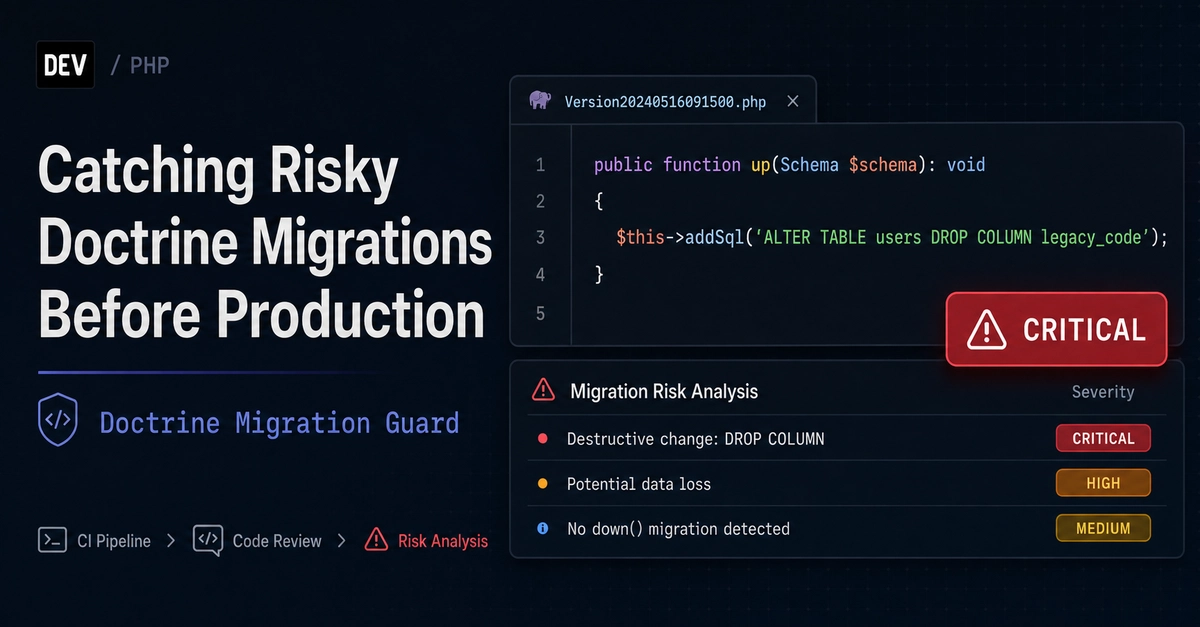
public function up(Schema $schema): void
{
    $this->addSql('ALTER TABLE users DROP COLUMN legacy_code');
}
The danger lies not in the syntax but in the potential for unexpected consequences. Developers might execute a migration that drops a column, assuming it's no longer in use. Yet, without a robust process for verifying column usage across the entire application codebase, this simple `ALTER TABLE ... DROP COLUMN` statement can lead to runtime errors, data loss, or application downtime once deployed to production.
The Hidden Dangers of Schema Changes
Consider the common scenario of refactoring or deprecating features. When a feature is retired, associated database columns or tables are often slated for removal. The migration to remove them is typically straightforward: an `ALTER TABLE ... DROP COLUMN` or `DROP TABLE` command. The application tests might pass because the specific code paths that interacted with that column have already been removed or are no longer executed in the test environment. However, this overlooks the possibility of indirect usage or forgotten code paths.
This is where the illusion of safety breaks down. The application tests might not cover every permutation of data access, or perhaps the column is referenced by a background job, a reporting script, or an administrative tool that wasn't updated in lockstep with the main application. The migration appears safe in isolation, but its impact is broader than the immediate code review suggests. The migration itself is a form of code, and like any code, it can have bugs and unintended side effects.
Strategies for Safer Migrations
To mitigate these risks, a multi-layered approach is essential. The first line of defense is to enhance the migration process itself. Instead of simply executing `ALTER TABLE ... DROP COLUMN`, developers should employ strategies that allow for a grace period and verification. One effective technique is to rename the column first, for example, to `legacy_code_to_be_removed`. This provides a clear signal that the column is deprecated and allows the application to continue functioning if it still references the old name, albeit with a warning.
After renaming, the application can be deployed and monitored. During this period, developers can actively search the codebase for any remaining references to the old column name. This search should be comprehensive, covering all parts of the application, including background workers, scheduled tasks, and any external integrations. Once confident that no part of the system is still using the deprecated column, a subsequent migration can be created to actually drop the column. This two-step process significantly reduces the risk of a runtime error caused by an unexpected dependency.
Leveraging Application Code for Verification
The core problem is the disconnect between schema changes and application code. A migration's safety is often judged by its SQL or ORM syntax, not its real-world impact on running code. To bridge this gap, developers can create helper scripts or tools that scan the application's codebase for references to specific table columns or other schema elements. Before a `DROP COLUMN` migration is committed, these tools can be run to identify any code that might still reference the column being dropped.
This approach turns the application code itself into a validator for schema changes. For instance, a script could search for patterns like `->column_name` or `['column_name']` within the application's source files. The output of this script should be reviewed rigorously. If any references are found, the migration cannot proceed until the code is updated and the references are removed. This proactive verification step is critical for preventing production incidents.
The Role of ORMs and Frameworks
Modern Object-Relational Mappers (ORMs) like Doctrine in PHP, Eloquent in Laravel, or SQLAlchemy in Python offer abstractions that can both simplify and complicate migrations. While they automate much of the SQL generation, they can also obscure the underlying database operations. A migration generated by an ORM might look cleaner, but it's crucial to understand what SQL it translates to and to apply the same verification principles.
For example, Doctrine's migration system allows developers to write custom SQL or use its schema tool. When dropping a column, the ORM might generate a `DROP COLUMN` statement. The same two-step process of renaming followed by dropping is applicable here. Developers should not blindly trust the ORM's generated code without verifying its safety. The ORM is a tool, not a guarantee against logical errors in schema evolution.
Beyond Simple Deletions: Risky Additions and Modifications
While dropping columns is a common source of risk, other schema modifications can also be problematic. Adding a new column that is required by default (e.g., `NOT NULL` without a default value) can cause issues if not all application instances are updated simultaneously. If the application expects the column to exist but the database hasn't yet been updated with the default value, it can lead to errors. A safer pattern for adding required columns is to first add the column allowing `NULL` values, deploy the application update that handles the new column, and then run a subsequent migration to set a default value and enforce `NOT NULL` constraints.
Similarly, altering column types or constraints can introduce subtle bugs. For instance, changing a `VARCHAR` column to an `INT` might fail if existing data cannot be cast to an integer. These operations require careful planning, data validation, and often a phased rollout. The principle remains the same: decouple the schema change from the application code that relies on it, and verify usage before making irreversible modifications.
The Unanswered Question: Comprehensive Usage Analysis
What nobody has fully addressed yet is how to achieve truly comprehensive, automated analysis of column usage across large, polyglot codebases. Static analysis tools are good, but they often miss dynamic references, reflection, or usage within dynamically generated queries or external scripts. Relying solely on code scanning might not be enough. The ideal solution would involve a system that can provide a definitive answer to: "Is this database element, at this exact moment, being used by any part of our running system or scheduled processes?" Until such a tool is widely available and reliable, a combination of careful manual review, staged rollouts, and tooling that approximates this analysis remains the best defense.
Ultimately, treating database migrations as just another piece of code, subject to the same rigorous review and testing processes, is paramount. The two-step rename-and-drop strategy, combined with thorough code scanning and a deep understanding of the application's architecture, forms a robust defense against the silent threats lurking in seemingly harmless schema changes.