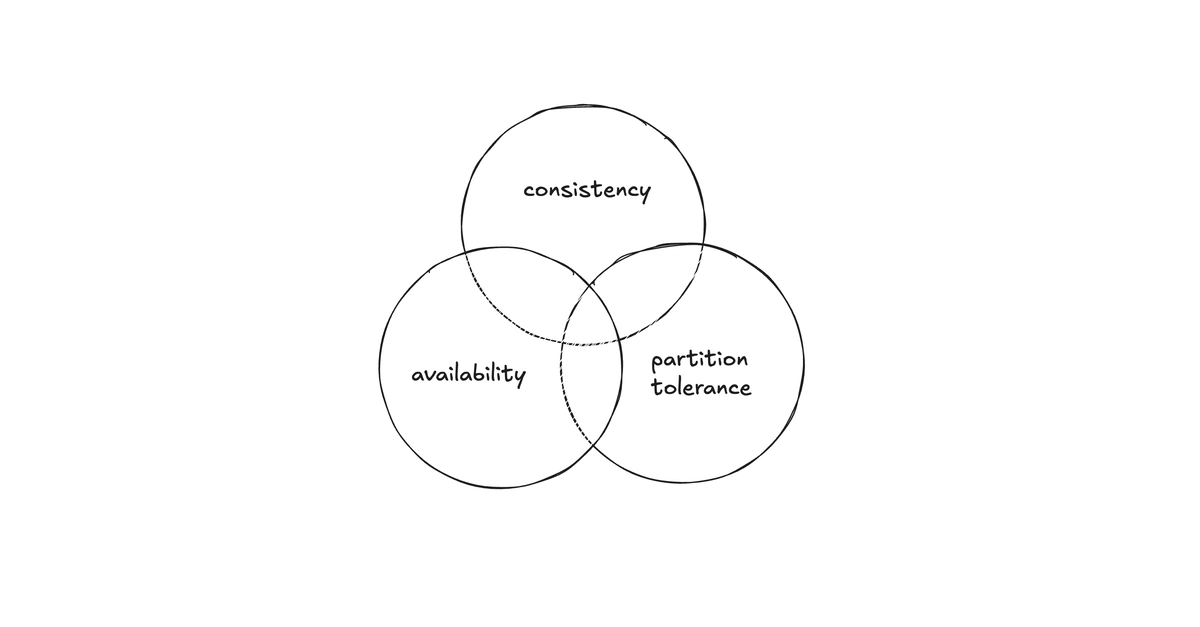
The Nuance of CAP Theorem
The CAP theorem, first introduced by Eric Brewer in 2000, is a cornerstone of distributed systems design. It states that a distributed system can only simultaneously guarantee two out of three desirable properties: Consistency, Availability, and Partition Tolerance. While the popular explanation is that you must choose two, the reality is more complex and hinges on the nature of network partitions.
The theorem is often presented as a simple choice: pick CA, CP, or AP. However, this framing can be misleading. In practice, network partitions (P) are an unavoidable reality in any distributed system that spans multiple network nodes or data centers. Therefore, the real trade-off is not between C, A, and P, but rather between Consistency and Availability when a network partition occurs.
Let's break down each component:
Consistency (C)
Consistency, in this context, means that every read receives the most recent write or an error. If you write a value to a distributed system and then immediately read it back from any node, you are guaranteed to get the value you just wrote. All nodes in the system see the same data at the same time. This is a strong guarantee, often associated with traditional relational databases.
Availability (A)
Availability means that every request receives a non-error response, without the guarantee that it contains the most recent write. Even if some nodes in the system are down or unreachable, the remaining nodes will continue to respond to requests. This is crucial for applications where downtime is unacceptable, even if it means serving slightly stale data.
Partition Tolerance (P)
Partition Tolerance means that the system continues to operate despite arbitrary network failures that cause some nodes to be unable to communicate with others. A network partition is essentially a split in the network, where groups of nodes can talk to each other within their group but not to nodes in other groups. Given that distributed systems are inherently prone to network issues (routers fail, cables break, data centers go offline), partition tolerance is not really a choice; it's a necessity for any real-world distributed system.
The Real Trade-off: Consistency vs. Availability During Partitions
Because network partitions are inevitable, the CAP theorem forces a choice between consistency and availability when a partition happens.
Consider a distributed database with two nodes, Node 1 and Node 2, holding the same data. A network partition occurs, isolating Node 1 from Node 2.
- If the system prioritizes Consistency (CP): When a client tries to write to Node 1, and Node 1 cannot confirm the write with Node 2 (due to the partition), the system will return an error. Similarly, if a client tries to read from Node 1, and Node 1 cannot guarantee it's getting the latest data from Node 2, it will also return an error or refuse the request. The system becomes unavailable to prevent serving potentially inconsistent data.
- If the system prioritizes Availability (AP): When a client tries to write to Node 1, Node 1 accepts the write and responds successfully, even though Node 2 is unreachable. Later, when the partition heals, the system must reconcile the conflicting data. Similarly, if a client reads from Node 1, it gets the data that Node 1 has, even if Node 2 has more recent updates. The system remains available, but the data might be stale or conflicting until reconciliation occurs.
The third option, CA (Consistency and Availability), implies a system that is not partition tolerant. This is only feasible for single-node systems or tightly coupled clusters within a single, highly reliable network segment, which is rare for truly distributed systems operating across different physical locations or networks.
Real-World Analogies
To grasp this, imagine a popular restaurant chain, 'Global Pizza', with two branches, North and South, sharing a single inventory system. The inventory is updated in real-time.
Scenario 1: No Network Partition (Normal Operation)
Both branches can communicate. If the North branch sells the last pizza, the inventory is updated instantly. When the South branch checks inventory, it sees zero pizzas. This is both consistent and available.
Scenario 2: Network Partition - Prioritizing Consistency (CP)
A storm cuts off communication between the North and South branches. The North branch sells the last pizza. Because it cannot confirm this update with the South branch's inventory system, it rejects the order, stating 'out of stock'. The South branch, also unable to communicate, also rejects orders if its local inventory count is low. The system is consistent (both branches agree on the limited stock, or lack thereof), but it is unavailable for new orders to prevent selling non-existent pizzas.
Scenario 3: Network Partition - Prioritizing Availability (AP)
Again, communication is cut. The North branch sells the last pizza. It accepts the order and updates its local inventory. It remains available to take orders. The South branch does the same. When the storm passes and communication is restored, the system discovers a problem: both branches sold pizzas that no longer existed. The system now needs a reconciliation process. Perhaps one branch's sale is voided, or an apology is issued. The system remained available, but at the cost of potential data inconsistency during the outage.
The surprising detail here is that the 'P' in CAP is not a choice to be made, but a condition that is assumed to exist in any practical distributed system. The real choice is always between 'C' and 'A' when 'P' strikes.
Implications for System Design
Understanding the CAP theorem's nuances is critical for developers and architects. Most modern distributed databases and systems are designed with partition tolerance as a given. The design choices then revolve around how to handle failures:
- Strongly Consistent Systems (CP): Databases like traditional RDBMS, Zookeeper, or etcd typically lean towards CP. They prioritize data integrity and consistency, even if it means sacrificing availability during network partitions. These are suitable for financial transactions, configuration management, or leader election where data accuracy is paramount.
- Highly Available Systems (AP): Systems like Amazon DynamoDB, Cassandra, or many NoSQL databases often favor AP. They are designed to remain operational and responsive, even at the risk of serving slightly stale data or requiring conflict resolution later. These are ideal for use cases like user profiles, shopping carts, or real-time analytics where occasional data staleness is acceptable.
The choice between CP and AP depends entirely on the specific requirements of the application. If your application can tolerate occasional inconsistencies for the sake of continuous operation, AP might be suitable. If absolute data consistency is non-negotiable, even if it means temporary unavailability, CP is the path.
What nobody has fully addressed yet is the complexity of reconciliation in AP systems. While the theorem states AP, the practical implementation of resolving conflicting writes after a partition can be a significant engineering challenge, often requiring custom business logic.