
The Illusion of Cache Success
A cache hit rate of 99% sounds like a dream. For many development teams, it signifies efficient data retrieval, minimal latency, and a healthy system. Yet, a recent load test revealed a stark reality: even with near-perfect cache performance, a database can still buckle under pressure. The culprit? A phenomenon known as a cache stampede, where a single cache miss triggers a cascade of identical, concurrent database queries, overwhelming the backend. This isn't a theoretical edge case; it's a practical pitfall that standard caching implementations often fail to address.
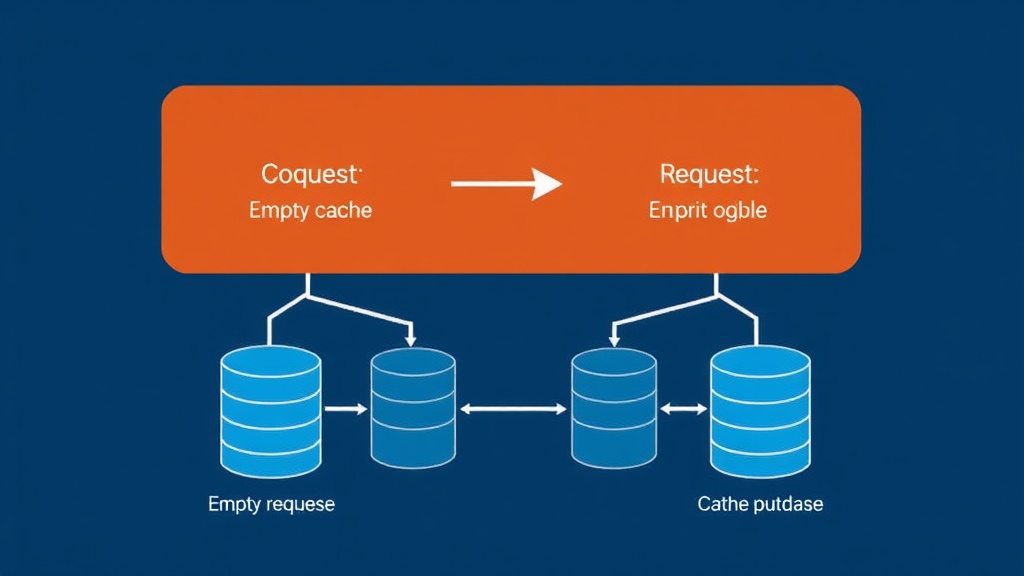
The scenario is deceptively simple. Imagine a popular piece of data that expires from the cache. Before the cache can be repopulated, dozens, even hundreds, of concurrent requests arrive, all seeking the same expired data. Each request independently checks the cache, finds it empty, and then proceeds to query the database. The result is a sudden, massive spike in database load, with identical queries hitting the database simultaneously. While the cache itself might be performing admirably, the downstream system—the database—bears the brunt of this synchronized onslaught.
This issue was starkly illustrated during a recent load test. The monitoring dashboard proudly displayed a 99% cache hit rate. However, beneath this seemingly robust metric, the database logs showed a terrifying burst of identical queries. Within a few hundred milliseconds, the same key was requested fifty times, each triggering a separate database call. This wasn't a gradual degradation; it was an instantaneous overload, proving that a high cache hit rate is not a panacea for database stability.
Understanding Cache Stampede
The standard implementation of in-memory caching, often seen in applications using patterns like the one found in .NET's IMemoryCache, typically involves a simple check-and-populate logic. When data is requested, the code first checks if it exists in the cache. If it does, the cached data is returned. If not, the code proceeds to fetch the data from the primary data source (e.g., a database), populates the cache with the retrieved data, and then returns it. This pattern works perfectly under normal conditions.
However, when multiple requests for the same cache entry arrive simultaneously after an expiration or a cache invalidation event, the problem emerges. Each request finds the cache entry missing. Consequently, each request initiates its own database query. This creates a flood of identical requests to the database, a phenomenon aptly named a cache stampede. The database, designed to handle a certain throughput, can quickly become a bottleneck, leading to increased latency, timeouts, and potentially a complete service outage. The irony is that the very mechanism designed to protect the database is, in this specific edge case, causing its failure.
A Practical Demonstration
To demonstrate this behavior, a small demo application was built. This application features a minimal API with two endpoints and a simulated database. The fake database is designed to mimic the latency of a real-world query, taking approximately 200 milliseconds to respond. To capture the cache stampede in action, the application starts on a random port and then fires 50 concurrent requests at each endpoint, all with a cold cache. This setup ensures that the cache miss is guaranteed and the subsequent race condition is observable.
The core of the issue lies in the race condition that occurs when multiple threads concurrently attempt to access a non-existent cache entry. Without proper synchronization, each thread independently decides to fetch the data. The demonstration uses .NET 10.0, but the underlying principle is not new; solutions like HybridCache have addressed this since .NET 9. The key is to ensure that only one request, among many hitting an expired cache entry, actually performs the expensive data retrieval operation, while the others wait for that single operation to complete and then use its result.
Mitigation Strategies
Preventing cache stampedes requires a more sophisticated caching strategy than the basic check-and-populate pattern. Several approaches can be employed:
1. Cache Entry Locking
The most direct method is to implement locking around the cache population process. When a request finds a cache entry missing, it acquires a lock before proceeding to query the database. Any subsequent requests for the same cache entry, arriving while the lock is held, will wait. Once the first request has fetched the data, populated the cache, and released the lock, the waiting requests can then retrieve the data from the now-populated cache. This ensures that the database is queried only once for the expired entry, regardless of how many requests arrive simultaneously.
Implementing this requires careful consideration of lock granularity and potential deadlocks. For distributed systems, distributed locks (e.g., using Redis or ZooKeeper) are necessary. In a single-process application, a simple mutex or semaphore can suffice, but care must be taken to ensure the lock is associated with the specific cache key being refreshed.
2. Single Flight / Throttling
Another strategy is to implement a mechanism that ensures only a single request for a given cache key is allowed to proceed to the database at any given time. This is often referred to as a "single flight" pattern. If multiple requests arrive for the same key, subsequent requests are either queued, deferred, or immediately return a placeholder indicating that the data is being refreshed. This prevents the N-to-1 query explosion.
This can be implemented by maintaining a small in-memory set of keys that are currently undergoing refresh. When a request arrives, it first checks this set. If the key is present, the request is treated as a waiting request. If not, the request adds the key to the set, proceeds to fetch the data, and then removes the key from the set upon completion. This pattern is conceptually similar to locking but can be implemented with different synchronization primitives.
3. Time-Based Cache Expiration with Padding
A simpler, though less robust, approach involves adjusting cache expiration times. Instead of setting a fixed expiration, caches can be configured with a slightly randomized expiration time. For instance, if data is expected to be valid for 5 minutes, set the expiration to be between 4 minutes 45 seconds and 5 minutes. This probabilistic approach reduces the likelihood of many requests hitting the cache at precisely the same moment after expiration. However, it doesn't guarantee prevention and might still lead to stampedes if requests align by chance.
A related technique is to implement a small time-based padding on the expiration. For example, if a cache entry is set to expire at time T, a new request arriving just before T could have its expiration extended by a small, fixed amount. This can help keep popular items in the cache slightly longer, but it doesn't address the fundamental issue of concurrent misses.
The Broader Impact
The cache stampede problem highlights a crucial point: optimizing one layer of the system without considering its downstream dependencies can lead to unexpected failures. Developers often focus on improving cache hit rates because it's a direct lever for reducing database load and improving application responsiveness. However, the mechanism of cache invalidation and repopulation is as critical as the hit rate itself. A system that appears healthy at the cache layer can still be actively harming its database.
For engineering teams, this means looking beyond simple cache hit metrics. It requires understanding the potential race conditions inherent in caching strategies and implementing robust solutions to prevent stampedes. The cost of a database outage, even a brief one caused by a cache miss, far outweighs the complexity of implementing proper synchronization mechanisms. By adopting strategies like locking or single-flight patterns, teams can ensure that their caching layers truly protect, rather than inadvertently attack, their critical data stores.