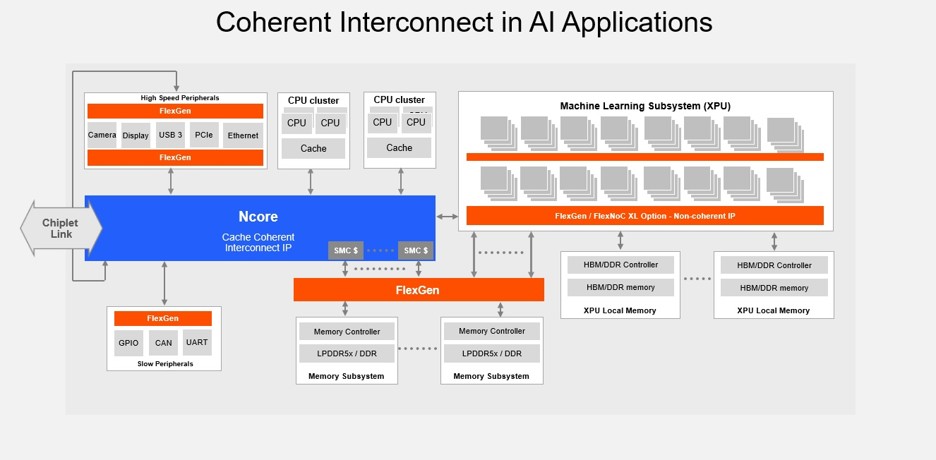
The Software Bottleneck in AI System Design
Designing System-on-Chips (SoCs) for artificial intelligence is rapidly becoming a battleground for software complexity. As AI models grow larger and inference tasks demand more specialized hardware accelerators, the challenge shifts from raw processing power to efficiently coordinating data flow between diverse processing units. Traditionally, this coordination relies heavily on intricate software layers – think of managing a bustling city where every delivery truck, construction crew, and emergency service needs explicit, real-time instructions to avoid collisions and ensure smooth operation. This software overhead consumes valuable development time, increases power consumption, and introduces potential points of failure.
The core problem lies in maintaining data consistency across multiple processors and memory caches. In a typical AI SoC, you might have a CPU for general tasks, a GPU for parallel processing, and dedicated AI accelerators (like NPUs or TPUs) for specific operations. Each of these components has its own local cache to speed up access to frequently used data. When one component modifies data that another component also needs, a mechanism must ensure that all caches are updated correctly or invalidated to prevent stale data from being used. Without a robust solution, developers must write complex, low-level software drivers and synchronization primitives to manage this coherency, which is akin to the city manager having to personally call every single worker to confirm they have the latest building blueprint before they start work.
This software-driven approach is not only time-consuming but also brittle. Debugging cache coherency issues can be notoriously difficult, often manifesting as subtle, intermittent bugs that are hard to track down. Furthermore, as the number of processing units and the complexity of their interactions increase, the software stack balloons, impacting performance and power efficiency. The drive for more sophisticated AI capabilities on edge devices, where power and thermal constraints are paramount, makes this software-centric approach unsustainable.
Cache Coherency as a Hardware Solution
Hardware-level cache coherency offers a compelling alternative by offloading the burden of data consistency from software to the hardware itself. Instead of relying on explicit software commands to manage data updates, the cache coherency protocol operates automatically at the SoC level. When a processor modifies data in its cache, the coherency protocol ensures that other caches holding the same data are either updated or invalidated without explicit intervention from the software. This is like having an intelligent traffic management system for the city that automatically reroutes traffic and updates digital signs based on real-time road conditions, rather than each driver needing a personal navigator and a direct line to the city planner.
This hardware automation significantly simplifies the software stack. Developers can focus on the higher-level logic of the AI application rather than getting bogged down in the minutiae of cache management. The need for complex synchronization primitives and low-level drivers is drastically reduced, freeing up engineering resources and accelerating development cycles. For AI workloads, where data is constantly being read, written, and shared between different processing units (e.g., weights, activations, input data), this hardware-level coherency is particularly impactful. It ensures that all processing units are operating on the most up-to-date information, preventing performance degradation and errors caused by stale data.
The benefits extend to performance and power efficiency. By reducing the software's role in coherency management, there are fewer instructions to execute, leading to lower power consumption and higher throughput. Hardware coherency protocols are typically implemented using highly optimized, low-latency circuits, ensuring that data consistency is maintained with minimal overhead. This is critical for real-time AI applications and for deploying powerful AI capabilities on power-constrained edge devices, such as autonomous vehicles, smart cameras, and industrial IoT sensors.
Architectural Implications and Design Trade-offs
Implementing hardware cache coherency introduces architectural considerations at the SoC design level. Designers must choose or develop appropriate coherency protocols (e.g., MESI, MOESI variants) that balance performance, complexity, and power consumption. The interconnect fabric of the SoC plays a crucial role, as it must efficiently support the communication required by the coherency protocol. This involves careful design of bus protocols, network-on-chip (NoC) architectures, and memory controllers.
One of the key trade-offs involves the overhead of the coherency protocol itself. While it reduces software complexity, the hardware implementation requires dedicated logic and potentially more complex interconnects, which can consume die area and power. However, for increasingly complex AI SoCs with a high degree of parallelism and data sharing, the benefits of offloading software management often outweigh these hardware costs. The critical factor is designing the coherency solution to be scalable and efficient for the specific AI workloads it is intended to support.
The surprising detail here is not that hardware can manage coherency, but the extent to which its absence has dictated software architecture in many prior AI accelerators. For years, developers have built complex software frameworks to compensate for the lack of hardware coherency, essentially reimplementing parts of what the hardware could do more efficiently. The shift towards hardware-managed coherency represents a fundamental architectural evolution, allowing for more sophisticated AI models to be deployed with greater ease and efficiency.
The Future: Coherency as Standard for AI Hardware
As AI continues its relentless march into every facet of computing, the demand for efficient, scalable hardware solutions will only intensify. Hardware cache coherency is poised to become a standard feature in AI SoCs, moving beyond specialized applications to become a foundational element. This shift will enable developers to build more ambitious AI systems without being perpetually constrained by software complexity and coordination overhead.
The implications for the broader AI ecosystem are significant. With simpler software stacks, the barrier to entry for developing and deploying AI applications on custom hardware will lower. This could foster innovation, allowing more companies to leverage specialized AI silicon without requiring deep expertise in low-level hardware-software interaction. Furthermore, the increased efficiency offered by hardware coherency will be critical for realizing the full potential of AI in power-sensitive environments, driving the adoption of AI at the edge.
What nobody has fully addressed yet is the long-term impact on the developer tooling and abstraction layers. As hardware coherency becomes ubiquitous, will we see new programming models emerge that are specifically designed to take advantage of this hardware capability, or will existing frameworks simply benefit from the underlying simplification? The transition promises a more streamlined path for AI hardware development, but the precise shape of the developer experience in this new paradigm is still taking form.