The Drive for Safer C++

The C++ standard committee is actively pursuing measures to enhance the safety and reliability of the C++ standard library. C++26 is set to introduce several experiments and proposals aimed at hardening common data structures and algorithms against typical programming errors. This initiative is driven by the persistent challenges of memory safety and undefined behavior that plague C++ development, leading to subtle bugs, security vulnerabilities, and difficult-to-diagnose crashes. The focus is not on rewriting the entire library but on introducing safer alternatives and guarding against common pitfalls.

Key Hardening Proposals

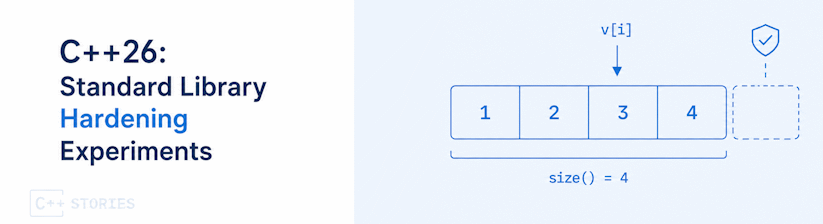
Several key areas are being addressed. One significant proposal involves adding safety checks to common container operations. For instance, `std::vector` and `std::string` might gain bounds-checked accessors or safer default behaviors for operations that could otherwise lead to out-of-bounds reads or writes. Think of it less like a database and more like a very organized friend who happens to remember everything you told them in 2019, but now that friend also checks if you're trying to access information that doesn't exist before handing it over. Another area of focus is the `std::string_view` and its interactions with underlying data. Ensuring that `string_view` does not outlive the string data it points to is a perennial problem. C++26 might introduce mechanisms or clearer guidelines to help developers manage the lifetime of string data referenced by views, potentially through new types or compiler-assisted checks. The standard library's algorithms are also under scrutiny. Functions like `std::sort`, `std::find`, and others, particularly those operating on ranges, are prime candidates for hardening. This could involve adding checks for iterator validity, ensuring that provided ranges are well-formed, and preventing algorithms from exhibiting undefined behavior when given invalid inputs. The goal is to make these fundamental building blocks more robust, catching errors at compile time or runtime rather than letting them manifest as silent data corruption or crashes.

`std::span` and Range-Based Safety

The introduction and subsequent adoption of `std::span` (from C++20) is a foundational element for many of these hardening efforts. `std::span` provides a non-owning view over a contiguous sequence of objects, offering a safer and more flexible alternative to raw pointers and C-style arrays. C++26 proposals leverage `std::span` to define safer interfaces for algorithms and data structures that operate on sequences. This allows for compile-time checking of element counts and iterator validity for a wider range of operations, reducing the risk of off-by-one errors and buffer overflows. For example, algorithms that currently accept pairs of iterators might gain overloads that accept `std::span`. This shift encourages developers to pass explicit, size-aware views of their data, which the standard library can then validate more effectively. The committee is exploring ways to make these `std::span`-based interfaces the default or at least highly recommended for new library components and updates.

Compile-Time vs. Runtime Checks

The hardening efforts will likely involve a mix of compile-time and runtime checks. Compile-time checks, often facilitated by `constexpr` and template metaprogramming, are preferred as they catch errors before the program even runs. Proposals for stricter type checking and static assertions within library functions will contribute to this. For instance, ensuring that an algorithm's preconditions regarding element types or ordering are met could be checked at compile time. Runtime checks, while incurring a slight performance overhead, are essential for catching errors that cannot be detected statically. These might include bounds checking for container access or validating iterator relationships. The committee is mindful of the performance implications and aims to make these checks opt-in or conditional, perhaps controlled by preprocessor definitions or compiler flags, allowing developers to balance safety with performance in release builds. This mirrors approaches seen in other languages and libraries that offer debug or checked modes.

The Impact on Developers

For C++ developers, these changes promise a more forgiving and robust standard library. By catching common errors earlier in the development cycle, developers can spend less time debugging elusive memory-related issues and more time building features. The adoption of safer interfaces, like those based on `std::span`, will naturally guide developers towards more secure coding practices. It's akin to a GPS system that not only tells you where to go but also warns you about upcoming sharp turns or potential hazards, making the journey smoother and safer. However, there will be a transition period. Developers will need to update their code to leverage the new, safer interfaces. Some existing code might behave differently if it relied on undefined behavior that is now being caught. The committee is working to ensure backward compatibility where possible, but the emphasis is on correctness and safety. This means that code that was technically incorrect but happened to