The Naive Implementation Fails
The concept of a 'burn-after-read' message sounds straightforward: display content once, then permanently delete it. Developers often implement this by serving the message content upon request and then immediately removing the underlying data. However, this simple approach encounters a critical flaw in modern communication environments, particularly when messages are shared via chat applications.
The failure manifests when a user creates a self-destructing note, copies its link, and pastes it into a chat platform like Slack, iMessage, WhatsApp, or Discord. Before the user even sends the message, the chat application automatically fetches the URL to generate a preview card. This preview includes the note's title, description, and favicon. This automated fetch constitutes an HTTP GET request. For a naive 'burn-after-read' system, this GET request is indistinguishable from a legitimate user reading the message. Consequently, by the time the intended recipient clicks the link, the system registers the note as already 'read' and presents an empty or 'expired' message, even though no human user has actually viewed it.
This issue arises because the server-side fetching mechanism employed by chat apps to generate link previews performs a GET request. If the 'burn-after-read' logic simply marks a message as read after the first successful GET request to its URL, it incorrectly consumes the message's single-use allowance on this automated preview generation. The system effectively burns the message on the preview bot, not on the intended recipient.
The core problem lies in the indistinguishability of the preview bot's GET request from a genuine user's GET request. A system designed to serve content and then delete it after one access treats both requests identically. This leads to a situation where the message is effectively rendered unreadable for the actual recipient due to an automated, invisible process occurring in the background.
Rethinking the 'Read' Event
The obvious implementation of burn-after-read assumes a single, direct user interaction triggers the 'read' state. However, the reality of web sharing, especially within chat applications, introduces intermediary agents that interact with the shared content. To properly implement burn-after-read, the system must differentiate between a genuine user reading the content and an automated process fetching metadata.
One approach to solving this involves distinguishing the source of the HTTP GET request. Systems can analyze the User-Agent string of incoming requests. Chat applications often use specific, identifiable User-Agent strings for their preview bots (e.g., `Slackbot`, `Discordbot`, `WhatsApp`, `LinkedInBot`). By maintaining a blocklist or allowlist of known bot User-Agents, the 'burn-after-read' system can ignore requests originating from these sources, preventing them from consuming the message's read count.
However, relying solely on User-Agent strings is fragile. These strings can be spoofed, changed by the application developers without notice, or may not be reliably identifiable for all platforms. A more robust solution requires a deeper understanding of the request context and potentially a multi-stage approach to content delivery.
Consider the problem less like a simple counter and more like a bouncer at a club checking tickets. The naive system lets anyone with a ticket stub (the first GET request) in, and then throws away the stub. But what if the first person to ask for the stub is just checking the club's facade for a sign (the preview bot)? You need to ensure the *actual* guest (the user) gets the final ticket to enter.
Advanced Strategies for True Burn-after-Read
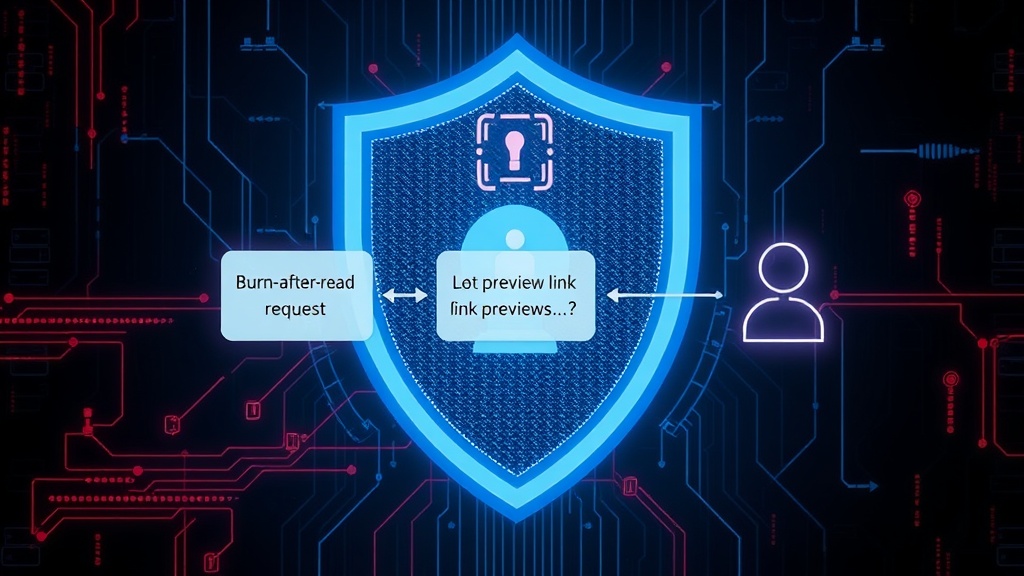
To achieve a truly robust burn-after-read functionality, developers must move beyond simple GET request counting. Several advanced strategies can be employed:
1. Token-Based Access
Instead of directly linking to the content, the 'burn-after-read' system can generate a unique, single-use token for each message. The shareable link would point to an endpoint that validates this token. Upon successful validation, the system serves the content and invalidates the token. This ensures that only one entity possessing the correct, unconsumed token can access the content. Chat app preview bots would not have access to these tokens unless explicitly provided, which is typically not the case for standard link unfurling.
2. Delayed Content Serving
Another approach involves a delay mechanism. The initial GET request (potentially identified as a bot) could trigger a response indicating that content will be available shortly, or it could simply return metadata without the full content. The actual content is then served only upon a subsequent, confirmed user request, perhaps after a short waiting period or via a different mechanism. This requires careful state management on the server.
3. Client-Side Rendering with Server-Side Verification
For certain applications, content could be rendered client-side after a secure, authenticated request. The server would issue a temporary, encrypted payload that the client decrypts and displays. The 'burn' aspect could be managed by ensuring the decryption key or payload is invalidated after the first successful decryption and display on a trusted client. This is more complex and may not be suitable for all use cases, especially those requiring broad accessibility without client-side JavaScript.
4. Differentiating Request Types
More sophisticated systems might attempt to differentiate between types of GET requests based on headers beyond just the User-Agent. For instance, the presence of specific `Accept` headers or patterns in the request path could hint at automated scraping versus user interaction. However, this is also prone to inaccuracies.
The Unanswered Question: User Expectations vs. Technical Reality
The fundamental challenge with 'burn-after-read' isn't just the technical implementation but managing user expectations. Users understand 'burn-after-read' as a simple, one-time view. They don't typically consider the background processes of the tools they use daily. What happens when a user *intends* for a preview bot to see the message, perhaps to verify its existence before sending to a group? The current naive implementations fail this use case, and the advanced ones might introduce new complexities that deviate from the user's mental model of a simple, ephemeral message.
Ultimately, building a reliable 'burn-after-read' feature requires acknowledging the complex ecosystem of web interactions. It demands moving beyond the simplistic model of 'serve once, delete' to a more nuanced system that can intelligently distinguish genuine user consumption from automated pre-fetching. The effort involved often means that what sounds like a trivial feature requires significant architectural consideration to function correctly in the wild.