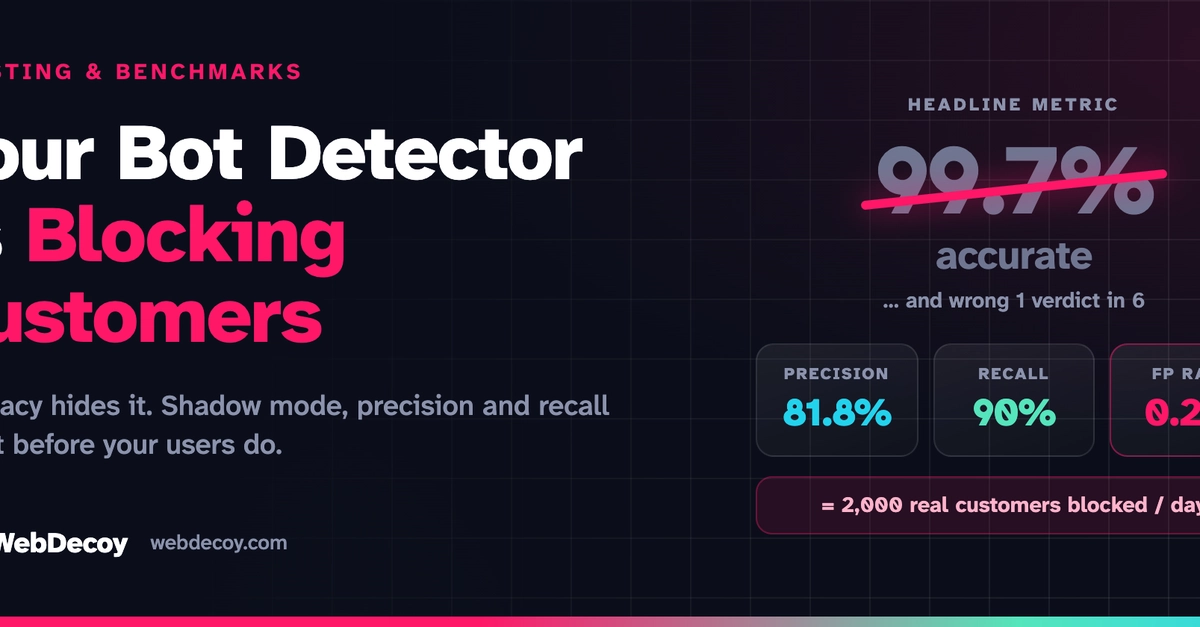
The True Cost of False Positives
The fastest way to lose confidence in bot protection isn't missing a bot. It's blocking a real customer. While a missed scraper might cost bandwidth or content, a blocked customer means a lost sale, a support escalation, and damage to trust earned over months. This fundamental truth means any benchmark for bot detection cannot stop at a single accuracy number. It must answer a harder question: what happens to real people when this policy leaves the dashboard and starts controlling traffic?
A false positive in bot detection is legitimate traffic classified as automated. The technical label is important, but the consequence matters more. The same wrong classification produces very different outcomes depending on the route. For a public article, a false positive might mean a single page view is challenged or delayed. However, for a login route, a false positive can prevent a legitimate user from accessing their account, leading to frustration and potential abandonment. For a checkout route, it's even more critical, potentially blocking a paying customer mid-transaction, directly impacting revenue.
This distinction highlights why a simple 'accuracy' score is insufficient. Accuracy typically measures how well a model correctly identifies both bots and humans. However, it treats false positives and false negatives (bots missed) as equal. In business-critical applications, they are not. The cost of a false positive on a login or checkout page is exponentially higher than a false negative on a static content page. Therefore, testing must evolve to prioritize minimizing false positives on sensitive routes, even if it means slightly increasing the rate of missed bots on less critical paths.
Beyond Simple Accuracy: Testing for Real-World Impact
To effectively test bot detection, we need to move beyond aggregate accuracy metrics. The focus must shift to evaluating the performance of the detection system on specific user journeys and traffic segments. This involves a more granular approach to testing, treating different types of traffic and different user flows with distinct evaluation criteria.
Consider a scenario where a bot detection system boasts 99% accuracy. This sounds impressive, but what does it mean in practice? If 10,000 users visit a site daily, a 1% false positive rate means 100 legitimate users are wrongly flagged. If these users are attempting to log in or make a purchase, the impact is severe. If the system is deployed on a popular e-commerce site with millions of users, even a fraction of a percent error can translate into thousands of blocked customers daily.
The testing methodology must therefore simulate real-world conditions. This includes:
- Segmented Performance Analysis: Evaluating false positive and false negative rates for different types of traffic (e.g., known good bots like search engine crawlers, known bad bots, human traffic from different regions or networks).
- User Journey Simulation: Testing how the bot detection rules impact critical user flows such as registration, login, checkout, and form submissions. Does a user get stuck in a CAPTCHA loop? Are they presented with excessive challenges?
- Risk-Based Policy Tuning: Implementing policies that are not one-size-fits-all. A stricter policy might be acceptable for accessing public blog content, but a far more lenient approach is required for checkout pages. The system should allow for granular control over rule enforcement based on the sensitivity of the endpoint.
- Monitoring and Feedback Loops: Establishing robust mechanisms to capture user feedback and monitor system performance in production. This includes analyzing support tickets related to access issues and correlating them with bot detection events.
This comprehensive approach ensures that the bot detection system not only identifies bots effectively but also protects the user experience for legitimate customers. It’s about understanding the business impact of every decision the system makes.
Designing a Better Bot Detection Test
A practical test for bot detection accuracy must account for the business impact of false positives. This means constructing test datasets and evaluation frameworks that reflect real-world traffic and user behavior. Instead of a single, aggregate accuracy score, focus on metrics that reveal the system's performance on critical paths.
One effective method is to create a stratified test set. This set should contain:
- A representative sample of known human traffic: This should include diverse user agents, IP ranges, and browsing patterns.
- A variety of known bots: This includes benign bots (e.g., search engine crawlers) and malicious bots (e.g., scrapers, credential stuffing bots).
- Synthetic traffic mimicking edge cases: This can include traffic with unusual header combinations or navigation patterns that might confuse less sophisticated detection systems.
When evaluating the system, we should measure:
- False Positive Rate (FPR) on sensitive endpoints: Calculate the percentage of legitimate human traffic incorrectly flagged as bots on critical pages like login or checkout.
- False Negative Rate (FNR) on known bot traffic: Calculate the percentage of malicious bots that bypass detection.
- Challenge Rate: The percentage of legitimate users presented with a CAPTCHA or other verification step. High challenge rates, even if not leading to a full block, degrade user experience.
- Time to Detect/Block: For malicious bots, how quickly are they identified and mitigated?
This multi-faceted evaluation provides a much clearer picture of a bot detection system's real-world effectiveness. It allows businesses to make informed decisions about deploying and configuring these systems, ensuring that security measures do not inadvertently harm the customer experience or revenue.
What nobody has addressed yet is how to standardize these segmented testing methodologies across the industry. Without common benchmarks for evaluating false positive rates on specific user journeys, businesses will continue to rely on opaque, aggregate accuracy scores that fail to capture the true risk.