From Prompt to Production: The bolt.gives Vision
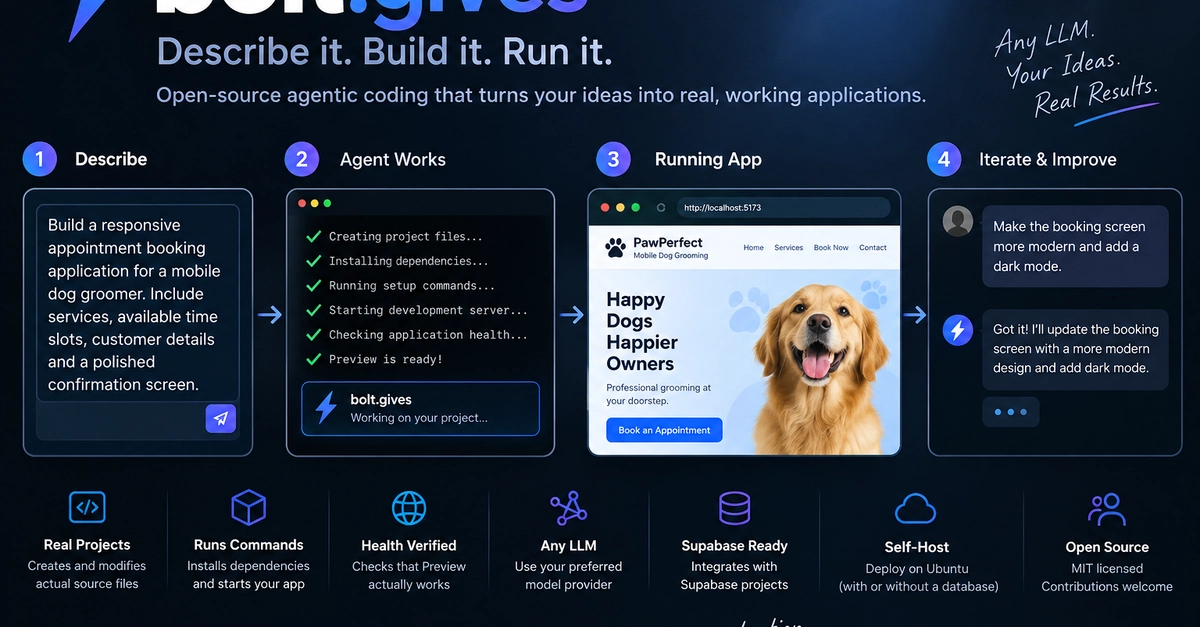
The pace of AI's integration into software development has been startling. Yet, a critical distinction remains: an AI that can generate snippets of code is not the same as an AI system capable of building a complete, functional application. This gap is precisely what the newly released bolt.gives aims to bridge. Launched under the permissive MIT license, bolt.gives is an open-source Agentic Coding platform designed to transform high-level application descriptions into tangible, working web applications.
Imagine typing a request like: "Build a responsive appointment booking application for a mobile dog groomer. Include services, available time slots, customer details, and a polished confirmation screen." bolt.gives doesn't just return a monolithic block of code. Instead, it functions as an active agent, managing the entire development lifecycle. This involves creating and modifying source files, installing necessary dependencies, executing build and test commands, and even starting the development server to present a functional product.
The platform operates on the principle of agentic workflows, where an LLM is not just a code generator but a project manager. It breaks down the complex task of application development into smaller, manageable steps. Each step is executed by an agent, which might involve writing code, researching libraries, configuring environments, or testing components. This iterative process allows bolt.gives to construct applications piece by piece, ensuring that dependencies are met and that the final output is a cohesive, runnable project.
The Agentic Workflow Explained
At its core, bolt.gives leverages the power of Large Language Models (LLMs) but goes beyond simple text generation. It orchestrates these models to perform complex, multi-step tasks. The system can be thought of as a digital development team, where each member (agent) has a specific role and can communicate with others. When a user provides a prompt, the primary agent interprets the request and begins decomposing it into actionable sub-tasks.
For instance, if the prompt includes requirements for a database, an agent responsible for database schema design might be invoked. This agent would then interact with another agent capable of writing SQL or ORM code. Similarly, frontend development tasks would trigger agents skilled in HTML, CSS, and JavaScript frameworks. The platform supports the use of various LLMs, allowing users to select the model that best suits their needs or budget. This flexibility is crucial, as different LLMs excel at different types of tasks, from pure code generation to logical reasoning and planning.
The output of bolt.gives is not just a collection of files. It's a structured project directory, complete with configuration files, dependency manifests (like `package.json` or `requirements.txt`), and runnable scripts. The platform handles the installation of dependencies, ensuring that all necessary libraries and packages are present before attempting to build or run the application. This automation significantly reduces the setup time and common errors developers encounter when starting new projects or integrating AI-generated code.
Key Features and Technical Underpinnings
The open-source nature of bolt.gives is central to its philosophy. By releasing the platform under the MIT license, the developers encourage community contribution, customization, and transparency. This allows developers to inspect the codebase, understand how it works, and even extend its capabilities. The platform is designed to be modular, making it easier to swap out components, such as the underlying LLM or specific task agents.
One of the standout features is its ability to manage project state. bolt.gives keeps track of the files it has created or modified, the dependencies it has installed, and the commands it has executed. This state management is vital for iterative development. If a user refines their prompt or if an agent encounters an error, bolt.gives can intelligently backtrack, modify existing code, or retry specific steps without starting from scratch. This is akin to how a human developer would approach a complex task, making revisions and improvements as needed.
The platform's architecture supports a variety of programming languages and frameworks. While the initial examples focus on web applications, the underlying agentic framework is generalizable. This means bolt.gives could potentially be adapted to generate other types of software, such as mobile applications, scripts, or even configuration files for cloud infrastructure. The key is the LLM's ability to understand context and follow instructions, which bolt.gives harnesses through its structured agentic approach.
Implications for Developers and the Future of Coding
bolt.gives represents a significant step towards truly autonomous AI development. It moves beyond code completion tools and into the realm of project automation. For developers, this means a potential shift in workflow. Instead of spending hours on boilerplate code, setup, and basic implementation, developers can focus on higher-level design, complex logic, and innovative problem-solving. The platform acts as a powerful assistant, accelerating the early stages of development and allowing for rapid prototyping and iteration.
The flexibility to use any LLM is a major advantage. Developers are not locked into a single vendor's proprietary model. They can experiment with different models from OpenAI, Anthropic, Google, or open-source alternatives, choosing the one that offers the best performance, cost-effectiveness, or specific capabilities for their project. This democratization of AI tooling is a key benefit of the open-source model.
What nobody has addressed yet is the long-term maintenance and evolution of applications built with agentic coding platforms like bolt.gives. While the initial generation might be seamless, ensuring the ongoing security, performance, and compatibility of these AI-generated applications as underlying libraries and LLM capabilities evolve presents a new set of challenges for development teams. This will require new paradigms for testing, debugging, and updating AI-authored codebases.
Conclusion
bolt.gives is more than just another AI coding tool; it's a platform that embodies the future of software development. By enabling users to describe applications in plain English and have them built automatically, it lowers the barrier to entry for creating complex software. Its open-source nature fosters collaboration and innovation, promising a vibrant ecosystem around agentic coding. As AI continues to reshape the technology landscape, tools like bolt.gives will be instrumental in defining how we build, deploy, and interact with software.