
The Memory Wall for Local AI Retrieval
Developers building applications that require local Retrieval-Augmented Generation (RAG), edge AI agents, or serverless AI pipelines often encounter a significant bottleneck: memory overhead. Traditional vector databases, while powerful for large-scale semantic search, demand substantial RAM – often hundreds of megabytes or even gigabytes – to maintain their indices in an active state. This makes them impractical for resource-constrained environments like edge devices, local development setups, or cost-sensitive serverless functions.
On the other end of the spectrum, lightweight solutions like scanning raw JSON files or querying SQLite databases fall short when dealing with high-dimensional vector embeddings, which are common in modern AI applications (e.g., 1536 dimensions or more). These methods struggle to scale efficiently with increasing vector complexity, leading to slow retrieval times.
This trade-off between memory footprint and retrieval performance has been a persistent challenge. Developers have been forced to choose between a large memory footprint with fast, accurate retrieval, or a small footprint with slower, less scalable search capabilities. This is the exact problem Bitweave was built to solve.
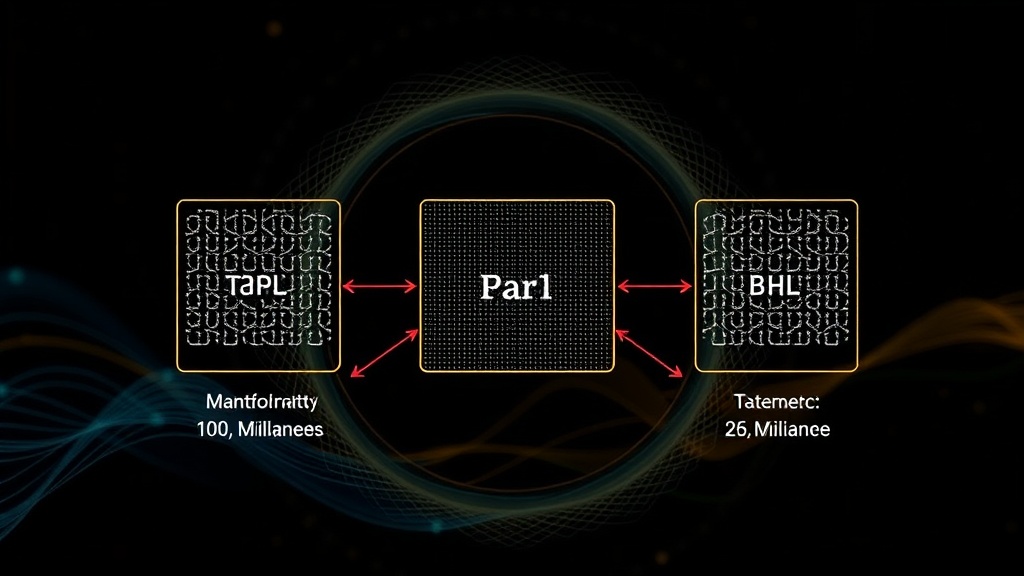
Bitweave's Three-Part Architecture for Efficiency
Bitweave is a new hybrid retrieval engine, written in Rust with Python bindings, designed to overcome the memory and speed limitations of existing solutions. Its core innovation lies in a three-part architectural design that enables sub-millisecond search speeds while maintaining a remarkably low active heap footprint, under 1.1 MB of Resident Set Size (RSS).
1. Bit-Sliced Bitmap for Categorical Filtering
The first component addresses categorical filtering. Instead of traditional methods that might involve separate index lookups or complex joins, Bitweave employs a bit-sliced bitmap approach. This technique encodes categorical data into a series of bitmaps, where each bit represents the presence or absence of a specific category for a given data point. By performing bitwise operations (AND, OR, NOT) across these bitmaps, Bitweave can rapidly filter data based on multiple categorical criteria. This is significantly faster and more memory-efficient than iterating through lists or performing hash lookups for each filter condition.
2. SIMD-Accelerated Vector Search
For the vector search component, Bitweave leverages Single Instruction, Multiple Data (SIMD) instructions. SIMD allows a single CPU instruction to perform the same operation on multiple data points simultaneously. In the context of vector search, this typically means accelerating the calculation of distance metrics (like cosine similarity or Euclidean distance) between query vectors and the vectors stored in the index. By processing multiple dimensions of the vectors in parallel, SIMD significantly boosts the speed of vector similarity calculations, contributing to the sub-millisecond retrieval times.
3. Zero-Copy Data Access
A key factor in Bitweave's low memory usage is its zero-copy data access strategy. This means that when data is loaded into Bitweave's index, it is not copied into new memory locations for processing. Instead, the engine operates directly on the existing data buffers. This minimizes memory allocations and deallocations, which are often performance bottlenecks and sources of memory bloat in other systems. By avoiding unnecessary data duplication, Bitweave ensures that the active memory footprint remains exceptionally small, even when handling large datasets.
The Hybrid Advantage
The combination of these three components—bit-sliced bitmaps for categorical filters, SIMD for vector search, and zero-copy access—creates a powerful hybrid retrieval system. This hybrid approach is crucial because many real-world AI applications require both semantic (vector-based) search and structured (categorical) filtering. For example, a RAG system might need to find documents semantically similar to a user's query AND filter those documents by publication date, author, or specific tags.
Bitweave's architecture allows it to perform these operations concurrently and efficiently. The categorical filters quickly narrow down the search space using bitmaps, and then the SIMD-accelerated vector search operates only on the relevant subset of vectors. This synergistic approach ensures that both speed and memory efficiency are maintained, regardless of the complexity of the query or the size of the dataset.
Use Cases and Implications
Bitweave's design makes it particularly well-suited for a range of demanding AI applications:
- Local RAG: Running RAG systems directly on developer machines or user devices without requiring powerful hardware.
- Edge AI Agents: Enabling intelligent agents on IoT devices, drones, or other edge hardware with limited memory and processing power.
- Serverless AI Pipelines: Deploying AI components in serverless environments where cold starts and memory limits are critical concerns.
- Real-time Search: Applications requiring extremely fast retrieval for interactive experiences.
What is surprising here is not just the low memory footprint, but the assertion of sub-millisecond retrieval times in conjunction with it. Historically, achieving such low latency has required dedicated hardware or significant memory resources to keep indices fully loaded and optimized for rapid access. Bitweave appears to achieve this balance through clever algorithmic design and low-level optimization, directly challenging the conventional wisdom that fast retrieval inherently demands large memory allocations.
The Future of Efficient AI Retrieval
Bitweave represents a significant step forward in making advanced AI retrieval capabilities more accessible and deployable in resource-constrained environments. By directly addressing the memory overhead that plagues many local AI applications, it lowers the barrier to entry for developers and unlocks new possibilities for edge and serverless AI. The engine's performance, backed by Rust's efficiency and Python bindings for ease of use, positions it as a compelling option for anyone building AI-powered applications where performance and memory footprint are paramount.