The Challenge of Granular Access Control
In the intricate world of California court operations, managing access to case management systems is a daily, critical task. It's not an abstract problem of security policies; it's about assigning specific permissions to roles, tracking those assignments as personnel change, and ensuring that individuals only see the data they are authorized to access. A courtroom clerk, a court reporter, and an interpreter might all be involved in the same case, yet each requires a distinct view into its associated files. The line between public and sensitive information is rarely a clear boundary; it often cuts through the very heart of a case file.
This is the operational reality that makes the approach taken by Bifrost, an open-source AI gateway from Maxim AI, particularly relevant. While often discussed through the lens of security, Bifrost's capabilities in scoping permissions and controlling data access resonate deeply with the day-to-day challenges faced by professionals managing sensitive information in complex environments. The team behind Bifrost reached out to explore this intersection, and the conversation quickly shifted from theoretical security to practical, real-world application.
Bifrost: An Open-Source AI Gateway
Bifrost is positioned as an open-source AI gateway. At its core, it aims to simplify the process of integrating and managing access to AI models and services. In practice, this means acting as a central point through which applications and users interact with various AI backends. This gateway architecture is designed to abstract away the complexities of individual AI model deployments, offering a unified interface for requests and responses.
The open-source nature of Bifrost, available on GitHub, encourages community involvement and transparency. This allows developers to inspect the codebase, contribute improvements, and adapt the gateway to specific needs. For organizations looking to leverage AI without getting bogged down in the intricacies of managing multiple AI services, a gateway like Bifrost can be a significant accelerator. It provides a layer of abstraction that can handle routing, authentication, rate limiting, and, crucially, access control.
The analogy to courtroom operations is potent because both scenarios demand a sophisticated understanding of who should see what, and why. In a courtroom, the sensitivity of information dictates access. In an AI gateway, the nature of the AI model, the data it processes, and the potential impact of its outputs define these boundaries. Bifrost's design principles appear to acknowledge this complexity by focusing on robust permission scoping.
The Nine Calls, Three Refusals, One Trap Scenario
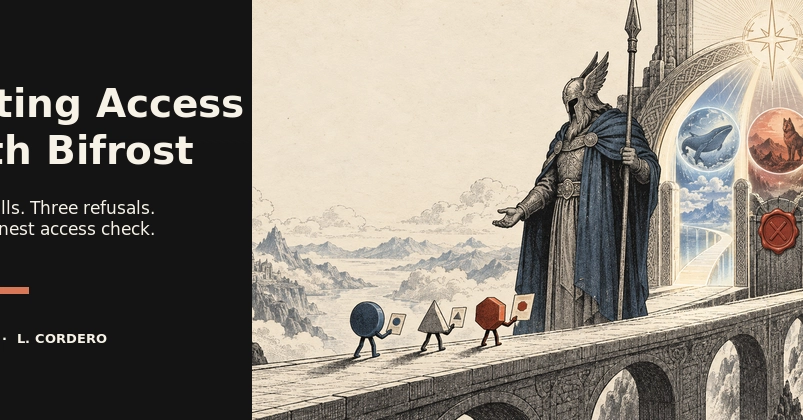
The narrative framework of "Nine Calls, Three Refusals, One Trap" provides a tangible way to understand Bifrost's access control mechanisms. Imagine a user attempting to access an AI service through Bifrost. This process can be visualized as a series of interactions or "calls" between the user, the gateway, and the underlying AI models.
The "nine calls" could represent various stages of a request, from initial authentication and authorization checks to specific data validation and model parameter configuration. Each call is an opportunity for Bifrost to enforce policy. For instance, a call might verify the user's identity, check their role against a predefined access matrix, ensure the requested operation is permitted for that role, and validate the input data's sensitivity.
The "three refusals" highlight the gateway's ability to deny access based on policy violations. These refusals are not arbitrary; they are the direct result of Bifrost's access control engine evaluating the incoming requests against configured rules. A refusal could occur if:
- The user is not authenticated.
- The user's role lacks permission for the requested AI model or operation.
- The input data exceeds predefined sensitivity thresholds or compliance requirements.
- The request violates rate limits or other usage policies.
Each refusal is a necessary step in protecting sensitive data and ensuring compliant AI usage. In the courtroom analogy, this is akin to a system preventing an unauthorized paralegal from accessing sealed documents or a judge's private notes. The system, like Bifrost, enforces boundaries.
The "one trap" is the most critical element, representing a scenario where a seemingly valid request, or a series of permitted actions, could lead to an unintended or undesirable outcome. This could involve a user exploiting a loophole, inadvertently gaining access to more data than intended through a series of seemingly legitimate queries, or a misconfiguration of permissions that creates a vulnerability. Bifrost's focus on granular control aims to minimize these trap scenarios by ensuring that each permission is narrowly defined and strictly enforced. It's about preventing the 'accidental' disclosure of sensitive information, which can be as damaging as a deliberate breach.
Referenced Sources
- verified