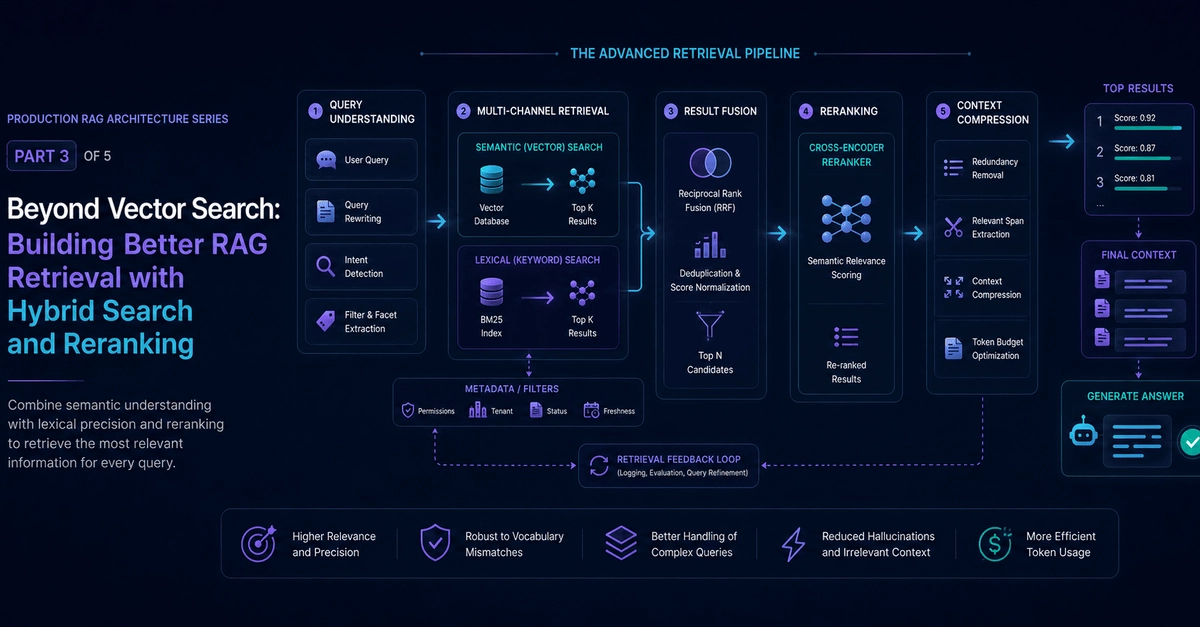
The Limits of Pure Vector Search in RAG
Retrieval-Augmented Generation (RAG) systems promise to ground LLMs in factual data, but their effectiveness hinges on the retrieval layer. While vector search excels at finding semantically similar documents, it frequently misses crucial information. This limitation stems from its reliance on dense embeddings, which can struggle with nuanced queries, specific keywords, or documents that are conceptually close but lexically distant. In production RAG systems, where accuracy is paramount, relying solely on vector search is a common failure point. The quality of the initial data processing—ingestion, parsing, chunking, and metadata design—lays the groundwork, but if retrieval fails to find the right information, the entire system falters.
Consider a query like "What are the tax implications of a Series B funding round for a Delaware C-corp?" A pure vector search might return documents discussing "Series B funding" or "tax implications" broadly, but miss a specific section detailing the nuances for a "Delaware C-corp." This is where hybrid approaches become essential.
Hybrid Search: The Power of Two Worlds
Hybrid search combines the strengths of different retrieval methods, most commonly semantic (vector) search and lexical (keyword) search. Lexical search, like BM25 or TF-IDF, is excellent at identifying documents that contain specific keywords or phrases. It's deterministic and precise when you know exactly what terms to look for. For instance, if a user specifically asks for "Form 1099-MISC," a lexical search will reliably find documents containing that exact string.
Semantic search, powered by vector embeddings, understands the *meaning* behind words. It can find documents that are conceptually related to a query, even if they don't use the exact same terminology. This is invaluable for open-ended questions or when users might not know the precise vocabulary. For example, if the query is "how to handle contractor payments," semantic search can surface documents discussing "1099s" or "miscellaneous income reporting" because it grasps the underlying intent.
By combining these two approaches, hybrid search creates a more robust retrieval mechanism. A query can be processed by both systems, and their results can be merged and ranked. This ensures that documents containing exact keywords are not missed, while also capturing semantically relevant content. This dual approach significantly increases the recall and precision of the retrieval system, providing a richer set of candidate documents for the LLM to process.
Reranking: Refining the Candidate Set
Even with hybrid search, the initial retrieval might return dozens or even hundreds of potentially relevant documents. Presenting this large set to an LLM can be computationally expensive and may still lead to the model getting lost in irrelevant details. This is where reranking comes into play. Reranking is a post-retrieval step that takes the initial set of candidate documents and reorders them based on a more sophisticated relevance score.
Reranking models, often smaller, specialized cross-encoders, analyze the query and each candidate document pair. Unlike bi-encoders used in initial vector search (which encode query and document independently), cross-encoders evaluate the query and document together. This allows them to capture finer-grained interactions and context, providing a more accurate measure of relevance. Think of initial retrieval as casting a wide net to catch many fish, and reranking as using a finer net to select only the best ones.
The output of the reranker is a highly curated list of the most relevant documents. This smaller, more focused set is then passed to the LLM, dramatically improving the quality of the generated response while reducing computational overhead and the risk of hallucination.
Optimizing the Retrieval Pipeline
Beyond hybrid search and reranking, several other techniques enhance RAG retrieval performance:
- Query Optimization: Rewriting or expanding user queries to improve retrieval. This can involve techniques like query expansion (adding synonyms or related terms) or query decomposition (breaking complex queries into simpler sub-queries).
- Metadata Filtering: Using document metadata (e.g., date, author, document type, tags) to narrow down the search space before or after retrieval. For example, if a user asks about recent policy changes, filtering by documents updated in the last year is crucial.
- Context Compression: Techniques that reduce the amount of text passed to the LLM without losing critical information. This can involve summarizing retrieved passages or extracting only the most relevant sentences.
By integrating these components—robust data processing, hybrid search, reranking, and query/metadata optimization—developers can build RAG systems that reliably deliver accurate and contextually relevant information. This multi-stage approach moves beyond the limitations of single-method retrieval, creating a more intelligent and effective knowledge retrieval backbone for LLM applications.