The Limits of Retrieval-Augmented Generation
Current AI systems often rely on Retrieval-Augmented Generation (RAG) to ground their responses in factual data. The premise is simple: find relevant documents and use them to inform the AI's answer. However, this approach has a fundamental flaw: retrieval is not evidence. Simply finding a document that mentions a fact does not prove the AI's generated statement is true, nor does it explain how the AI arrived at its conclusion based on that document. This leaves users with answers that may be superficially plausible but lack genuine verification.
The challenge is to move beyond simply surfacing information to building AI systems that can demonstrably prove their assertions. This means developing architectures that not only retrieve data but also reason over it, construct logical arguments, and present the evidence in a verifiable manner. The goal is an AI that can show its work, much like a student solving a complex math problem, rather than one that just presents the final answer.
Agentic AI for Verifiable Truth
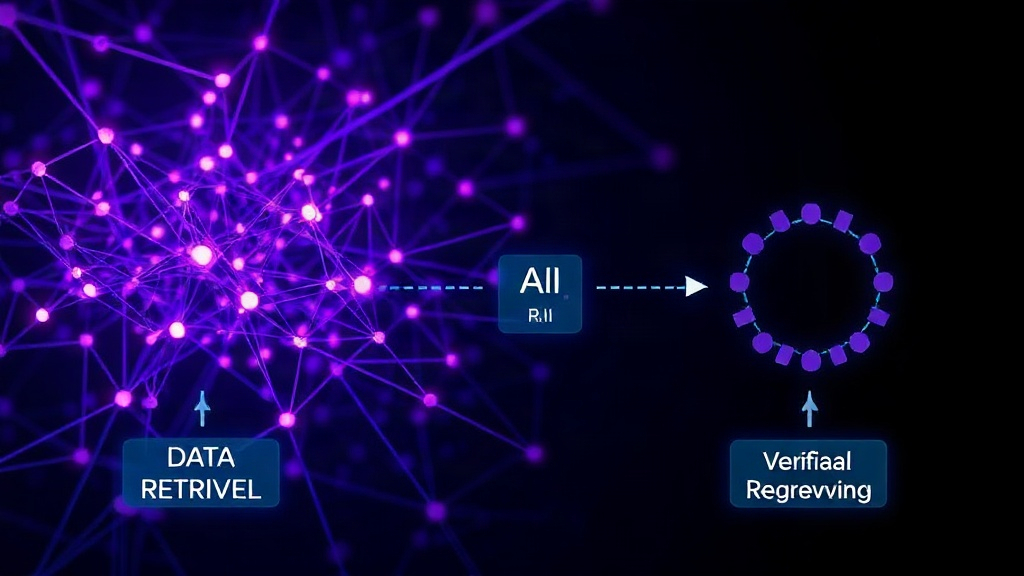
To achieve this, a new paradigm is emerging: agentic AI systems. These systems are designed with multiple components that work in concert to achieve a specific goal. Instead of a single model generating text, an agentic system might involve a retriever, a reasoner, a verifier, and a memory component.
Consider fraud investigation, a domain where simply flagging a transaction as 'fraudulent' is insufficient. Analysts need to understand the 'why' and 'how'. An agentic system, like SentinelGraph built by Aryan Gupta for the HHGOA 2026 Task 4, demonstrates this approach. SentinelGraph combines TigerGraph for its graph-based retrieval capabilities with Large Language Model (LLM) reasoning, a case memory, and deterministic policy controls.
Here's how such systems move beyond basic RAG:
- Graph-Based Retrieval: Instead of keyword searches, graph databases like TigerGraph allow for complex relationship traversal. This means the AI can uncover connections between entities, transactions, and historical events that a simple document search would miss. It's like tracing threads in a tapestry rather than just finding a paragraph about one thread.
- LLM Reasoning: Once relevant data is retrieved (potentially multiple pieces of evidence from various connections), an LLM is employed not just to synthesize but to reason. This involves inferring causality, identifying patterns, and constructing a logical narrative explaining why a transaction is suspicious.
- Case Memory: For complex investigations, remembering past cases and their outcomes is crucial. A case memory allows the agentic system to learn from historical data, avoid repeating errors, and apply successful investigative strategies to new scenarios.
- Deterministic Policy Controls: To ensure reliability and prevent uncontrolled hallucinations, deterministic policies can guide the agent's actions. These rules ensure that the AI's recommendations are aligned with predefined operational guidelines, adding a layer of accountability.
Demonstrating, Not Just Stating
The critical difference lies in the output. A standard RAG system might say, "Transaction X is fraudulent because it shares characteristics with known fraudulent activities." An agentic system, however, could output: "Transaction X (ID: 12345) is flagged as suspicious. It originated from IP address Y, which has been associated with 3 previous fraudulent transactions (Case IDs: 789, 101, 112). Furthermore, the recipient account Z was involved in a pattern of money laundering detected in Case ID 101, involving a similar transaction amount and timing. Based on these connections and the established policy for high-risk IP addresses, a manual review is recommended. See attached evidence graph and summary of Case ID 101 for details."
This level of detail provides not just an answer, but a verifiable audit trail. The AI is not just retrieving information; it is performing an investigation, constructing an argument, and presenting its findings with supporting evidence. This makes the AI's conclusions trustworthy and actionable.
The Future of Truthful AI
Building AI that can prove its own claims is essential for applications where accuracy and accountability are paramount – finance, healthcare, legal services, and scientific research. The shift from simple information retrieval to demonstrable reasoning represents a significant step towards truly reliable AI systems. As these agentic architectures mature, we can expect AI to become not just a source of information, but a trusted partner capable of independent, verifiable analysis.
What remains to be seen is how these complex agentic systems will scale and be optimized for real-time decision-making across diverse industries, and what new security challenges arise from systems that can generate their own evidence chains.