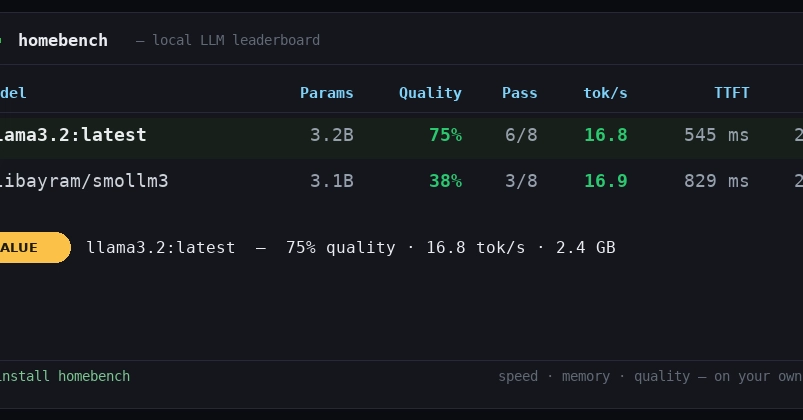
The Illusion of Speed: Beyond Tokens Per Second
For anyone running large language models (LLMs) locally, a common question arises: which model is best? The initial impulse is to look at raw speed metrics, typically measured in tokens per second. Tools like llama-bench provide this data, indicating that a model like llama3.2 might be fast. However, speed alone is a poor proxy for quality or usability. A heavily quantized model, while potentially fast, might have subtle or even overt issues that compromise its output. Conversely, a smaller, seemingly sluggish 8B model could offer superior results, making its slower generation time a worthwhile trade-off.
This disconnect between raw speed and actual performance led to the development of homebench, a project designed to measure both the speed and the quality of local LLMs. The primary challenge in building such a tool wasn't just the coding, but defining what metrics truly matter and how to interpret them. The initial thought that "output tokens divided by time" would suffice quickly proved insufficient. The process of generating text involves several distinct phases: loading the model (which can vary significantly based on hardware and quantization), processing the user's prompt, and then generating the output tokens. Including model load time, especially for a cold start, drastically skews the perceived performance of a model. A model that appears slow on its first run might be significantly faster on subsequent, warmed-up runs.
To address this, homebench separates these phases. It measures prompt processing time (how long it takes to understand the input) and token generation speed (how many tokens are produced per second after the prompt is processed). This distinction is crucial. A model might be exceptionally fast at processing a prompt but slow at generating tokens, or vice versa. Understanding these individual components allows for a more accurate assessment of a model's true capabilities on a given hardware setup.
Defining 'Good': The Qualitative Benchmark
Beyond raw speed, the more significant hurdle is defining and measuring 'good' output. What constitutes a quality response from an LLM is inherently subjective and context-dependent. For homebench, this meant moving beyond simple, automated metrics and incorporating elements that approximate real-world usage scenarios. This involves crafting a diverse set of prompts designed to test various LLM capabilities:
- Factual Accuracy: Prompts requiring specific, verifiable information.
- Reasoning and Logic: Tasks that involve step-by-step deduction or problem-solving.
- Creativity and Coherence: Prompts asking for narrative generation, summarization, or creative writing, where flow and consistency are key.
- Code Generation: Tasks that involve producing functional code snippets in various programming languages.
- Instruction Following: Prompts that test the model's ability to adhere to complex or multi-part instructions.
Each of these categories requires a different evaluation strategy. For factual accuracy, comparing generated answers against known ground truths is possible. For reasoning and instruction following, more complex validation logic is needed, potentially involving other LLMs or human review. Creativity is the hardest to quantify, often relying on human judgment for coherence and originality. The goal is not to achieve a single, perfect score, but to provide a profile of the model's strengths and weaknesses across these different dimensions.
The Quantization Conundrum
Quantization is a technique used to reduce the memory footprint and computational requirements of LLMs, allowing them to run on less powerful hardware, like a typical laptop. This typically involves reducing the precision of the model's weights (e.g., from 16-bit floating-point numbers to 8-bit or even 4-bit integers). While essential for local deployment, quantization is not without its risks. Aggressive quantization can lead to a phenomenon known as 'quantization drift' or 'quantization error,' where the model's performance degrades significantly. This can manifest as:
- Degraded Output Quality: Models may start producing nonsensical, repetitive, or factually incorrect responses.
- Loss of Nuance: Subtle understandings and complex reasoning capabilities can be diminished.
- Hallucinations: Models might generate plausible-sounding but entirely fabricated information more frequently.
Benchmarking must account for this. A simple speed test on a quantized model doesn't tell you if the trade-off in quality is acceptable. homebench aims to highlight these trade-offs by evaluating both speed and output quality for different quantization levels of the same base model. This allows users to see, for instance, that a 4-bit quantized model is 30% faster but produces 15% lower scores on reasoning tasks, enabling an informed decision based on their specific needs and hardware constraints.
Hardware and Software Dependencies
The performance of local LLMs is inextricably linked to the hardware they run on and the software stack used to deploy them. Factors such as CPU, GPU (if available and utilized), RAM speed, and even the specific library used for inference (e.g., llama.cpp, transformers, vLLM) can dramatically influence benchmark results. A benchmark run on one machine might be entirely unrepresentative of performance on another.
homebench acknowledges this by attempting to provide context for the results. It logs key hardware specifications (CPU type, RAM amount, GPU model if used) and software versions. However, true comparability across vastly different hardware configurations remains a significant challenge. What is 'fast' on a high-end gaming PC with a powerful NVIDIA GPU will be vastly different from a standard laptop with integrated graphics. The goal is to provide users with a baseline for their system, allowing them to compare different models and quantization levels on their own hardware, rather than relying on potentially misleading external benchmarks. This empowers users to make decisions tailored to their specific environment.
The Evolving Landscape of LLM Benchmarking
The field of LLM benchmarking is still nascent and rapidly evolving. Existing benchmarks, like HELM or EleutherAI's LM-evaluation-harness, are valuable but often designed for large-scale, cloud-based deployments and can be complex to set up and run locally. For the average user experimenting with models on their personal machine, these tools can be overkill or inaccessible.
homebench represents an effort to bridge this gap, offering a more accessible, albeit less comprehensive, approach to evaluating local LLMs. It highlights that honest benchmarking isn't about finding a single, universally superior model, but about understanding the trade-offs inherent in model choice, quantization, and hardware. As LLMs become more integrated into local workflows, the need for practical, user-friendly evaluation tools will only grow. The question remains: as models become more capable and diverse, how will benchmarking methodologies adapt to capture the full spectrum of their utility and potential pitfalls?