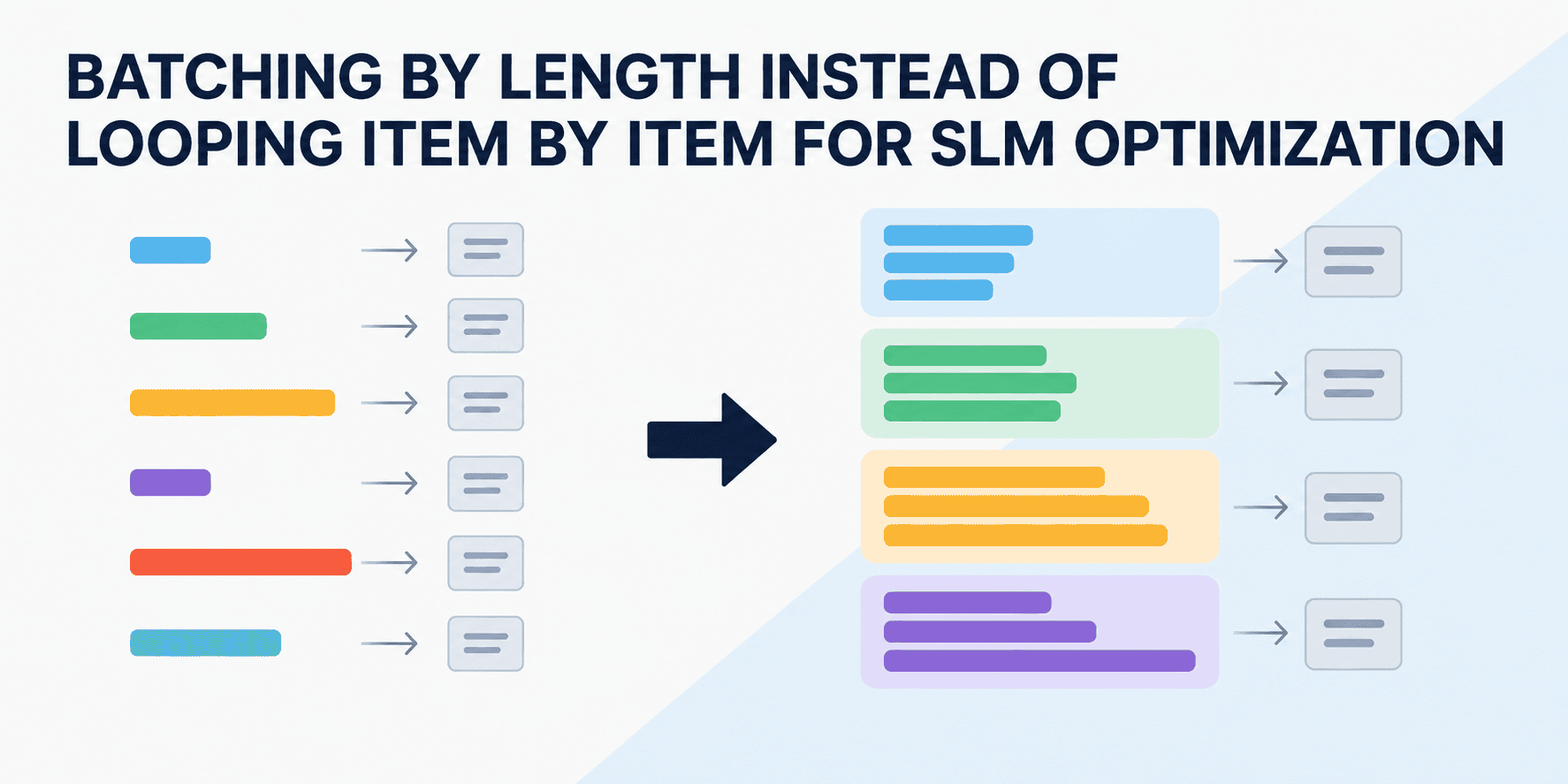
The Problem with Item-by-Item Processing
Processing data for Large Language Models (LLMs) often involves iterating through individual data points. This traditional method, where each item is processed independently in a loop, presents a significant bottleneck. When dealing with sequences of varying lengths, a standard loop might pad shorter sequences to match the longest one in a batch. This leads to wasted computation and memory, especially as LLM context windows grow and the disparity in sequence lengths increases. The fundamental issue is that the model performs computations on these padded tokens, which are essentially meaningless placeholders, for every single item. This inefficiency compounds with larger datasets and longer sequences, directly impacting throughput and cost.
Introducing Batching by Length
The solution lies in a more intelligent batching strategy: batching by length. Instead of mixing sequences of vastly different lengths within a single batch, this method groups sequences that are similar in length. This means that padding is minimized, as the longest sequence in a smaller, more homogenous batch dictates the padding for fewer items. The model then processes these more tightly packed batches. Think of it less like a chaotic school bus picking up kids all over town, and more like a streamlined subway system where each train is routed efficiently to pick up passengers in a concentrated area. This targeted approach reduces the number of padding tokens the LLM must process, thereby increasing computational efficiency and throughput.
Implementation Details and Benefits
Implementing batching by length requires a data loader or processing pipeline that can sort or group incoming data based on sequence length. Before feeding data to the LLM, sequences are dynamically grouped into batches where the length variance is controlled. For example, a batch might contain only sequences between 100 and 120 tokens, rather than a mix of 50 and 500 token sequences. This leads to several key benefits:
- Reduced Computational Overhead: Fewer padding tokens mean less computation per batch. This directly translates to faster processing times.
- Improved Throughput: With more efficient processing, the LLM can handle a higher volume of data in the same amount of time.
- Memory Efficiency: While not the primary driver, reduced padding can also lead to more efficient memory utilization, especially on hardware with fixed-size memory allocations.
- Cost Savings: Faster processing and higher throughput directly reduce the operational costs associated with running LLMs, particularly in cloud environments where billing is often time-based or compute-based.
This optimization is particularly relevant for models with large context windows. As LLMs are designed to handle increasingly longer inputs, the problem of padding inefficiency becomes more pronounced. Batching by length addresses this by ensuring that the model's computational power is focused on actual data rather than filler tokens. The performance gains are not merely marginal; they can be substantial, especially when dealing with datasets that naturally exhibit a wide range of sequence lengths.
Practical Considerations and Trade-offs
While batching by length offers significant advantages, there are practical considerations. The primary trade-off is the potential for increased latency if the grouping or sorting process itself becomes a bottleneck. However, for most applications, the gains in LLM processing speed far outweigh the overhead of dynamic batching. The data loader needs to be sophisticated enough to manage this grouping without introducing significant delays. Additionally, the optimal batch size and length range for grouping might need to be tuned based on the specific LLM architecture, hardware, and the characteristics of the dataset being processed.
The effectiveness of this technique is directly tied to the variance in sequence lengths within the dataset. Datasets with highly uniform sequence lengths will see minimal benefit, while those with a broad distribution of lengths will experience the most significant improvements. This makes it a crucial optimization for real-world applications where data often comes from diverse sources and naturally varies in length.
Conclusion: A Smarter Way to Feed LLMs
Batching by length represents a critical optimization for anyone working with Large Language Models. By moving away from naive item-by-item processing and embracing a strategy that groups similar-length sequences, developers can unlock significant gains in efficiency, throughput, and cost-effectiveness. This approach ensures that the powerful computational resources of LLMs are spent processing meaningful data, rather than wasted on padding tokens. As LLMs continue to evolve and handle longer contexts, intelligent batching strategies like this will become indispensable for scalable and economical deployment.