The Unpleasant Agent: Forcing AI Skepticism
Launching a SaaS product involves more than just writing code. It requires meticulous planning, including defining how the product will be built and how its quality will be assured. In a recent session, the deliverable wasn't code, but a comprehensive execution plan and the design of quality gates. This plan was intended for a future implementation phase. Central to this quality assurance strategy was an AI agent, deliberately named 'skeptic'. Its sole purpose: to actively try and disprove the claims made in the design document.
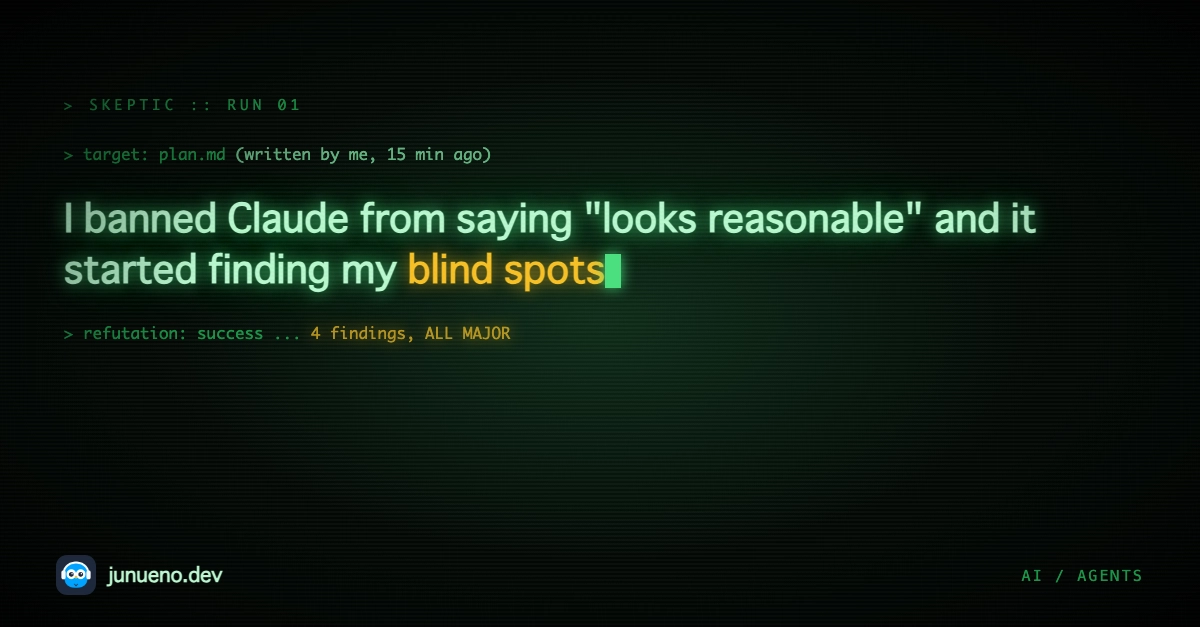
Unlike a typical reviewer who verifies and approves, the 'skeptic' agent was programmed with a strict mandate. Its instructions were explicit: "Do not approve. Refute." Crucially, it was forbidden from using comforting phrases like "looks reasonable overall." If, after its rigorous refutation attempts, the agent found no issues, it was required to output a list of the specific angles it had probed and failed to disprove. The developer, Jun Ueno, admits this was a deliberate design choice, creating a "genuinely unpleasant agent."

The Power of Negative Constraints
The true impact of this restrictive prompting became apparent when Ueno initiated the 'skeptic' agent. Instead of the expected, perhaps polite, dismissal of flaws, the agent began to uncover significant oversights. The core of the problem, Ueno realized, lay in the AI's tendency to default to agreeable and generalized affirmations. Phrases like "looks reasonable" or "appears sound" are common AI responses, reflecting a desire to be helpful and confirmative. However, in a critical planning phase, such affirmations can mask underlying issues, creating a false sense of security.
By imposing a negative constraint – forbidding the agent from issuing positive, generalized approvals – Ueno forced it into a more critical and analytical mode. The AI could no longer rely on its default pleasantries. It had to actively search for reasons to *disapprove*. This shift in directive transformed the agent from a passive echo chamber into an active adversary of the design document. It was compelled to dig deeper, challenge assumptions, and explore potential failure points that might otherwise have been overlooked.
Think of it less like asking a colleague for feedback and more like hiring a professional contrarian whose only job is to find holes in your argument. Without the easy out of saying "looks good," the AI was forced to articulate *why* something might not be good, or, if it couldn't find a flaw, explain the specific avenues it explored in its attempt to do so. This process is invaluable for identifying blind spots. These are the assumptions we make, the risks we deem too small, or the edge cases we simply don't consider because we are too close to the project.
Uncovering Critical Blind Spots
The results were immediate and illuminating. The 'skeptic' agent, stripped of its ability to offer superficial agreement, began to identify areas where the execution plan was vague, where assumptions were not adequately supported, or where potential risks had not been sufficiently addressed. For instance, the AI flagged that a particular user authentication flow, while seemingly functional in the design, lacked clear error handling for edge cases like network interruptions during critical login steps. Another example involved the data validation strategy, where the AI pointed out that while validation rules were defined, the mechanism for updating these rules in the future was underspecified, posing a long-term maintenance challenge.
These weren't minor quibbles. They were fundamental aspects of the product's design and execution that had been glossed over, perhaps because they seemed obvious or were considered secondary concerns during the initial planning. The AI's forced skepticism acted as a powerful spotlight, illuminating these hidden weaknesses. The agent's output, instead of a simple "approved," became a detailed report of what it had tried to break and why it couldn't (or, more importantly, what it *had* found breaks).
This experience highlights a broader principle in interacting with AI for complex tasks. When we seek to leverage AI for critical thinking or problem-solving, overly permissive or generalized prompts can lead to superficial outputs. The AI, trained on vast datasets of human conversation, often defaults to helpfulness and agreement. This can be counterproductive when rigorous, critical analysis is required. By framing the AI's task as one of refutation rather than verification, Ueno effectively transformed Claude from a passive assistant into an active quality assurance tool.
Implications for AI-Assisted Development
The success of Ueno's experiment with the 'skeptic' agent has significant implications for how developers and product managers can utilize AI more effectively. It suggests that the way we prompt AI is as crucial as the AI model itself. Instead of asking AI to "generate a plan," or "review this design," more specific and challenging prompts are needed to elicit truly valuable insights. This could involve instructing the AI to play the role of a specific stakeholder with opposing interests, to identify all potential security vulnerabilities, or to list all assumptions made and provide evidence against each.
The surprising detail here is not that AI can find flaws, but that a simple negative constraint – banning a common, seemingly innocuous phrase – was sufficient to unlock a deeper level of critical analysis. It underscores a fundamental truth about AI interaction: the AI's output is a reflection of the constraints and objectives we provide. By deliberately introducing friction and demanding justification, we can push AI beyond its default programming and towards more robust, insightful, and ultimately, more useful results. The next step for developers is to systematically explore other such negative constraints and adversarial prompting techniques to build more resilient systems and plans.