The Core of Backend Request Handling
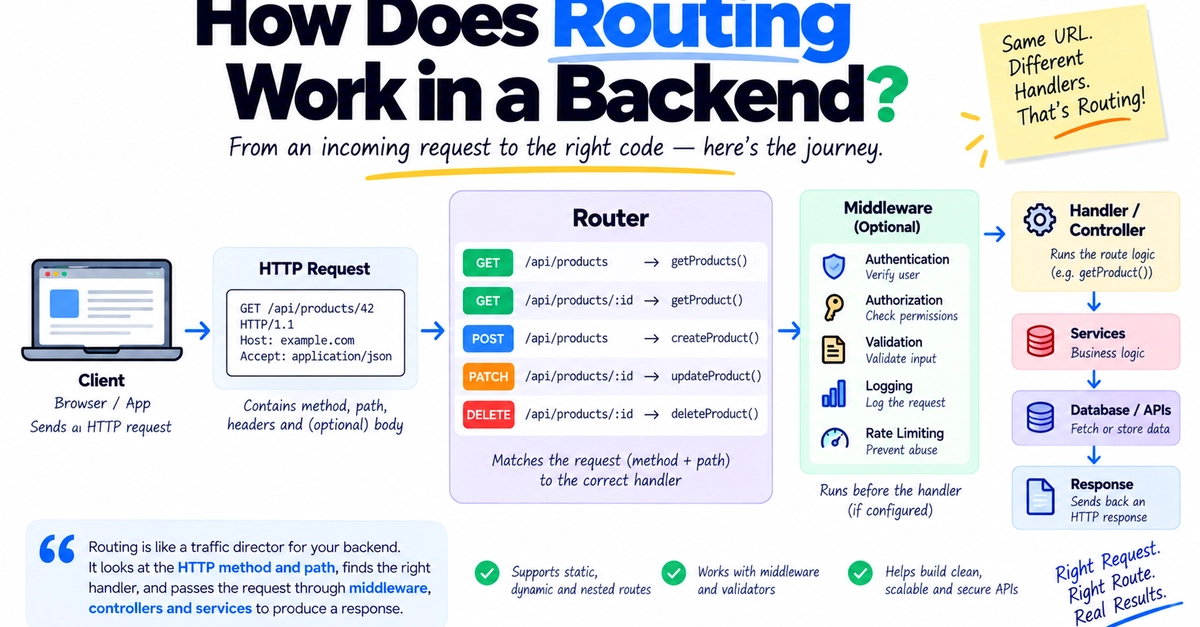
Every time a user interacts with a web application—whether it's opening a product page, logging in, or deleting a post—a request travels from their browser to the backend server. But how does the server know precisely which piece of code should process that specific request? The answer lies in backend routing. Routing is the fundamental process by which a backend application maps incoming requests to the appropriate handler function or controller. It’s the application’s internal GPS, ensuring that a request for GET /api/products/42 doesn’t end up being handled by the code meant for POST /api/login.
Think of backend routing like a postal service for your application. When a letter (a request) arrives at the post office (the server), it has an address. The routing system reads that address (the URL and HTTP method) and determines which specific mailbox (handler function) it needs to be delivered to. Without this system, the server would be overwhelmed, unable to differentiate between the myriad of actions a user might want to perform.
Requests come in various forms, each with a specific HTTP method and a URL path:
- Viewing a product:
GET /api/products/42 - Logging in:
POST /api/login - Updating a profile:
PATCH /api/profile - Deleting a post:
DELETE /api/posts/10
Each of these examples uses a different HTTP method (GET, POST, PATCH, DELETE) and a unique URL path. The routing mechanism is responsible for distinguishing these and directing them to the correct logic. This is essential for maintaining order and ensuring that the correct data is retrieved, created, updated, or deleted.
Defining Routes and Handlers
At its heart, routing involves defining a set of rules. These rules associate specific URL paths and HTTP methods with corresponding functions or code blocks that are designed to handle those particular requests. Most modern web frameworks provide built-in routing capabilities to simplify this process. For instance, in a framework like Express.js for Node.js, you might define a route like this:
const express = require('express');
const router = express.Router();

// GET handler for /api/users/:id
router.get('/users/:id', (req, res) => {
  const userId = req.params.id;
  res.send(`Fetching user with ID: ${userId}`);
});

module.exports = router;
In this example, router.get('/users/:id', ...) defines a route that listens for GET requests to any path matching /users/ followed by a dynamic segment (:id). When such a request arrives, the provided callback function is executed. This function has access to the request object (req), which contains details like the ID extracted from the URL (req.params.id), and the response object (res), which is used to send a reply back to the client.
Route Parameters, Query Strings, and Request Bodies
Routing mechanisms often support different ways to pass data from the client to the server, beyond just the URL path. These include:
- Route Parameters: As seen in the
/users/:idexample, these are dynamic segments within the URL path itself. They are typically used to identify specific resources, like a user ID or a product SKU. - Query Strings: These are appended to the URL after a question mark (
?) and consist of key-value pairs separated by ampersands (&). For example,/api/products?category=electronics&sort=price. Query strings are often used for filtering, sorting, or pagination. - Request Bodies: For methods like POST, PUT, or PATCH, data is often sent in the request body. This is common for creating or updating resources, where you might send a JSON object containing all the details of the new or modified resource.
The routing system must be able to parse and extract data from all these sources to provide the handler function with the necessary information. Frameworks typically provide convenient ways to access these data points through the request object (e.g., req.params, req.query, req.body).
The Order of Routes Matters
A crucial aspect of backend routing is the order in which routes are defined. Most routing engines process routes sequentially. This means that if you have multiple routes that could potentially match a single incoming request, the first one defined in your code will be the one that gets executed.
Consider these two routes:
GET /api/users(to get all users)GET /api/users/:id(to get a specific user by ID)
If you define the more general route (/api/users) before the more specific route (/api/users/:id), any request for a specific user, like GET /api/users/123, would incorrectly match the /api/users route. The handler for /api/users would receive '123' as the id parameter, which is not the intended behavior. Therefore, it's a common best practice to define more specific routes before more general ones to ensure correct matching.

Middleware and Routing
Middleware functions play a significant role in the routing process. Middleware are functions that have access to the request object, the response object, and the next middleware function in the application's request-response cycle. They can be used to perform tasks such as:
- Authentication and Authorization: Checking if a user is logged in and has permission to access a resource.
- Logging: Recording details about incoming requests.
- Data Validation: Ensuring that incoming data (from query strings or request bodies) meets certain criteria before reaching the main handler.
- Request Modification: Adding additional information to the request object that might be useful for subsequent handlers.
Middleware can be applied globally to all routes, or specifically to a group of routes, or even to a single route. When a request comes in, it passes through all the applicable middleware in the order they are defined. If a middleware function doesn't call the next() function (or sends a response), the request-response cycle can terminate early, preventing the intended route handler from executing. This allows for powerful pre-processing and control flow management within the application.
Conclusion: The Backbone of API Interaction
Backend routing is far more than just a technical detail; it’s the architectural backbone that enables dynamic web applications and APIs to function. It’s the system that intelligently directs traffic, ensuring that every incoming request, from a simple page view to a complex data submission, is processed by the correct logic. By understanding how routes are defined, how parameters are handled, and how middleware integrates into the process, developers can build more robust, scalable, and maintainable backend systems.