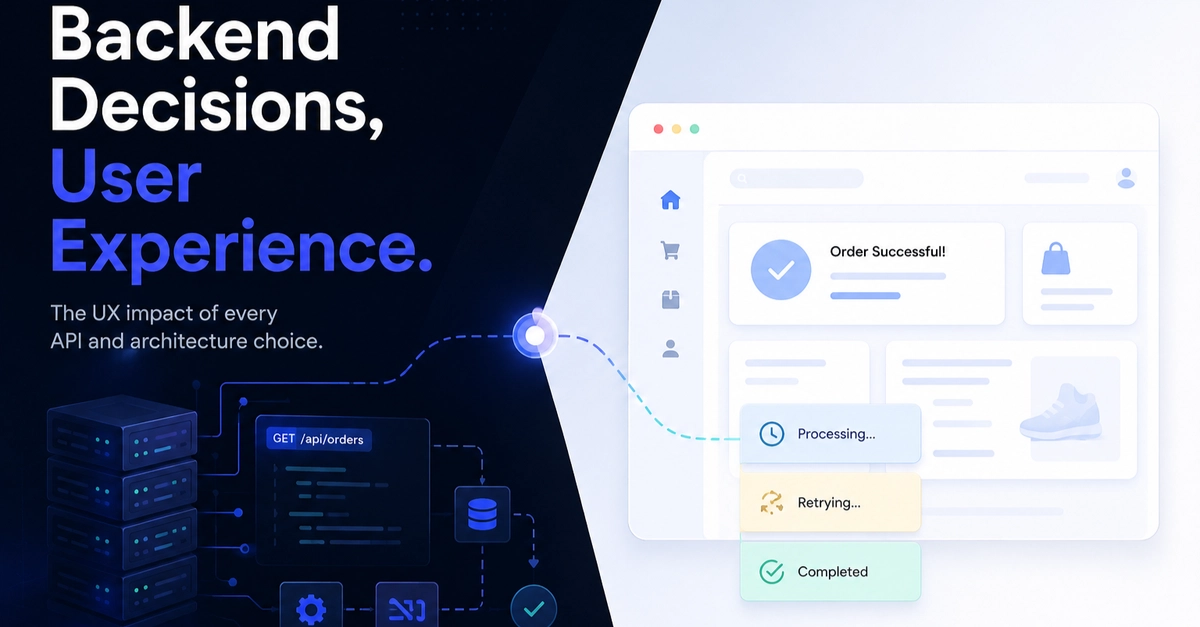
Backend's Role in User Experience
For too long, the conversation around User Experience (UX) has been dominated by UI/UX designers and frontend engineers. The assumption is that users interact solely with the visual or command-line interface, and the backend's role is purely functional – making endpoints work, ensuring architecture is sound, but otherwise detached from the user's perception of the product. This is a critical misunderstanding. Users experience the entire system, not just the part they see. Every technical decision made in the backend has a tangible impact on how a user perceives and interacts with an application.
As backend engineers gain more experience, they must look beyond technical correctness and ask a fundamental question: How does this technical decision affect the user's experience? The answer lies in understanding how backend operations translate into user-facing outcomes.
API Response Times as a UX Metric
A user doesn't care that your endpoint is technically flawless if it takes too long to respond. Slow API response times directly translate into a sluggish, frustrating user experience. When a user clicks a button, submits a form, or requests data, they expect an immediate or near-immediate response. Delays, even by a few hundred milliseconds, can lead to perceived lag. This lag can cause users to abandon tasks, lose trust in the application, and seek alternatives. Think of it like a restaurant waiter who takes an eternity to bring your order; the food might be exquisite, but the experience is soured by the wait. Backend engineers must optimize for speed, not just correctness. This involves efficient database queries, optimized algorithms, judicious use of caching, and potentially asynchronous processing for non-critical operations. The goal is to minimize latency at every stage of the request-response cycle.
Data Integrity and User Trust
Beyond speed, the accuracy and consistency of data are paramount. If a user sees incorrect information, experiences data loss, or encounters conflicting data points, their trust in the application erodes rapidly. Imagine a banking app that shows an incorrect balance, or an e-commerce site that displays an item as in stock when it's not. These are direct consequences of backend issues, such as faulty data validation, race conditions, or inconsistent database states. Ensuring data integrity means implementing robust validation rules, using transactional operations where necessary, handling errors gracefully, and designing data models that accurately reflect the real-world state. A backend system that consistently delivers accurate and reliable data builds user confidence, which is a cornerstone of a positive user experience.
Error Handling and User Perception
How a backend system handles errors significantly shapes user perception. A cryptic, unhelpful error message like "Internal Server Error 500" provides no insight and only serves to frustrate the user. Effective error handling means translating backend errors into user-friendly messages that explain what went wrong and, if possible, what the user can do about it. For example, instead of a generic failure message for a payment processing error, a user-friendly message might say, "Your payment could not be processed. Please check your card details or try a different payment method." This requires backend engineers to not only catch errors but also to contextualize them for the frontend to display appropriately. This thoughtful error management demonstrates that the system is robust and considerate of the user's journey, even when things go wrong.
Scalability and User Experience Under Load
The ability of a backend system to scale is directly tied to the user experience during peak usage. An application that performs well with a few users might become unusable when traffic surges. This can happen during marketing campaigns, product launches, or seasonal events. If the backend cannot handle the increased load, users will experience slow load times, timeouts, and outright unavailability. Scalability isn't just an architectural concern; it's a user experience imperative. Designing for scalability involves choosing appropriate technologies, employing load balancing, using stateless services where possible, and implementing auto-scaling mechanisms. The backend must be able to flex and adapt to demand, ensuring a consistent experience for all users, regardless of the current traffic volume. Think of a popular concert venue; if it can't handle the crowd, the experience for everyone deteriorates.
Security as a Foundation for Trust
While often seen as a purely technical domain, backend security is fundamental to user trust and, by extension, user experience. Users entrust applications with sensitive personal and financial data. A security breach, data leak, or even the perception of vulnerability can devastate user confidence. Backend engineers are on the front lines of protecting this data. Implementing secure authentication and authorization, encrypting sensitive data, protecting against common vulnerabilities like SQL injection and cross-site scripting (XSS), and regularly auditing security practices are all critical. A secure backend reassures users that their data is safe, allowing them to engage with the application without fear. This underlying sense of security is an invisible but vital component of the overall user experience.
The Backend Engineer's New Mandate
The days of backend engineers focusing solely on logic and architecture are over. The modern backend engineer must be a holistic problem-solver, keenly aware that their technical choices have direct, measurable impacts on the end-user. This requires a shift in mindset, prioritizing performance, reliability, accuracy, user-friendly error handling, scalability, and robust security. By embracing this broader perspective, backend teams can build applications that are not only technically sound but also deliver exceptional user experiences, fostering loyalty and driving product success.