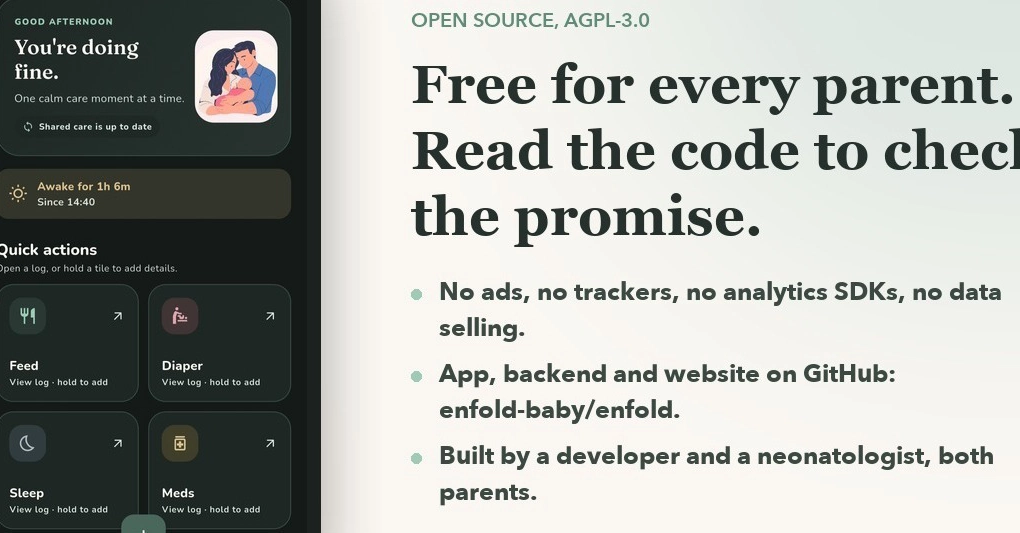
The Genesis of Enfold: A Parent's Solution
The creation of Enfold stems from a common parental challenge: the need for a straightforward, privacy-respecting tool to track infant health. Developed by a software engineer and his neonatologist wife, Enfold was designed to address the shortcomings of existing baby tracking applications. The core motivations were clear: a quiet interface for nighttime use, one-handed operation, and accurate, unadulterated information about normal infant development. Frustration with apps laden with ads, gamified streaks, and subscription walls blocking essential safety information spurred the development of Enfold. Last week, the project reached a significant milestone: its full codebase was made public on GitHub, allowing anyone to examine, use, and even self-host the application.
Transparency as a Foundation for Trust
In the realm of health applications, particularly those handling sensitive data about children, claims of prioritizing privacy are ubiquitous. However, Enfold's creators aimed to move beyond mere assurances. They built the application with a commitment to verifiable privacy, allowing users and developers to inspect the code and understand exactly how their data is handled. This commitment is evident in several key aspects of the app's design and its open-source release:
- No External Trackers: The app explicitly avoids ad SDKs, analytics SDKs, and any other form of trackers. Developers can verify this by examining the
pubspec.yamlfile and the native iOS and Android manifests. This ensures that the app's primary function—tracking health data—is not compromised by data collection for advertising or third-party analytics. - Local-First Data Handling: For users who prefer not to create an account or sync their data, Enfold operates entirely on the device. Health information remains local, never leaving the phone. This architecture provides a robust baseline of privacy for all users, regardless of their willingness to engage with cloud features.
- Self-Hostable Backend: When an account is created, data syncs securely over HTTPS to a backend server. Crucially, this backend is built using FastAPI and is designed to be small and manageable, enabling users to self-host it themselves. This offers an unparalleled level of control over data, as users can run the server in their own environment, further enhancing privacy and security.
This approach transforms the abstract promise of privacy into a tangible, inspectable reality. For parents entrusting an app with their child's health metrics, this transparency is not just a feature; it's a fundamental requirement.
The Open-Source Decision and License Nuances
The decision to open-source Enfold was driven by a desire to foster trust and allow for community contribution and scrutiny. By releasing the code, the developers empower users to understand the technology intimately. However, the nature of a health application necessitates careful consideration of its licensing, especially concerning data and potential commercial misuse. Enfold is released under a modified Apache 2.0 license, with specific carve-outs designed to maintain the project's core ethos of privacy and responsible use.
The standard Apache 2.0 license is permissive, allowing broad use, modification, and distribution. Enfold's version retains this permissiveness for personal and non-commercial use, encouraging widespread adoption for families. However, it includes explicit restrictions to prevent the creation of commercial, closed-source derivatives that might reintroduce the very problems Enfold was built to solve.
Key License Carve-Outs:
- Non-Commercial Use: The license clearly states that the software is intended for personal and non-commercial purposes. This means individuals are free to use and modify Enfold for their own families or for educational purposes.
- Prohibition of Commercial Forks: A critical carve-out prevents others from taking the Enfold codebase, making modifications, and then launching it as a new commercial product, especially one that might reintroduce advertising, subscription models, or data tracking. This protects the integrity of the project and ensures that the spirit of privacy and user-centric design is maintained.
- Attribution: As with many open-source licenses, attribution to the original creators is likely required, ensuring that the project's origins are acknowledged.
These specific license terms are vital. They allow developers and users to benefit from the open-source nature of Enfold—inspecting the code, running it locally, and contributing to its development—while simultaneously safeguarding against its exploitation for commercial gain in ways that would undermine its fundamental principles. It’s a delicate balance, aiming to be open without being vulnerable to the very issues it seeks to combat.
Referenced Sources
- verified