
The Container Revolution: Packaging Applications for Consistency
In today's fast-paced digital landscape, businesses grapple with the imperative to develop, deploy, and scale applications with unprecedented speed and efficiency. Container technology has emerged as a cornerstone of this transformation. Containers package applications into lightweight, self-contained, and portable units. This ensures they run consistently across diverse environments, from a developer's laptop to a production cloud platform. The primary benefit is the drastic reduction in dependencies, simplifying deployment and scaling efforts.
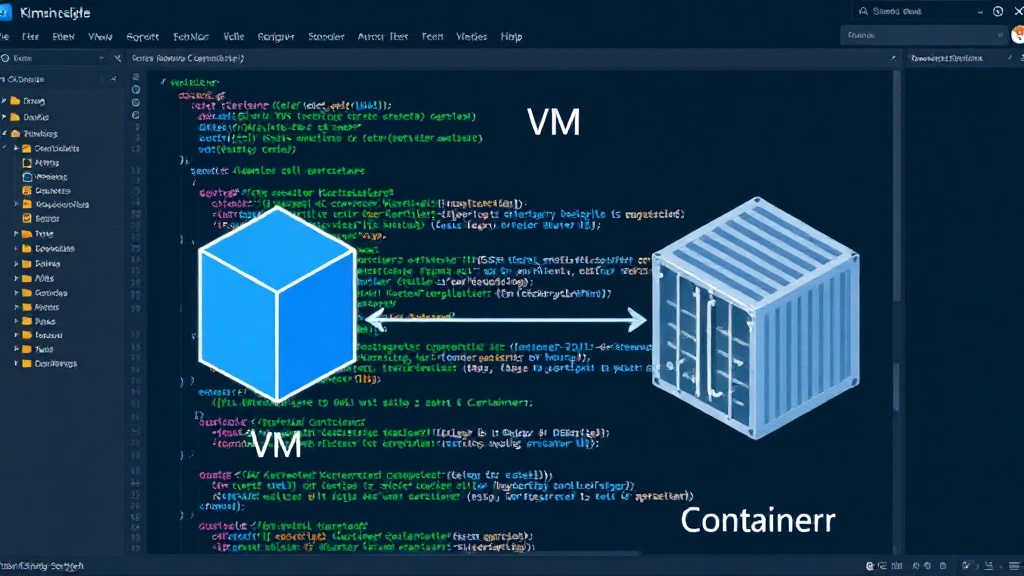
Unlike traditional virtual machines (VMs), containers share the host operating system's kernel. This architectural difference makes them significantly more resource-efficient. This efficiency translates directly into higher application density, allowing organizations to run more services on the same underlying infrastructure. It’s like fitting more apartments into the same city block by sharing the city's core utilities instead of giving each apartment its own power plant and water treatment facility.
Introducing Kubernetes: Orchestrating Container Armies
While containers solve the problem of packaging and consistent execution, managing them at scale introduces new complexities. Imagine having dozens, hundreds, or even thousands of these containers running across multiple machines. How do you ensure they are healthy, discoverable, and can communicate effectively? This is where orchestration platforms like Kubernetes come into play.
Kubernetes, often abbreviated as K8s, is an open-source system designed to automate the deployment, scaling, and management of containerized applications. It handles tasks such as load balancing, service discovery, rolling updates, and self-healing. If a container fails, Kubernetes can automatically restart it or replace it. If demand surges, Kubernetes can scale up the number of container instances to meet the load. Conversely, during lulls, it can scale down to save resources.
At its core, Kubernetes provides a declarative API. You tell Kubernetes what you want your application's desired state to be—for example, 'run three instances of my web server, expose it on port 80, and ensure it's always available.' Kubernetes then works continuously to maintain that state. It abstracts away the underlying infrastructure, allowing developers and operations teams to focus on the application itself rather than the complexities of managing servers.
Azure Kubernetes Service (AKS): Managed Kubernetes in the Cloud
While Kubernetes is powerful, setting up and managing a Kubernetes cluster from scratch can be a complex and time-consuming endeavor. It requires expertise in networking, storage, security, and the Kubernetes control plane itself. This is precisely the problem that Azure Kubernetes Service (AKS) solves.
AKS is a managed Kubernetes service offered by Microsoft Azure. It significantly simplifies deploying, managing, and operating Kubernetes clusters in Azure. Microsoft handles the complex, undifferentiated heavy lifting of maintaining the Kubernetes control plane—the core components that manage the cluster. This includes the API server, etcd (the distributed key-value store), and the scheduler. For users, this means they can focus on deploying their applications without worrying about the operational burden of managing the Kubernetes infrastructure.
With AKS, users can spin up a Kubernetes cluster in minutes. Azure manages the availability and security of the control plane, while the user is responsible for the worker nodes (the machines that run the actual application containers). However, even managing worker nodes is simplified through features like automated node provisioning, scaling, and upgrades. AKS integrates seamlessly with other Azure services, such as Azure Monitor for logging and metrics, Azure Container Registry for storing container images, and Azure Active Directory for access control.
Key Benefits of Using AKS
The adoption of AKS brings several distinct advantages to organizations looking to leverage cloud-native technologies:
- Simplified Operations: As mentioned, Microsoft manages the Kubernetes control plane, reducing the operational overhead for users.
- Scalability and Elasticity: AKS allows for easy scaling of applications based on demand, both horizontally (adding more container instances) and vertically (increasing resources for existing instances). Auto-scaling capabilities ensure that applications can handle fluctuating workloads efficiently.
- Hybrid and Multi-Cloud Capabilities: While AKS is an Azure-native service, its foundation in Kubernetes allows for a degree of portability. Organizations can develop and test applications on AKS and potentially deploy them on other Kubernetes environments, facilitating hybrid or multi-cloud strategies.
- Enhanced Security: AKS provides robust security features, including integration with Azure Active Directory for authentication and role-based access control (RBAC). It also supports network policies for fine-grained traffic control between pods and integration with Azure security services.
- Developer Productivity: By abstracting infrastructure management, AKS empowers developers to deploy and manage their applications more rapidly. Integration with CI/CD tools and development environments further streamlines the developer workflow.
The Cloud-Native Journey Begins
The cloud-native paradigm, with containers and Kubernetes at its heart, represents a fundamental shift in how applications are built and operated. It prioritizes agility, scalability, and resilience. Azure Kubernetes Service provides an accessible and powerful entry point into this world for organizations already invested in the Azure ecosystem or those looking for a managed Kubernetes solution.
This series will continue to explore deeper aspects of AKS, including practical deployment strategies, networking, storage, and advanced management techniques. Understanding the foundational concepts of containers and Kubernetes orchestration is the crucial first step in harnessing the full potential of cloud-native architectures.