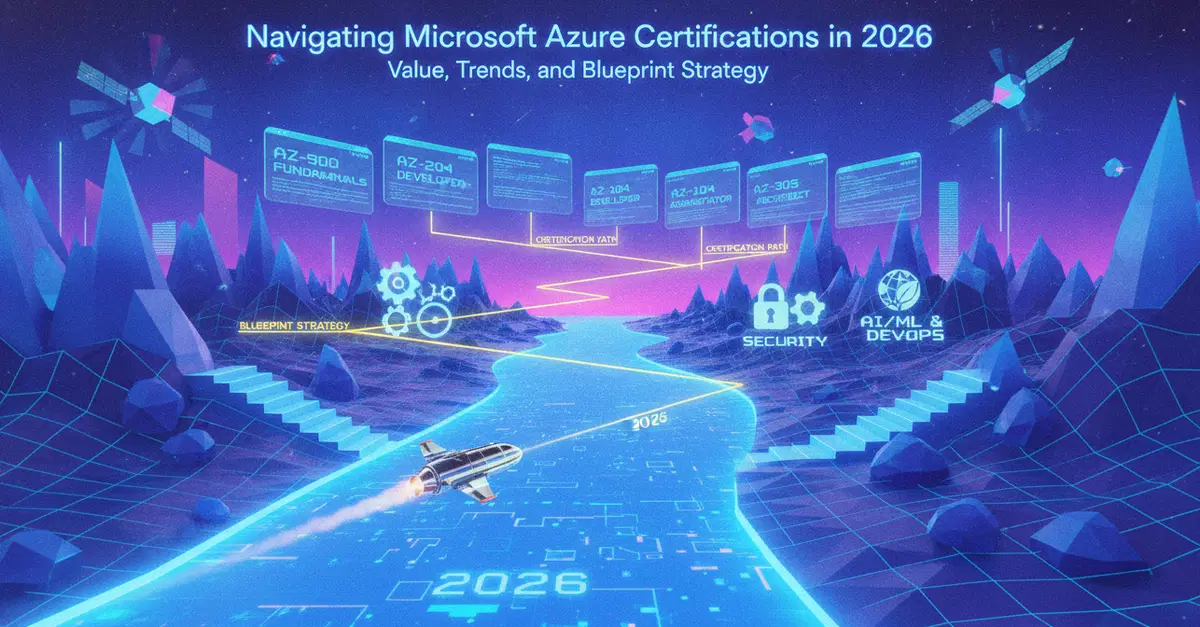
The Shifting Landscape of Azure Expertise
By 2026, the cloud landscape is no longer solely about lifting and shifting virtual machines to public clouds. The focus has dramatically shifted towards hybrid operations, unified security telemetry, sophisticated AI integration, and the complex governance required for multi-region architectures. As enterprise technology stacks continue their rapid evolution, Microsoft Azure certifications remain a critical benchmark for assessing technical competence. However, many engineers struggle to identify the most relevant certification tracks that align with current and future market demands.
This analysis aims to clarify the current standing of Microsoft credentials, assess what the market truly requires, and map specific exams to practical, real-world scenarios. The value of certification has moved beyond mere recognition of features; it now signifies the ability to solve operational problems under realistic constraints.

Market Trends: Why Azure Credentials Still Drive Real ROI
The value proposition for Azure certifications in 2026 centers on practical, hands-on problem-solving. Exams are increasingly designed to test scenario-based trade-offs, requiring candidates to make informed decisions about resource allocation, security posture, and service integration under pressure. This reflects a market demand for professionals who can navigate the complexities of modern, distributed cloud environments.
Key trends shaping certification value include:
- Hands-on Scenario Focus: Exams increasingly test scenario-based trade-offs—balancing cost, performance, security, and compliance. This moves away from rote memorization towards applied knowledge.
- Hybrid Cloud Mastery: With organizations operating both on-premises and in the cloud, certifications validating hybrid solutions (e.g., Azure Arc, Azure Stack) are paramount. Understanding how to manage and secure resources across these environments is a core requirement.
- AI and Machine Learning Integration: As AI becomes embedded in enterprise applications, certifications covering Azure Machine Learning, Azure OpenAI Service, and related data services are gaining significant traction. Professionals need to demonstrate proficiency in building, deploying, and managing AI workloads.
- Unified Security and Compliance: The increasing sophistication of cyber threats necessitates a consolidated approach to security. Certifications that cover Microsoft Defender for Cloud, Azure Sentinel, and identity management (Azure AD/Entra ID) are crucial for establishing and maintaining a robust security posture across hybrid and multi-cloud environments.
- Advanced Networking and Governance: Managing complex, multi-region deployments requires deep knowledge of Azure networking (e.g., Virtual WAN, ExpressRoute) and governance frameworks (e.g., Azure Policy, management groups). Certifications in these areas validate an engineer's ability to design scalable, secure, and compliant cloud infrastructures.
The Blueprint Strategy: Aligning Certifications with Career Goals
To effectively navigate Azure certifications in 2026, a strategic approach is essential. This involves understanding the different certification paths and aligning them with specific career objectives and the evolving demands of the tech industry.
Foundational Level: Azure Fundamentals (AZ-900)
This remains the starting point for many. It covers core Azure concepts, services, security, privacy, compliance, and trust, plus pricing and support. While not deep, it's a necessary primer.
Associate Level: Core Competencies
This level offers several critical paths:
- Azure Administrator Associate (AZ-104): Focuses on implementing, managing, and monitoring identity, governance, storage, compute, and virtual networks. This is foundational for anyone managing Azure resources.
- Azure Developer Associate (AZ-204): Covers designing, building, testing, and maintaining cloud applications and services on Azure. Essential for developers working with Azure services.
- Azure Security Engineer Associate (AZ-500): Validates skills in implementing security controls, threat protection, identity and access management, and data security. Crucial in today's threat landscape.
- Azure AI Engineer Associate (AI-102): Tests the ability to implement Azure AI solutions, including natural language processing, computer vision, and conversational AI. This is a rapidly growing area.
Expert Level: Specialization and Leadership
For those seeking to demonstrate deep expertise:
- Azure Solutions Architect Expert (AZ-305): The pinnacle for designing robust, scalable, and secure cloud solutions. It requires passing either the AZ-104 or AZ-204 exam first, followed by AZ-305. This exam dives deep into architectural trade-offs and best practices for complex deployments, including hybrid scenarios.
- Azure DevOps Engineer Expert (AZ-400): Focuses on combining people, processes, and technologies to deliver value through software. It covers strategy and implementation of DevOps practices.
Beyond the Exam: Continuous Learning and Practical Experience
While certifications provide a structured learning path and a recognized credential, they are not a substitute for hands-on experience. The most successful cloud professionals combine their certification knowledge with practical application in real-world projects. Continuous learning is also vital, as Azure services are updated constantly. Staying current with new features, services, and best practices ensures that your skills remain relevant.
The market in 2026 demands more than just theoretical knowledge. It requires individuals who can architect, secure, and optimize complex cloud environments, leveraging AI and hybrid capabilities. Strategic certification planning, coupled with persistent hands-on practice, is the most effective blueprint for career success in the evolving Azure ecosystem.