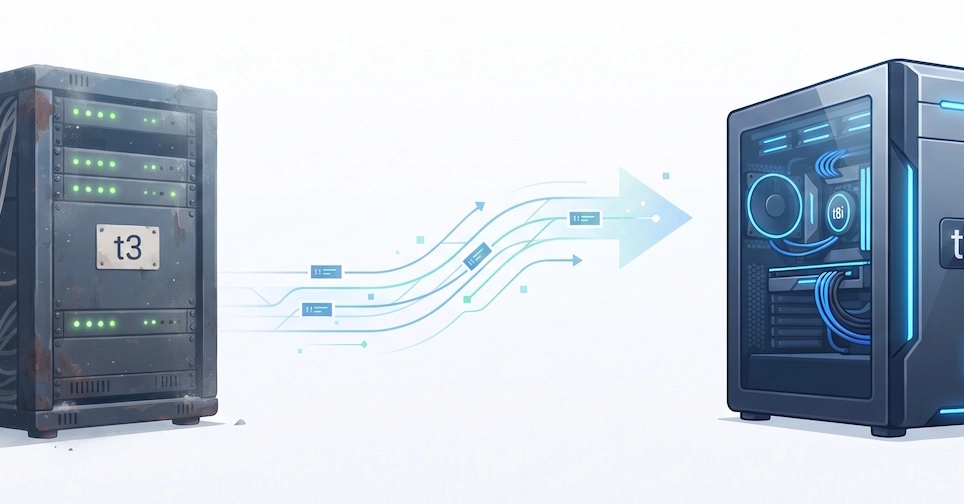
Introducing the AWS T8i Instance Family
Amazon EC2 has unveiled its latest generation of low-cost, burstable instances: the T8i family. Built on the robust AWS Nitro System and featuring custom 6th Generation Intel Xeon Scalable processors (codenamed Granite Rapids), these instances are engineered for workloads that experience low to moderate CPU utilization. This includes common applications like microservices, development and testing environments, low-traffic websites, and batch processing tasks. The key question on many users' minds is how these new instances stack up against their predecessors, particularly the venerable T3 instances.
The T3 instances, launched in 2018, have served many users well for years. However, in the fast-paced world of computing, eight years represents a significant technological leap. The T8i instances aim to bridge this gap, offering substantial improvements in performance, efficiency, and underlying architecture. This article explores the key differences and evaluates whether it's time to consider migrating from T3 to T8i.
Under the Hood: Architecture and Performance
The most striking difference lies in the processor architecture. While T3 instances utilize older Intel processors, the T8i instances are powered by Intel's latest 6th Generation Xeon Scalable processors. This generational leap translates directly into enhanced performance. These new chips are designed for greater power efficiency and higher clock speeds, enabling the T8i instances to deliver more compute power per core. The AWS Nitro System, a cornerstone of modern EC2 instances, further optimizes performance by offloading virtualization, networking, and storage functions to dedicated hardware, allowing the main CPUs to focus entirely on running customer workloads.
For burstable instances, sustained performance and efficient bursting are critical. The T8i instances are expected to offer improved baseline performance and more responsive CPU bursting capabilities compared to T3. This means applications that experience occasional spikes in demand will see quicker recovery and better responsiveness. The improved architecture also contributes to better overall energy efficiency, a growing concern for both AWS and its customers.
Key Differences and Advantages of T8i
Beyond the core processor upgrade, several other factors differentiate the T8i from the T3:
- Enhanced CPU Performance: The 6th Gen Intel Xeon processors provide a significant uplift in raw processing power and instruction-per-clock cycle efficiency.
- Improved Memory Bandwidth: Newer processor generations typically come with support for faster memory, leading to better overall system performance, especially for memory-intensive applications.
- Latest Networking Capabilities: While specific details might vary, newer instance families generally incorporate the latest networking advancements for lower latency and higher throughput.
- AWS Nitro System Benefits: T8i instances fully leverage the Nitro System, which has been refined over several years, offering more efficient resource allocation and better security isolation.
- Cost-Effectiveness: While pricing details are still emerging, AWS typically aims to offer better price-performance ratios with new instance generations. The T8i instances are positioned as low-cost options, suggesting they could offer more compute for the dollar compared to T3s.
When to Consider Migrating from T3 to T8i
The decision to migrate from T3 to T8i depends on your specific workload characteristics and performance requirements. If your applications are currently CPU-bound or if you've experienced performance limitations with T3 instances, the T8i family presents a compelling upgrade path. Consider migrating if:
- You need more sustained CPU performance: For applications that regularly utilize a significant portion of their allocated CPU credits, the improved baseline performance of T8i will be beneficial.
- Your applications are sensitive to latency: The newer architecture and potential networking improvements in T8i could lead to reduced latency.
- You are looking for better price-performance: As cloud infrastructure evolves, newer generations often provide more value. Benchmarking your current T3 performance against T8i on a cost-per-unit-of-work basis is advisable.
- You are deploying new workloads: For any new application or service, starting with the latest generation of burstable instances like T8i is generally recommended to leverage the most current technology and optimize for future needs.
The T3 instances, while still functional, are nearing the end of their lifecycle for new deployments and may eventually be phased out. AWS often provides advance notice for such transitions, but planning for the future is prudent. The performance gap between T3 and T8i is substantial, making the upgrade a strong consideration for many users.
The Unanswered Question: End-of-Life for T3?
While AWS has not announced an immediate end-of-life for T3 instances, the introduction of T8i marks a clear technological successor. The critical question for IT decision-makers is not if T3 instances will eventually be retired, but when and how AWS will manage this transition. Will there be a prolonged period where both families are supported, or will AWS encourage migration more aggressively through pricing or support changes? Understanding the long-term roadmap for T3 instances will be crucial for strategic capacity planning and avoiding last-minute migration challenges.
Conclusion: A Clear Evolution
The AWS T8i instances represent a significant step forward from the T3 family. Powered by next-generation Intel processors and the efficient AWS Nitro System, they offer enhanced performance, better efficiency, and improved responsiveness for burstable workloads. For developers and businesses running applications on T3 instances, the T8i family presents a clear and compelling opportunity to upgrade. While T3 instances remain available, the technological advancements offered by T8i make them the logical choice for new deployments and a strong candidate for migration for existing workloads seeking better performance and value.