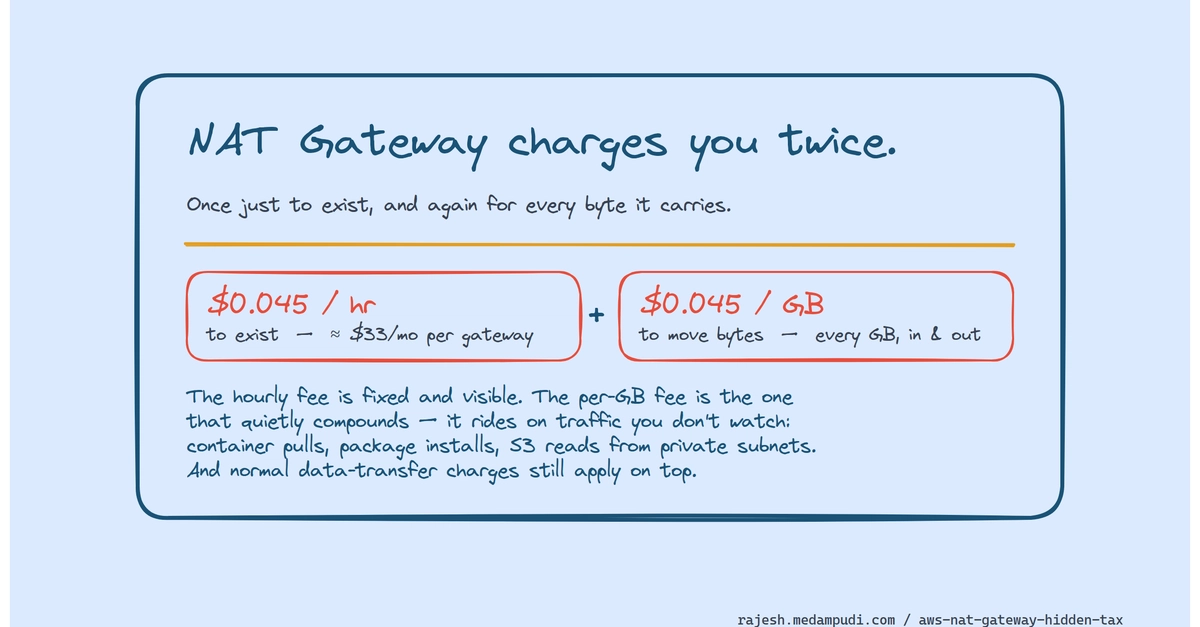
The Dual NAT Gateway Charge
Many AWS users are unknowingly paying double for data processed by their NAT Gateways. This isn't a single fee; it's a two-part charge that often leads to bill shock. The first charge is the hourly fee for keeping the NAT Gateway provisioned. This fee applies regardless of whether any traffic is passing through it. The second, and often more significant, charge is for the data processed by the gateway. This is billed per gigabyte, and it accumulates quickly for services that frequently communicate with the public internet.
The complexity of AWS billing can obscure these costs. The hourly charge might appear under a general networking section, while the data processing fee is often itemized separately. This separation allows the data processing cost to become a "hidden tax" for many organizations, as they may only notice the hourly fee and underestimate the total expense. Understanding both components is the first step to optimizing your AWS spend.

The Free Fix: Gateway Endpoints
Fortunately, a straightforward and free solution exists for the most common and expensive NAT Gateway traffic: S3 and DynamoDB. AWS offers gateway endpoints for these services. When you configure a gateway endpoint, you create a private connection from your Virtual Private Cloud (VPC) directly to S3 or DynamoDB, bypassing the public internet entirely. This means traffic destined for these services never needs to traverse your NAT Gateway.
Adding these endpoints is a simple process within the VPC console. You select your VPC, choose to create an endpoint, select the service (S3 or DynamoDB), and specify the route tables associated with your private subnets. Once configured, your instances in those private subnets can access S3 and DynamoDB using their private IP addresses, and all associated data transfer costs through the NAT Gateway are eliminated for these services. This is not a theoretical optimization; it's a practical, immediate cost-saving measure.
Strategic Routing for Cost Reduction
The core strategy to kill the hidden NAT Gateway tax is to route traffic intelligently. For services like S3 and DynamoDB, gateway endpoints are the obvious first step. They are free to enable and directly address the highest volume, most expensive traffic patterns. By diverting this traffic, you immediately reduce the per-gigabyte data processing costs associated with your NAT Gateway.
Beyond S3 and DynamoDB, consider other services that might not require direct outbound internet access. If your applications need to reach other AWS services, check if VPC endpoints (interface endpoints, which are different from gateway endpoints and incur their own hourly and data processing charges, but can be cheaper than NAT Gateway for specific use cases) are available and suitable. For services that absolutely must reach the public internet, evaluate if the volume of traffic justifies the NAT Gateway cost. In many scenarios, the savings from implementing gateway endpoints for S3 and DynamoDB are substantial enough that further optimization might not be immediately necessary.
When to Consider Alternatives
While gateway endpoints offer a powerful, free solution for S3 and DynamoDB, they don't cover all use cases. If your private instances need to access a wide range of public internet resources, or if you have very high throughput requirements that even optimized traffic patterns can't sufficiently reduce, you might need to explore other options. These could include running your own NAT instances on EC2 (which requires more management overhead), or investigating third-party NAT solutions.
However, the immediate and most impactful step for nearly every AWS user with a NAT Gateway line item is to implement S3 and DynamoDB gateway endpoints. This single change can reduce NAT Gateway data processing costs by 50% or more, depending on your workload. It’s a no-brainer that requires minimal effort and delivers immediate financial relief. The key is to identify where your data is going and to leverage AWS's private connectivity options whenever possible.