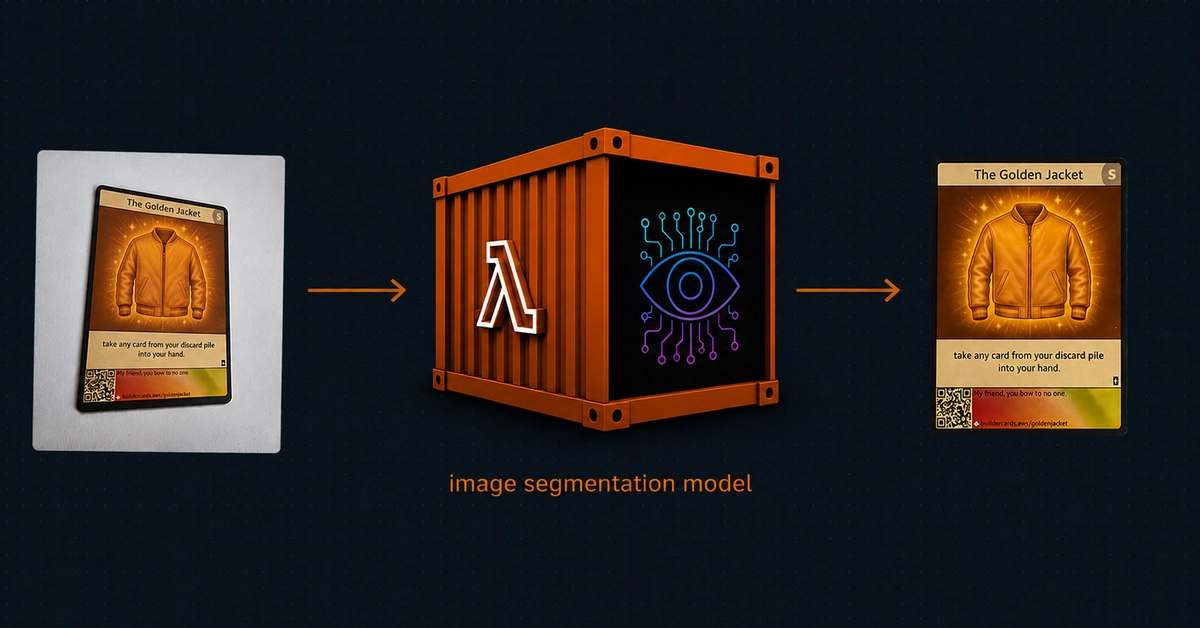
The Challenge: Straightening and Isolating Cards from Photos
The goal is to take a crooked, everyday phone photo of a card and transform it into a clean, straight, isolated image. This isn't about simple cropping; it's about sophisticated image processing that can correct perspective distortion and precisely delineate the card from its background. The system needs to be robust enough to handle variations in lighting, angles, and background clutter. The key constraint? Achieving this without dedicated GPUs, relying instead on the capabilities of AWS Lambda, specifically its largest available container configuration.
The process begins with an uploaded image, often a mobile phone snapshot. This raw input is fed into an image processing pipeline. The first step in this pipeline is image segmentation. This AI task identifies and separates the target object – the card – from the rest of the image. Following segmentation, a perspective transformation is applied to straighten the card, correcting for any skew or tilt introduced by the camera angle. The final output is a perfectly aligned, high-quality image of the card, ready for further use, such as data extraction or display.
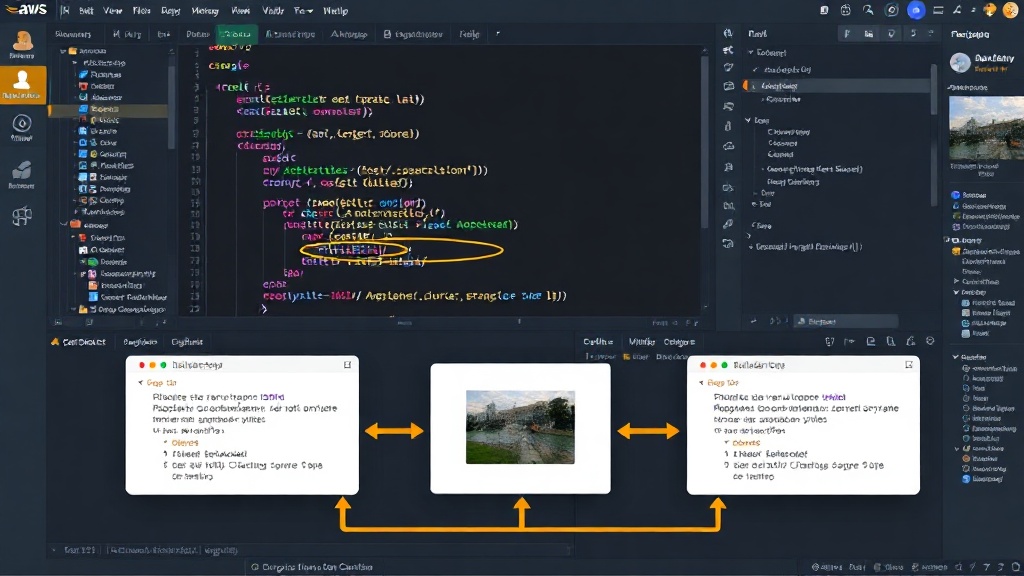
Building the Pipeline on AWS Lambda
The entire image processing pipeline is designed to run within AWS Lambda. This serverless compute service allows developers to run code without provisioning or managing servers. For computationally intensive tasks like image processing and AI model inference, Lambda's performance is directly tied to the resources allocated to its execution environment. The team opted to use the largest Lambda container size available, which provides 10GB of memory and 3 vCPUs, running for a maximum of 15 minutes per invocation. This configuration is crucial because the image segmentation model, while not requiring a GPU, is still resource-intensive. The challenge lies in fitting the model and its dependencies into Lambda's environment and ensuring it performs within the service's time limits.
The decision to use Lambda offers significant advantages. Firstly, it provides an event-driven architecture. The processing only runs when an image is uploaded, meaning no resources are consumed when the system is idle. This is a stark contrast to a continuously running server or a dedicated GPU instance. Secondly, it scales automatically. As more images are uploaded concurrently, Lambda can spin up multiple instances of the function to handle the load, up to account concurrency limits. However, the 'maxed-out' Lambda container, while substantial, is not infinite. Developers must carefully manage dependencies, optimize model inference, and ensure efficient code execution to avoid timeouts or out-of-memory errors.
The Image Segmentation Model: No GPU, Big Lambda
The core of the solution is an image segmentation model. Unlike many deep learning tasks that benefit immensely from parallel processing on GPUs, this model is designed to run effectively on CPUs. This is a critical design choice that enables its deployment on Lambda, which does not natively support GPU acceleration for general-purpose functions. The model's architecture and the framework it runs on are optimized for CPU inference. However, even with CPU optimization, the model demands significant computational power and memory. This is why the largest Lambda container size is essential. It provides the necessary horsepower and RAM to load the model, process the input image, and generate the segmentation mask within the allocated time.
Fitting a complex AI model and its supporting libraries into Lambda's deployment package size limits (250MB unzipped) and execution environment is a significant engineering feat. This often involves techniques like model quantization, selective library inclusion, and potentially using Lambda Layers to manage dependencies. The 'maxed-out' Lambda, while offering 10GB of RAM, still requires careful memory management. Developers must monitor memory usage during inference to prevent the function from crashing due to exceeding the limit. The performance tuning is a delicate balance between model accuracy, inference speed, and resource constraints.
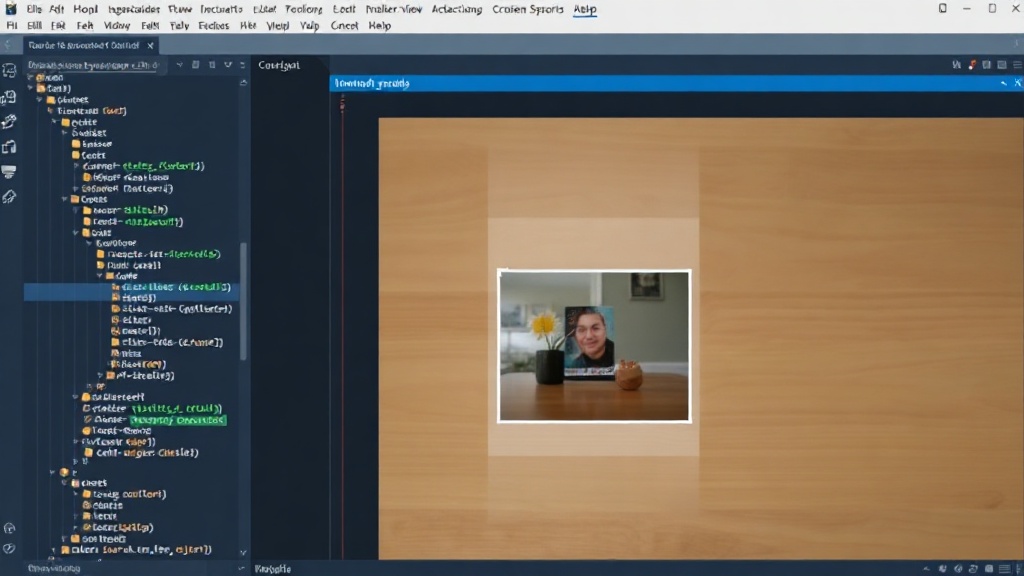
The Outcome: Clean, Straight Card Images
The result of this pipeline is a remarkably accurate transformation. A user uploads a photo of a card, potentially taken in suboptimal conditions – think glare, a slightly tilted phone, or a busy background. The Lambda function, triggered by the upload, executes the segmentation and perspective correction. The output is a perfectly oriented, edge-to-edge image of the card. This clean image can then be used for various downstream applications. For instance, if the card contains text or data, this processed image is ideal for optical character recognition (OCR) without the noise and distortion of the original photo. For display purposes, it presents a professional and standardized view of the card.
The 'no GPU, nothing running when nobody uploads' paradigm is a powerful demonstration of serverless efficiency. It offers a cost-effective and scalable solution for image processing tasks that might otherwise require dedicated, always-on infrastructure. The success hinges on the careful selection and optimization of the AI model and the precise configuration of the Lambda environment to meet the demands of the task. This approach proves that complex AI inference can be achieved on serverless platforms, provided the engineering challenges of resource management and model optimization are thoroughly addressed.
Future Considerations and Scaling
While the current setup effectively handles individual card images, scaling to massive volumes or more complex image processing tasks might require further architectural considerations. If inference times push the limits of the 15-minute timeout, or if memory constraints become a bottleneck for larger images or more complex models, alternative strategies might be necessary. These could include exploring multi-function Lambda workflows, leveraging services like AWS Step Functions to orchestrate more complex processing chains, or even re-evaluating the need for specialized compute if performance requirements significantly increase. However, for the specific task of straightening and segmenting card images from typical phone photos, the 'maxed-out' Lambda container provides a compelling, cost-efficient solution.