Ava: A Conversational AI for English Language Practice
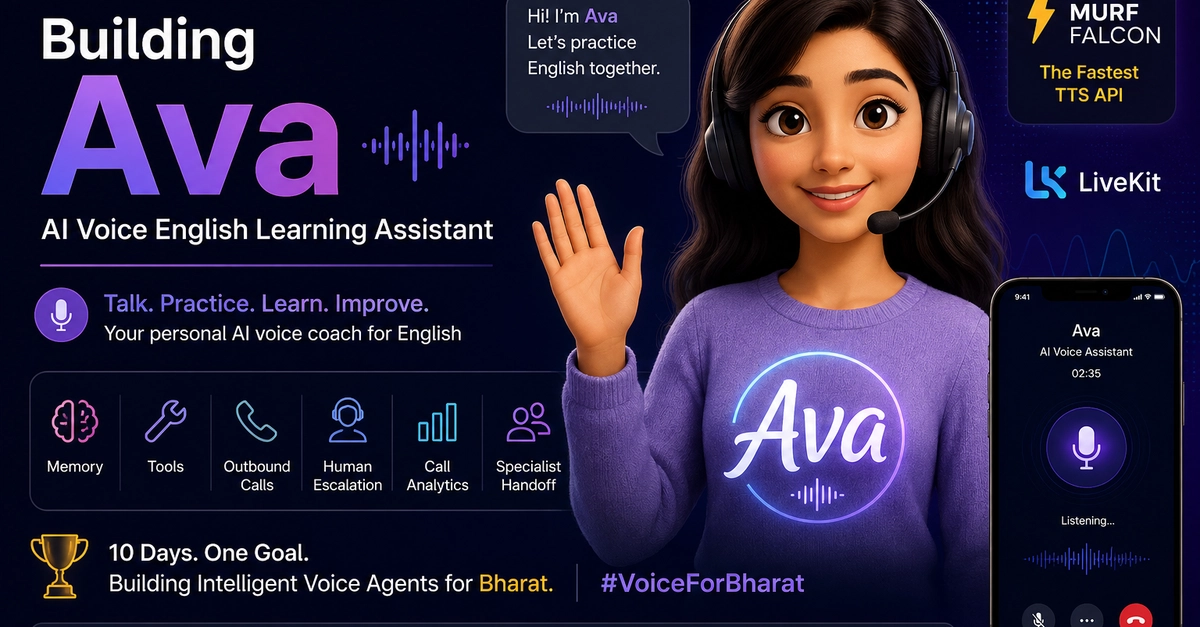
In a 10-day sprint, a developer built Ava, an AI-powered voice assistant designed to revolutionize English language learning. Unlike traditional typing-based applications, Ava enables learners to practice speaking through natural, real-time voice conversations. The core objective was not merely to create an AI that could speak, but one that could actively listen, comprehend, retain information, initiate actions, and crucially, recognize when human intervention or the expertise of a specialist agent was required. This project, part of the VoiceForBharat initiative, transformed a simple voice agent into a sophisticated voice AI system capable of complex interactions.
Ava's design prioritizes a natural conversational flow. Learners can speak directly to Ava, bypassing the need for text input. Ava processes the spoken words, understands the user's intent, and responds contextually. This approach simulates real-world conversation practice, a critical component often missing in digital language learning tools. The system’s ability to remember past interactions and user preferences allows for personalized learning experiences, adapting to the individual's progress and learning style over time.
Technical Architecture and Key Components
The development of Ava leveraged several key technologies to achieve its advanced conversational capabilities. Murf Falcon, a powerful speech-to-text and text-to-speech engine, forms the backbone of Ava's voice processing. This allows Ava to accurately transcribe user speech and generate natural-sounding responses in real-time. LiveKit, an open-source infrastructure for building video and audio applications, provides the real-time communication layer, ensuring seamless and low-latency voice interactions between the learner and the AI.
The system's intelligence extends beyond basic conversation. It incorporates features like memory, enabling Ava to recall previous topics and user information, creating a more cohesive and personalized dialogue. This memory function is vital for tracking a learner's progress and tailoring feedback. Furthermore, Ava is equipped with tools that allow it to perform specific actions based on the conversation, such as retrieving information or guiding the user through exercises. The system also includes outbound calling capabilities, potentially for proactive learning prompts or practice scenarios.
Advanced Features: From Conversation to Action
Ava's design goes beyond simple Q&A. It’s built to handle more complex scenarios, including human escalation and specialist agent handoffs. This means that if Ava encounters a query it cannot answer or a situation requiring human empathy or nuanced understanding, it can seamlessly transfer the conversation to a human agent. This hybrid approach ensures that learners always receive appropriate support, whether from the AI or a human expert. The specialist agent handoff feature allows for specific learning needs to be met by agents trained in particular areas, such as grammar, pronunciation, or business English.
Call analytics provide valuable insights into learner performance and interaction patterns. This data can help identify common errors, areas of difficulty, and overall progress, informing both the learner and potentially the developers of the system. The ability to analyze conversations allows for continuous improvement of Ava’s responses and learning modules. The goal is to create a comprehensive learning ecosystem where the AI acts as a persistent, accessible, and intelligent tutor.
The Significance of Real-Time Voice Interaction
The emphasis on real-time voice interaction is central to Ava's efficacy as a learning tool. Speaking a language involves not just vocabulary and grammar but also pronunciation, intonation, and fluency. By engaging in live conversations, learners can practice these crucial elements in a low-stakes environment. Ava provides immediate feedback on pronunciation and can correct grammatical errors as they occur, fostering better speaking habits. This direct practice is far more effective than rote memorization or text-based exercises for developing conversational competence.
The project highlights a broader trend in AI development: the move towards more natural and intuitive human-computer interaction. Voice interfaces are becoming increasingly sophisticated, enabling AI agents to perform complex tasks and engage in meaningful dialogues. Ava represents a practical application of these advancements in the field of education, offering a scalable and accessible solution for English language learners worldwide. The ability to deploy such a system within a short timeframe also demonstrates the power of modern AI development tools and frameworks.
Future Implications for AI in Education
Ava's development signals a promising future for AI in personalized education. The combination of advanced speech processing, conversational AI, and real-time feedback creates a potent learning tool. Such systems can adapt to individual learning paces, provide consistent practice opportunities, and offer support anytime, anywhere. This could significantly democratize access to quality language education, especially in regions where qualified human tutors are scarce or expensive.
The underlying architecture, combining a robust speech engine with a flexible real-time communication platform and intelligent agent logic, is a blueprint for future AI-driven educational applications. As these technologies mature, we can expect to see AI tutors capable of handling even more complex subjects and providing even deeper levels of personalized instruction. The challenge ahead lies in scaling these systems, ensuring their ethical deployment, and continuously refining their ability to foster genuine understanding and skill development.