Triggering Autonomous Agents: Diagnosis Over Breach
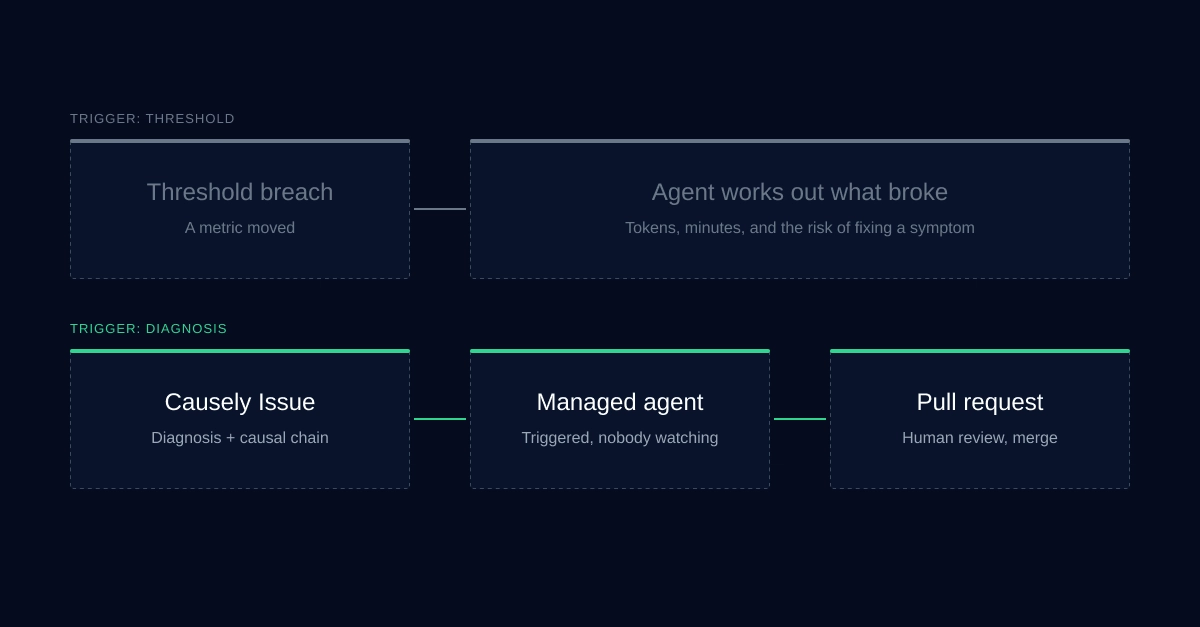
The question of what should initiate an autonomous agent in a production environment is critical for effective and efficient operation. Source 1, drawing from Anthropic's AI-Native SDLC Playbook, posits that agents should be triggered by a diagnosis rather than merely a breach of a control band. While monitoring production for control band breaches is a valid approach, it means the agent's initial, and often most expensive, phase is spent determining what went wrong. A trigger that initiates a causal chain, starting from a diagnosed issue, carries the agent further along the problem-solving path from the outset.
Anthropic’s playbook outlines a six-stage SDLC, from planning to maintenance, detailing how agents can perform tasks within these stages while humans retain accountability. The core idea is to leverage agents for execution but not for the initial problem identification if a more precise trigger can be established. This approach aims to optimize the agent’s computational resources and time by having it act on a pre-identified problem rather than a symptom.
Consider this analogy: If your car’s check engine light comes on (a breach of control), you might take it to a mechanic who then diagnoses the specific problem (e.g., a faulty oxygen sensor). An agent triggered by a diagnosis would be akin to the mechanic already knowing it's the oxygen sensor and starting the repair process, rather than spending time figuring out what the light means. This proactive or diagnostic trigger allows the agent to move directly to solutions, potentially reducing response times and costs.
Decomposing Work Around Failure Boundaries for Reliability
Beyond the trigger mechanism, Source 2 introduces the concept of decomposing work around failure boundaries as a cornerstone for engineering reliable multi-agent pipelines. This perspective challenges the notion that simply increasing the number of agents automatically solves larger problems. Instead, it emphasizes a more nuanced approach to production reliability.
The example from Monogram.io, which built a nine-agent pipeline to generate code, interactive previews, and implementation guides from natural language, highlights this. This system serves thousands of users daily but initially consumed significant tokens and model calls per request. The key takeaway from their experience is the strategic decision-making involved in defining:
- What work belongs to a model: Identifying tasks that are best suited for AI processing, considering their complexity, determinism, and potential for error.
- Mandatory context: Determining the essential information that must be provided to the agents to ensure accurate and relevant outputs. This involves defining clear input requirements and data schemas.
- Strict contracts over freeform generation: Implementing well-defined interfaces and protocols between agents, or between agents and external systems. This means replacing loosely defined instructions with rigid, predictable interactions, much like traditional software engineering contracts.
By decomposing the overall task into smaller, manageable sub-tasks, and defining clear responsibilities and interaction protocols for each agent, the pipeline becomes more robust. If one agent fails or produces an erroneous output, the impact is contained. This boundary-driven decomposition allows for easier debugging, targeted improvements, and a more resilient system overall. It’s about building a system where failures are isolated and managed, rather than cascading and bringing down the entire operation. This is analogous to how microservices architecture isolates failures within individual services, preventing a single service outage from affecting the entire application.
The Interplay Between Trigger and Architecture
The two sources, while focusing on different aspects, converge on a shared principle: proactive and structured design for autonomous agent deployment. Triggering an agent based on a diagnosis (Source 1) sets the stage for efficient operation. Decomposing work around failure boundaries (Source 2) ensures that this operation is reliable and maintainable. An agent triggered by a diagnosis is more effective when it operates within a system architected for resilience, where its tasks are clearly defined and its potential failure points are isolated.
What remains unaddressed is the optimal strategy for identifying and formalizing these