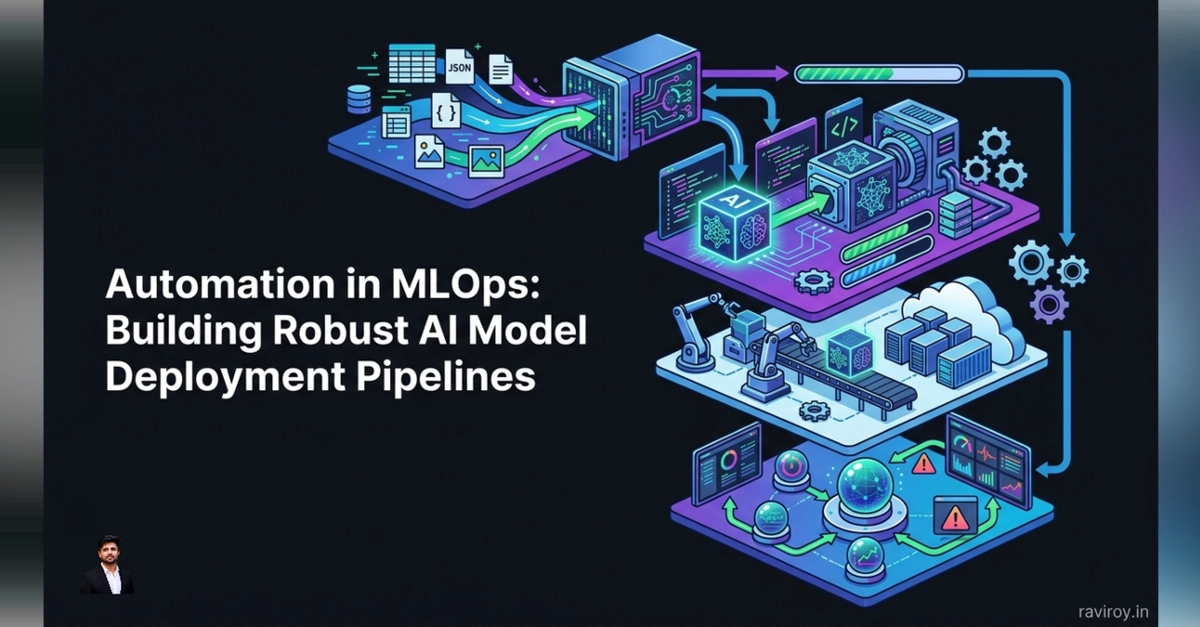
The AI Deployment Minefield: Why Automation is Non-Negotiable
Deploying AI models into production is a complex dance. You've painstakingly trained a high-performing model, but the journey to a reliable, scalable, and continuously improving production asset is fraught with peril. For too long, development teams have grappled with the friction of manual processes, the chaos of environment drift, and the sheer difficulty of keeping pace with rapid iteration. This isn't a minor inconvenience; it's a fundamental bottleneck that transforms promising AI experiments into costly failures.
Automation in MLOps is not a luxury; it is the essential foundation upon which successful, production-grade AI systems are built. It bridges the gap between experimental curiosity and tangible business value, enabling organizations to move beyond proof-of-concepts and deliver AI solutions that are robust, scalable, and trustworthy.
Defining the Automated MLOps Pipeline
MLOps, at its core, represents the convergence of Machine Learning, DevOps, and Data Engineering. Its overarching goal is to systematically streamline the entire lifecycle of an ML model, from initial data collection and model training through to deployment, monitoring, and retraining. An automated MLOps pipeline operationalizes this by establishing a continuous integration, continuous delivery, and continuous training (CI/CD/CT) framework specifically tailored for machine learning workflows.
Think of it less like a traditional software deployment pipeline and more like a highly sophisticated, self-driving car for AI. It doesn't just move the model from point A to point B; it constantly monitors the road, adjusts to conditions, logs its performance, and can even autonomously reroute or initiate repairs if something goes wrong. This level of automated oversight and control is critical for managing the unique complexities of ML systems, such as data drift, model decay, and the need for frequent retraining.
Key Components of an Automated MLOps Pipeline
Building a robust automated MLOps pipeline involves integrating several critical components. Each stage is designed to reduce manual intervention and increase reliability:
1. Data Management and Versioning
The foundation of any ML model is its data. An automated pipeline must include robust mechanisms for data ingestion, validation, transformation, and, crucially, versioning. Data versioning ensures reproducibility by tracking not only the code used for training but also the exact datasets. This prevents the dreaded scenario where a model performs well in development but fails in production due to subtle data discrepancies.
2. Model Training and Experiment Tracking
Automating the training process involves setting up reproducible training environments and experiment tracking tools. These tools log key metrics, hyperparameters, model artifacts, and code versions for every training run. This allows teams to easily compare experiments, debug failures, and select the best-performing models for deployment. The pipeline can be triggered automatically based on new data or performance degradation alerts.
3. Model Validation and Testing
Before a model can be deployed, it must undergo rigorous validation. This includes not only standard software testing but also ML-specific tests for bias, fairness, robustness, and performance against predefined benchmarks. Automated pipelines integrate these checks, ensuring that only models meeting quality standards proceed to deployment.
4. CI/CD for ML Models
This is where the DevOps principles truly shine. Continuous Integration (CI) for ML involves automatically building and testing code and data pipelines whenever changes are committed. Continuous Delivery (CD) automates the deployment of validated models to various environments (staging, production). This could involve packaging the model as a microservice, deploying it to a cloud ML platform, or integrating it into an existing application.
5. Model Monitoring and Observability
Deployment is not the end; it's the beginning of a new phase. Automated monitoring systems track model performance in real-time, looking for signs of drift (data drift, concept drift) or degradation. Alerting mechanisms notify teams when performance dips below acceptable thresholds, triggering further automated actions like retraining or rollback.
6. Continuous Training (CT)
When monitoring detects performance degradation or when new data becomes available, the pipeline can automatically initiate retraining. This CT loop ensures that models remain relevant and accurate over time, adapting to changing real-world conditions without constant manual intervention.
Building Trust in Automated MLOps
The