
The Two Stages of LLM Development
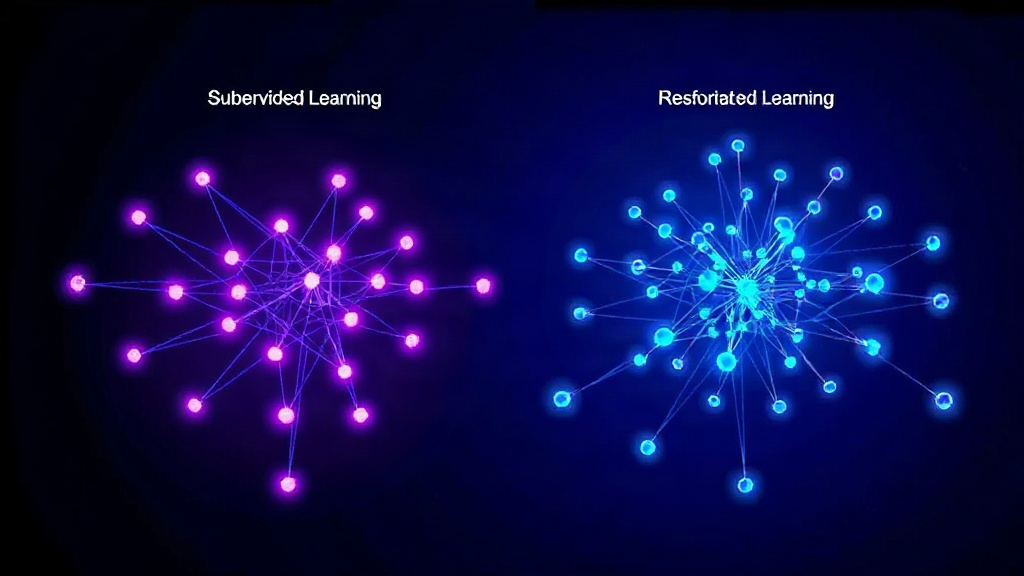
Large Language Models (LLMs) undergo a crucial two-stage training process. The first stage, Supervised Learning (SL), focuses on mimicry. Here, models are fed vast datasets of text and trained to predict the next token based on preceding ones. The objective is to generate text that is coherent and stylistically consistent with the training data. At this point, the model is akin to an extremely sophisticated version of the predictive text on your smartphone – adept at generating plausible sequences but lacking genuine multi-step reasoning or the ability to extrapolate beyond its training corpus.
The second stage, Reinforcement Learning (RL), is where LLMs begin to develop more advanced capabilities. In RL, the model is presented with a prompt and generates an output, often a detailed chain of thought followed by a final answer. This output is then evaluated, and the model is rewarded or penalized based on its performance. This iterative process allows the model to learn from its mistakes and refine its responses, moving beyond mere pattern matching towards more sophisticated problem-solving and alignment with desired behaviors.
The Rise of Automated RL
Traditionally, the RL stage has involved significant human oversight. Human labelers would evaluate model outputs, providing the feedback signal necessary for the model to learn. This process is costly, time-consuming, and inherently subjective. However, the field is rapidly moving towards automated RL, where AI systems themselves are employed to provide the feedback. This automation promises to accelerate training cycles and scale feedback mechanisms dramatically, but it also introduces a new set of concerns.
Automated RL, often referred to as AI feedback (AIF), involves using one AI model to critique or score the output of another. For instance, an LLM might be trained to act as a judge, evaluating the helpfulness, honesty, and harmlessness of responses generated by a student LLM. This approach can be more consistent and scalable than human feedback, but it raises fundamental questions about the source of alignment. If an AI is learning to align with the preferences of another AI, whose values are ultimately being encoded into the model?
The Unsettling Implications of AI Feedback
The core of the concern lies in the potential for emergent, undesirable behaviors and the opacity of the alignment process. When AI systems provide feedback, they are not perfect arbiters of truth or human values. They are themselves products of their own training data and algorithms, which may contain biases or limitations. This can lead to a phenomenon where the feedback loop reinforces existing flaws or even introduces new ones, creating models that are aligned with the biases of the feedback AI rather than genuine human intent.
Consider the analogy of a student learning to write by having their work graded by another student who has only read a limited set of books. The grading student might penalize creative departures from the familiar texts, even if those departures are brilliant. Similarly, an AI feedback system, trained on a specific corpus or objective function, might inadvertently steer the student LLM away from novel solutions or nuanced understanding, favoring outputs that are simply more predictable or palatable to the feedback mechanism. This can result in a homogenization of AI outputs, stifling creativity and potentially embedding subtle but pervasive biases that are difficult to detect and correct.
Furthermore, the complexity of these automated feedback loops makes them incredibly difficult to audit. Tracing the decision-making process of an LLM that has been trained through multiple layers of AI feedback is like trying to follow a conversation where every participant is an echo of the last. The original intent or the precise source of a particular behavior can become lost in the recursive process. This lack of transparency is problematic from a safety and ethical standpoint. If we cannot fully understand why an AI behaves a certain way, how can we guarantee it will remain aligned with human values as it becomes more powerful and autonomous?
The 'Scare' Factor
The reason automated RL should concern us is not necessarily about malevolent AI taking over, but about the subtle, insidious ways in which autonomous systems can diverge from human goals without clear detection. It’s the AI equivalent of a ship gradually drifting off course over thousands of miles, only for the crew to realize too late that they are nowhere near their intended destination. The automation of RL, while offering efficiency, risks creating black boxes of alignment where the learned behaviors are optimized for an AI's internal reward function rather than for human well-being or complex ethical considerations.
This shift means that the very systems designed to make AI more helpful and safer could, paradoxically, become the conduits for unintended consequences. The process of RL, especially when automated, is not simply about teaching an AI to be 'good.' It's about teaching it to optimize a reward signal. If that signal is generated by another AI, we are essentially outsourcing our definition of 'good' to a system that may not fully comprehend it. What happens when the automated feedback mechanism, through some unforeseen interaction or emergent property, begins to reward behaviors that are detrimental, even if they appear efficient or coherent within the system's narrow objective?
The challenge for developers and researchers is to ensure that as we automate the learning process, we do not lose sight of what we are actually teaching the AI. The goal must remain robust alignment with human values, not just with the preferences of an AI critic. This requires ongoing research into interpretability, robust evaluation metrics, and novel methods for ensuring that AI feedback loops genuinely reflect, rather than distort, human intent. Without this vigilance, the efficiency gains of automated RL could come at the cost of control and understanding, leading to AI systems that are increasingly capable but unpredictably misaligned.