The Problem with Ad Hoc LLM Model Evaluation
Building with Large Language Models (LLMs) means moving beyond generic benchmark leaderboards. What truly matters is how a model performs with your specific prompts, your brand's tone, your unique domain data, and your budget constraints. Yet, many teams fall into the trap of ad hoc, unreliable testing methods. This typically involves manually copying prompts into a chat interface, subjectively comparing a few responses by eye, perhaps logging results in a spreadsheet, and then repeating the process later with a different model. This approach is not only time-consuming but also highly prone to bias and lacks reproducibility.
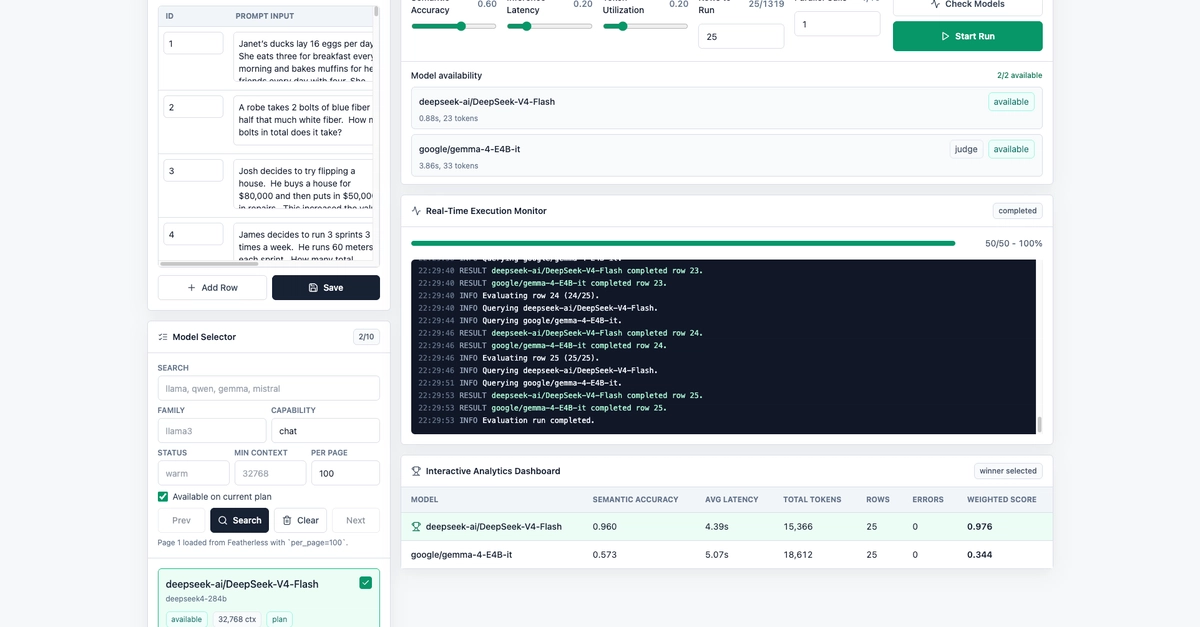
This guide provides a blueprint for engineers and product teams to construct a repeatable evaluation harness. This system will enable programmatic comparison of multiple open-weight models against the same dataset. It automates scoring based on key metrics like accuracy, latency, and token cost, and can programmatically select a winner. By the end, you will have a clear mental model for building a cross-model evaluation system that runs asynchronously, stores results locally, and leverages a model execution layer like Featherless.ai.

Designing Your Automated LLM Evaluation Harness
To move beyond subjective, manual testing, we need a structured, programmatic approach. The core components of an effective evaluation harness include:
- Dataset: A curated set of prompts and expected outputs (or criteria for good outputs). This dataset should reflect the real-world use cases your LLM application will encounter.
- Model Execution Layer: A service or framework that can interface with multiple LLM APIs or local models, managing authentication, request formatting, and response retrieval. Featherless.ai is one such option, designed for efficient model execution.
- Evaluation Metrics: Quantifiable measures to score model performance. Common metrics include accuracy (e.g., using ROUGE, BLEU, or custom classifiers), latency (response time), and cost (token usage, API fees).
- Orchestration Logic: The code that sequences the evaluation process: loading the dataset, sending prompts to each model via the execution layer, collecting responses, running evaluations, and storing results.
- Results Storage: A system for persisting evaluation outcomes, typically a local database or file system, allowing for historical analysis and comparison.
The goal is to create a system that treats model evaluation like a software engineering problem, complete with version control, automated testing, and clear metrics.
Implementing the Evaluation Pipeline
Building this harness involves several key steps. First, define your evaluation dataset. This should be a collection of prompt-response pairs or prompts with clear criteria for successful output. For instance, if you're building a customer support bot, your dataset might include common customer queries with ideal agent responses. Each entry should also ideally have metadata, such as the intended use case or difficulty level.
Next, select your model execution layer. If using open-weight models, this layer needs to handle loading different models, managing their dependencies, and providing a consistent API for inference. Featherless.ai simplifies this by offering a unified interface to various models, abstracting away much of the underlying complexity. For proprietary models, you'll integrate directly with their respective APIs.
The orchestration logic is where the automation truly comes to life. You'll write scripts that iterate through your dataset, sending each prompt to every model you wish to evaluate. Crucially, this process should be asynchronous to maximize throughput. For each prompt, you'll capture the model's response, the time taken (latency), and the number of tokens consumed (cost). This is where the programming becomes critical – you're not just sending text; you're managing API calls, handling potential errors, and collecting structured data.
Automating Model Scoring and Selection
Once responses are collected, the next phase is automated scoring. This requires defining objective evaluation metrics. For factual accuracy, you might use semantic similarity scores against a gold standard response or employ another LLM as a judge to assess quality, relevance, and adherence to instructions. For stylistic aspects or tone, more sophisticated NLP techniques or human-in-the-loop validation might be necessary, though the goal is to automate as much as possible.
Latency and cost are straightforward to measure. Latency is the difference between the request timestamp and the response timestamp. Cost is typically derived from the token counts of the input prompt and the generated output, multiplied by the model's specific pricing. By combining these metrics, you can create a composite score or a set of ranked preferences. For example, you might prioritize models that achieve a certain accuracy threshold while minimizing token cost and latency.
The output of this process is a structured report detailing each model's performance across all prompts and metrics. This report can then be used to programmatically select the best-performing model for deployment, or to identify specific prompts where a particular model excels or struggles. This data-driven approach ensures that model selection is based on empirical evidence directly relevant to your application, rather than on general benchmarks.
Storing and Analyzing Results
Persisting these evaluation results is vital for tracking progress and making informed decisions over time. A simple JSON file or a local SQLite database can serve this purpose effectively for smaller projects. For larger-scale evaluations, consider more robust database solutions. Each entry in your results store should contain the prompt, the model evaluated, the response generated, the measured latency, token counts, and any calculated scores.
This historical data allows you to:
- Track the performance of models as they are updated or as your prompts evolve.
- Identify drift in model performance over time.
- Perform deeper analysis, such as correlating prompt complexity with model cost or latency.
- Justify model choices to stakeholders with concrete data.
What remains an open question is how to effectively visualize these multi-dimensional results, especially when comparing dozens of models across hundreds of prompts and multiple metrics. Developing intuitive dashboards that highlight trade-offs between accuracy, speed, and cost is the next frontier in practical LLM evaluation.
Conclusion: Building for Scalable LLM Deployment
Automating LLM A/B testing transforms model evaluation from a subjective art into a reproducible engineering discipline. By building a programmatic harness, teams can confidently compare models, optimize for specific business objectives, and ensure their LLM-powered products deliver consistent, high-quality results. This systematic approach is not just about choosing the best model today; it's about establishing a robust pipeline for continuous improvement and scalable deployment in the rapidly evolving landscape of AI.