The Authorization Lexicon: A Breeding Ground for Confusion
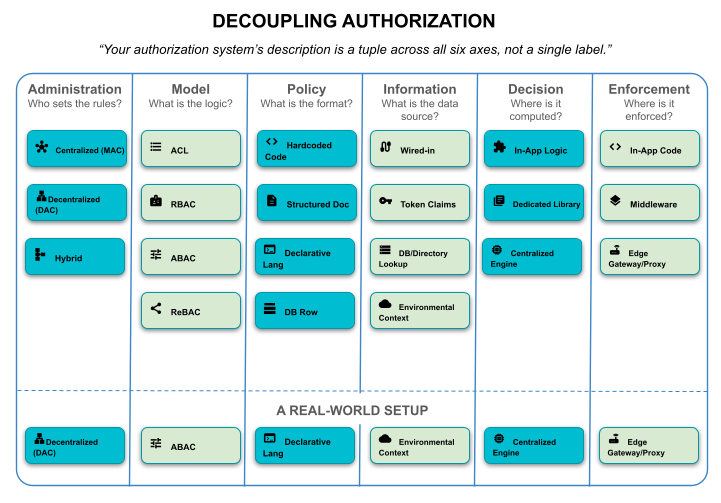
The world of authorization is drowning in a sea of overlapping, ambiguous, and often contradictory terminology. This isn't a minor semantic quibble; it's a systemic issue that directly impacts security, development velocity, and the ability to build robust, trustworthy systems. From access control lists (ACLs) and role-based access control (RBAC) to attribute-based access control (ABAC) and policy-based access control (PBAC), the landscape is a minefield of jargon that often fails to clearly delineate distinct concepts. This linguistic chaos leads to misinterpretations, insecure implementations, and significant engineering overhead as teams struggle to map abstract concepts to concrete technical controls.
Consider the fundamental terms: 'permission' versus 'privilege.' In many contexts, these are used interchangeably, yet they can represent vastly different levels of access. A permission might be the right to 'read a document,' while a privilege could be the ability to 'delete all documents in a folder.' Without a shared, precise understanding, developers might implement a system that grants what they believe is a limited permission, when in reality, it confers a dangerous privilege. This ambiguity is not confined to simple terms; it extends to entire architectural paradigms. The lines between RBAC and ABAC, for instance, are frequently blurred, leading to implementations that don't fully leverage the strengths of one model over the other, or worse, create security gaps.
The root of the problem lies in the organic, often ad-hoc, evolution of authorization concepts within different communities and technologies. As new security challenges emerged, new terms were coined, often without a deliberate effort to harmonize them with existing lexicons. This has resulted in a sprawling, unmanaged glossary where a single concept can have multiple names, and a single name can refer to multiple concepts. This is akin to trying to navigate a city where every street has three different names, and every name applies to three different streets. The result is inevitable confusion, wasted time, and increased risk.
The Cost of Ambiguity: Security and Development Roadblocks
The consequences of this terminological muddle are severe and far-reaching. For security professionals, it means increased difficulty in designing, implementing, and auditing access control policies. When discussing security requirements with development teams, a lack of precise language can lead to critical requirements being misunderstood or overlooked. This can result in systems that are either overly permissive, exposing sensitive data or functionality, or overly restrictive, hindering legitimate user access and productivity. The effort spent clarifying these terms during development cycles could otherwise be dedicated to more proactive security measures.
Developers face similar challenges. When integrating third-party services or working in cross-functional teams, the assumptions about what an authorization term means can lead to incorrect configurations. A developer might implement a system based on their understanding of 'role,' only to find that the system's definition of a role is fundamentally different, requiring a costly re-architecture. Furthermore, the lack of standardization makes it harder to adopt best practices and leverage established patterns. If the foundational language is unstable, building reliable and secure systems becomes a much more arduous task.
This confusion also impacts the creation and adoption of authorization standards and frameworks. Without a clear, agreed-upon vocabulary, it becomes challenging to define universal principles or develop interoperable solutions. Projects aiming to provide generalized authorization solutions often struggle with the ambiguity of the requirements they are trying to meet. This can lead to solutions that are either too narrowly focused or too complex, attempting to account for every possible interpretation of terms.
A Path Forward: Towards a Unified Authorization Vocabulary
The call for a standardized authorization terminology is not merely an academic exercise; it is a practical necessity for the health of the digital ecosystem. To address this, several key steps are proposed:
- Define Core Concepts Clearly: Establish unambiguous definitions for fundamental terms like 'resource,' 'action,' 'subject,' 'policy,' 'permission,' 'privilege,' 'role,' and 'attribute.' These definitions must be precise, mutually exclusive where necessary, and broadly applicable across different authorization models.
- Identify and Map Overlaps: Systematically identify terms that are commonly conflated or used synonymously. For each overlap, clearly distinguish the differing concepts or establish a hierarchy where one term is a subset or superset of another. For instance, clarifying how 'policy' relates to 'rules' within a policy is crucial.
- Develop a Canonical Glossary: Create and maintain a publicly accessible, community-vetted glossary of authorization terms. This glossary should serve as a reference for practitioners, educators, and tool builders. Think of it less like a dry dictionary and more like a living, breathing guide for understanding the nuances of access control.
- Promote Adoption and Education: Encourage the widespread adoption of this standardized terminology within organizations, open-source projects, and academic research. Educational materials, training programs, and documentation should all adhere to the established definitions.
The journey towards a unified authorization vocabulary will require collaboration across industry, academia, and open-source communities. Organizations like IDPro (Identity Defined Security Professionals) are already working in this direction, but the effort needs broader participation. The benefits are substantial: reduced development friction, stronger security postures, and a more coherent understanding of how to manage access in complex systems. Until we can speak the same language about authorization, we will continue to stumble in building secure and functional digital environments.
The Unanswered Question: Who Owns the Standard?
While the need for a unified terminology is clear, a significant unanswered question remains: who will champion and maintain this standard? Will it be a consortium of industry giants, an open-source governing body, an academic institution, or a dedicated non-profit like IDPro? The success of this initiative hinges on establishing a neutral, authoritative source that can evolve with the technology and gain widespread trust and adoption. Without a clear owner and governance model, even the most well-intentioned efforts risk fragmentation and eventual obsolescence.