
Understanding ATProto's Core Principles
ATProto, short for "Accessible, Trustable, Protocol," is an open-source, decentralized protocol designed to power the next generation of social media applications. Unlike traditional centralized platforms, ATProto aims to give users more control over their data and identity, while providing developers with a flexible and robust framework for building diverse social experiences. At its heart, ATProto is an attempt to solve the fundamental problem of decentralized identity and data portability in a way that is both technically sound and accessible to a broad range of applications.
The protocol is built upon a few key pillars: decentralization, identity, data, and services. Decentralization means that no single entity controls the network; instead, it's composed of many independent servers that can interoperate. Identity is handled through Decentralized Identifiers (DIDs), allowing users to own and manage their digital personas across different applications. Data is stored in a structured, queryable format, enabling portability and interoperability. Services encompass the APIs and methods for interacting with the network, such as posting content, following users, and discovering information.
Decentralized Identity and Data Storage
A critical challenge in building decentralized social networks is managing user identity and data. ATProto addresses this by using Decentralized Identifiers (DIDs) as its foundation for user accounts. Each user has a unique DID, which is not tied to a specific service provider. This means a user can take their identity and social graph with them, even if they switch applications or servers. This is a significant departure from current social media models, where your followers and your content are locked into a single platform.
Data storage is managed through a system of "app-specific data" (app data) and "social data." App data is specific to a particular application built on ATProto, allowing developers to create unique features and experiences. Social data, on the other hand, includes core social graph information like follows, likes, and posts, which are designed to be interoperable across different ATProto-compatible applications. This structured approach allows for rich querying and efficient data retrieval, without requiring a single, monolithic database.
Consider it less like a single giant social media company's database and more like a collection of interconnected libraries, where each library (server) can store books (user data) that are cataloged in a standardized way, allowing you to find and borrow books from any library, regardless of which one you originally registered at.
The Role of Bluesky and the ATProto Stack
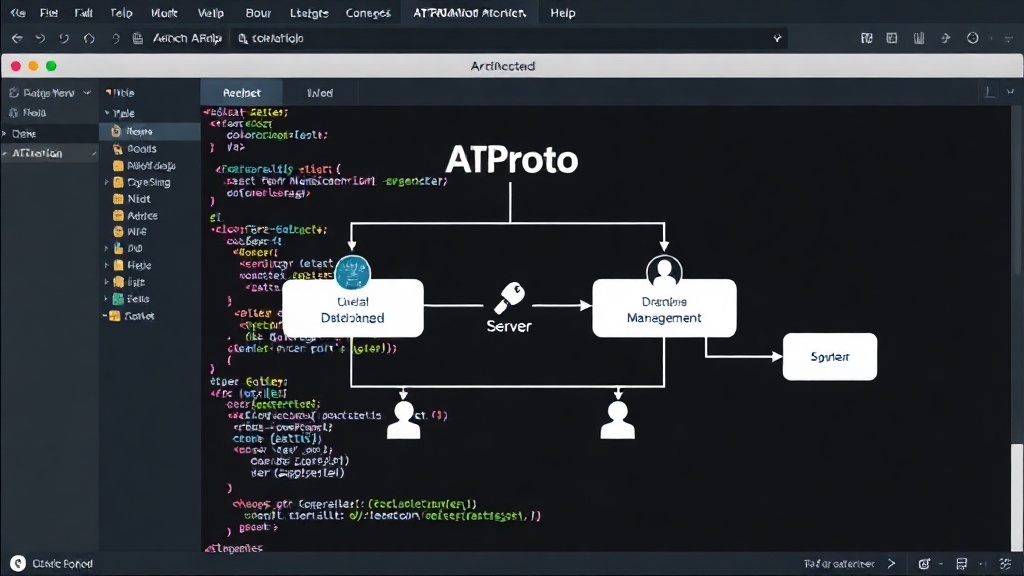
While ATProto is a protocol designed for broad adoption, its development has been closely associated with Bluesky, a decentralized social network project. Bluesky is one of the first major applications to implement ATProto, showcasing its capabilities and driving its evolution. The ATProto stack consists of several components:
- Lexicons: A schema definition language for ATProto APIs. Lexicons define the data structures and methods available on the network, ensuring consistency and predictability for developers.
- Com: A content-addressable object model for storing data on the network. This ensures data integrity and enables efficient replication and synchronization across servers.
- Identity: The system for managing Decentralized Identifiers and user authentication.
- Graph: The data model for representing social relationships, such as follows and likes.
- Feeds: A mechanism for creating and discovering personalized content streams.
These components work together to provide a comprehensive framework for building decentralized social applications. Developers can leverage Lexicons to define their own data types and API endpoints, while relying on the core ATProto infrastructure for identity, data storage, and social graph management.
Interoperability and the Future of Social Media
The ultimate goal of ATProto is to foster an open and interoperable social web. By decoupling identity and data from specific platforms, ATProto empowers users and encourages innovation among developers. Imagine being able to use your existing social graph and content on a new social app without having to rebuild your entire online presence from scratch. This is the promise of ATProto.
The protocol is designed to be extensible, allowing for the creation of diverse applications beyond traditional social feeds. This could include decentralized marketplaces, community forums, or even specialized professional networks. The flexibility of Lexicons means that developers can tailor the protocol to their specific needs, while still benefiting from the network effects of a larger decentralized ecosystem.
However, building a truly decentralized ecosystem is a complex undertaking. One of the lingering questions is how to effectively moderate content and handle abuse across a network of independent servers. While ATProto provides the technical foundation, robust community governance and moderation strategies will be crucial for its long-term success. What nobody has addressed yet is how to achieve scalable, decentralized content moderation without sacrificing user privacy or introducing new forms of censorship.
Practical Considerations for Developers
For distributed systems engineers and developers looking to build on ATProto, understanding the protocol's architecture is key. The use of Lexicons for API definitions means that developers can clearly understand the capabilities of any ATProto service. The content-addressable nature of data storage (Com) ensures that data is immutable and verifiable, simplifying issues around data integrity and synchronization.
Developers can choose to run their own ATProto server, giving them full control over their infrastructure and user data. Alternatively, they can leverage existing servers or managed services. The protocol is designed to be lightweight and efficient, making it suitable for a wide range of applications, from mobile apps to large-scale social networks.
The open nature of ATProto means that the community plays a vital role in its development and adoption. Contributions to the protocol, the creation of new tools and libraries, and the development of innovative applications are all essential for realizing its full potential. If you're a developer interested in building the next generation of social applications, ATProto offers a compelling alternative to the status quo, providing the tools and flexibility to create truly user-centric experiences.
What About Rock Paper Scissors?
The analogy of Rock Paper Scissors being a distributed systems problem, as highlighted in Source 2, provides a surprisingly relevant lens through which to view ATProto. The core challenge in Rock Paper Scissors—ensuring that neither player can gain an unfair advantage by seeing the opponent's move before making their own—mirrors the fundamental need for secure and private communication in a decentralized network. In Rock Paper Scissors, the server must acknowledge your pick without revealing it to the opponent prematurely. This principle of minimizing information leakage and ensuring fair play is echoed in ATProto's design, where user actions and data need to be managed securely and privately across a distributed network of servers.
The lesson from Rock Paper Scissors, "You can't leak what you never send," is particularly potent. Applied to ATProto, it suggests that the protocol must be designed to avoid unnecessary data exposure. Users' choices, their social graph, and their content should only be revealed when explicitly intended. This requires careful API design and data handling to prevent information from "leaking" to unintended parties or servers. Just as a premature reveal in Rock Paper Scissors breaks the game, premature data exposure in a social network erodes trust and privacy. ATProto's architecture, with its emphasis on structured data and controlled access, aims to embody this principle, ensuring that users remain in control of their digital interactions.