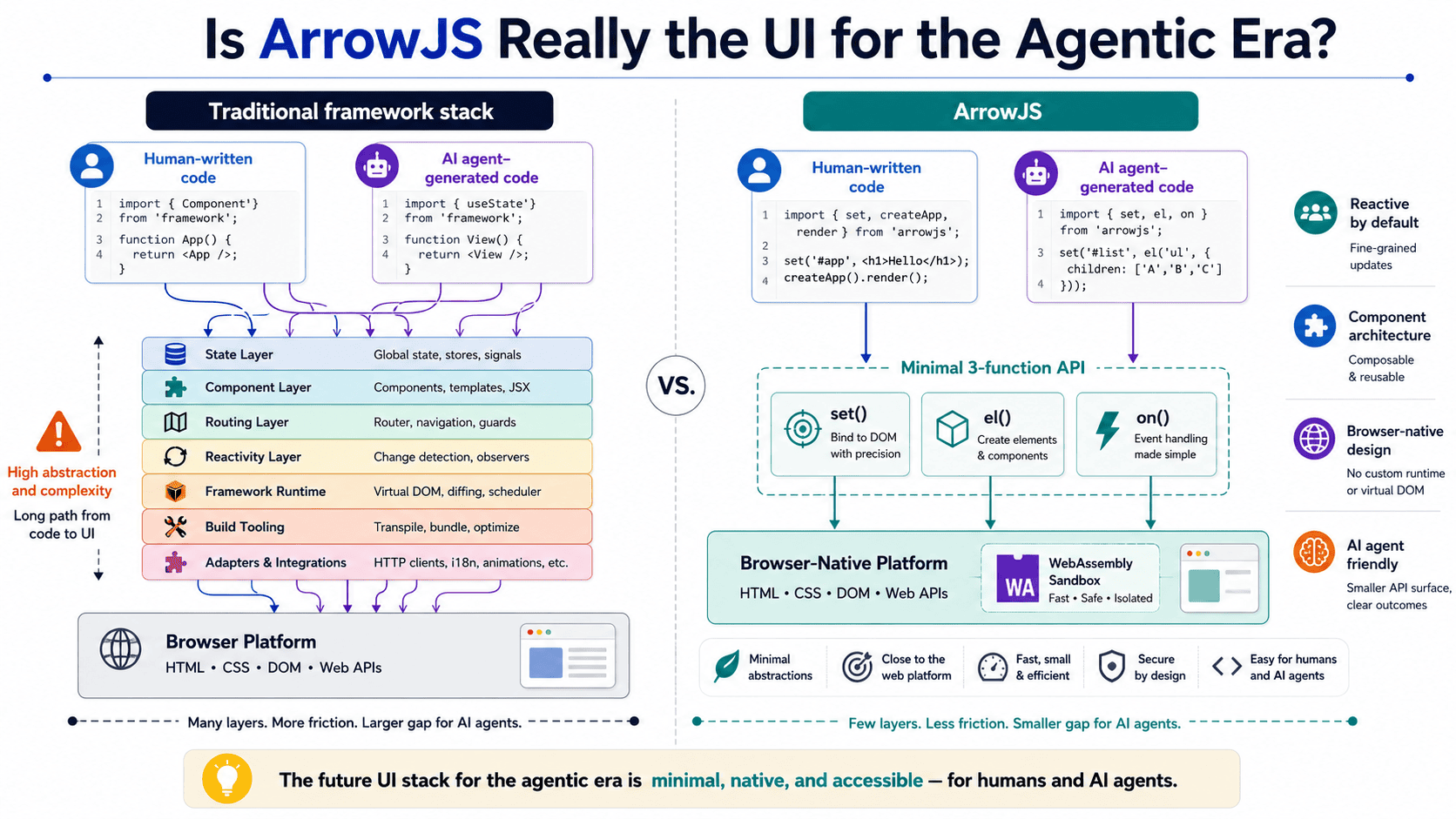
The Shifting Landscape of UI Development
The way we build user interfaces is on the cusp of a significant transformation. As artificial intelligence agents become more capable of writing code, the tools and frameworks developers rely on to render these interfaces will need to adapt. This is the core problem that ArrowJS seeks to address. The traditional approach, where developers meticulously craft every line of UI code, is becoming less tenable as AI takes on more of this responsibility. Instead of a direct hand in pixel-perfect layout, the developer's role may shift towards orchestrating, validating, and integrating AI-generated components.
ArrowJS positions itself as a framework designed for this future. It's not just another React or Vue alternative. Its premise is built around the idea that AI agents will generate UI code, and ArrowJS is built to handle this generated code efficiently and effectively. This means moving away from monolithic component trees that are difficult for AI to parse and modify, towards a more modular, declarative, and potentially hierarchical structure that AI can more easily understand and manipulate.
Understanding the Agentic UI Challenge
The fundamental challenge is that current UI frameworks are optimized for human developers. They are built with patterns, abstractions, and lifecycles that are intuitive to people but can be opaque or cumbersome for AI. Imagine an AI tasked with building a complex dashboard. If it generates code that relies on deep, nested component hierarchies with complex state management logic, it becomes difficult for the AI to modify that same code later, or for another AI to understand and build upon it. This is akin to asking a carpenter to edit a painting; the tools and mental models are misaligned.
ArrowJS aims to solve this by providing an architecture that is inherently more amenable to AI generation and manipulation. The framework's design principles likely focus on:
- Declarative Rendering: Defining *what* the UI should look like rather than *how* to build it, making it easier for AI to specify desired outcomes.
- Component Modularity: Breaking down UIs into smaller, self-contained, and easily composable units that AI can generate and assemble.
- State Management Abstraction: Offering a clear and consistent way to manage application state that AI can interact with predictably.
- Event Handling: Providing standardized mechanisms for handling user interactions that AI can implement.
The ultimate goal is to create a symbiotic relationship between AI code generators and the UI framework, enabling faster iteration and more complex applications than human developers could achieve alone. This isn't about replacing developers but augmenting their capabilities, allowing them to focus on higher-level design and problem-solving while AI handles the more repetitive and structured aspects of UI implementation.
What This Means for the Future Developer
If ArrowJS or similar frameworks gain traction, the role of the front-end developer will evolve. Instead of writing every component, developers might become:
- AI Orchestrators: Guiding AI agents, setting parameters, and defining the overall architecture of the application.
- Prompt Engineers for UI: Crafting precise instructions for AI to generate specific UI elements and behaviors.
- Validator and Integrator: Reviewing AI-generated code for correctness, security, and adherence to design principles, then integrating it into larger systems.
- Framework Specialists: Deeply understanding frameworks like ArrowJS to effectively manage and debug AI-generated UIs.
This shift requires a new skill set. Developers will need to be adept at understanding AI capabilities, prompt engineering, and systems thinking. They will need to trust and verify AI output, much like a seasoned architect trusts and verifies the blueprints from junior draftsmen.
The Unanswered Question of Adoption
The most significant hurdle for ArrowJS, or any paradigm shift in UI development, is adoption. The developer community is deeply invested in existing ecosystems like React, Vue, and Angular. Migrating to a new framework is a massive undertaking, involving learning curves, tooling adjustments, and potential compatibility issues. For ArrowJS to succeed, it must not only prove its technical superiority in the context of AI-generated code but also offer a compelling migration path and a clear developer experience that justifies the switch. The surprising detail here is not the technical innovation, but the sheer inertia of established developer workflows. Convincing a generation of developers to fundamentally alter how they think about and build UIs is a monumental task.
Furthermore, the AI agents themselves need to mature to a point where they can reliably generate complex and maintainable UI code that benefits from ArrowJS's architecture. The success of ArrowJS is intrinsically tied to the advancement of AI code generation capabilities. Without sophisticated AI partners, ArrowJS might remain a niche solution for a future that hasn't fully arrived.
Beyond the Code: The Broader Implications
The implications extend beyond just code generation. If AI can more effectively build user interfaces, it could democratize application development further. Individuals with great ideas but limited coding skills might be able to leverage AI agents and frameworks like ArrowJS to bring their visions to life. This could lead to an explosion of new applications and digital experiences, tailored to highly specific needs.
For businesses, this could mean faster product development cycles, reduced costs, and the ability to experiment with more UI variations. The ability to rapidly prototype and iterate on interfaces driven by AI could become a significant competitive advantage. Companies that embrace this new paradigm may find themselves outpacing those still reliant on traditional development methods.